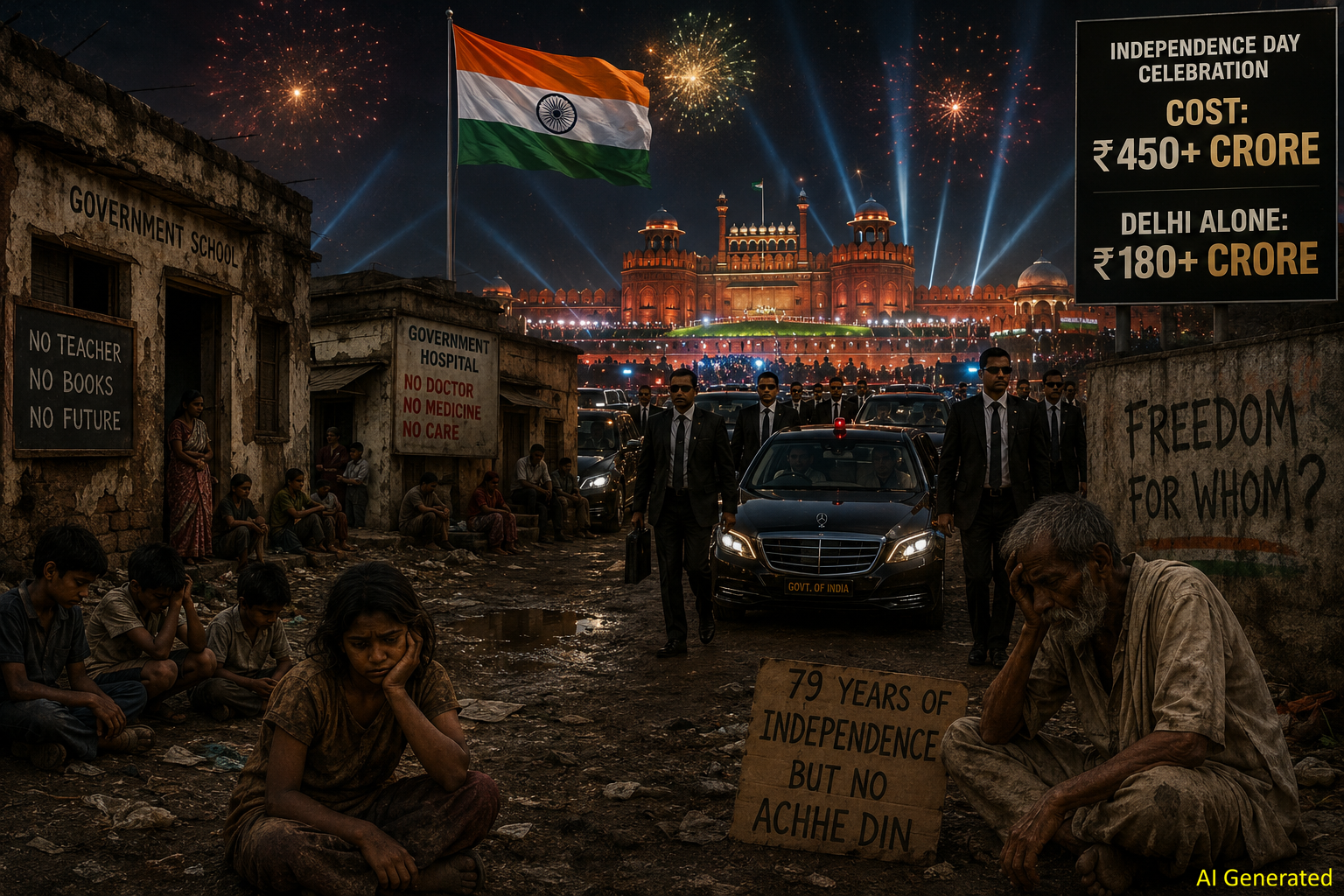
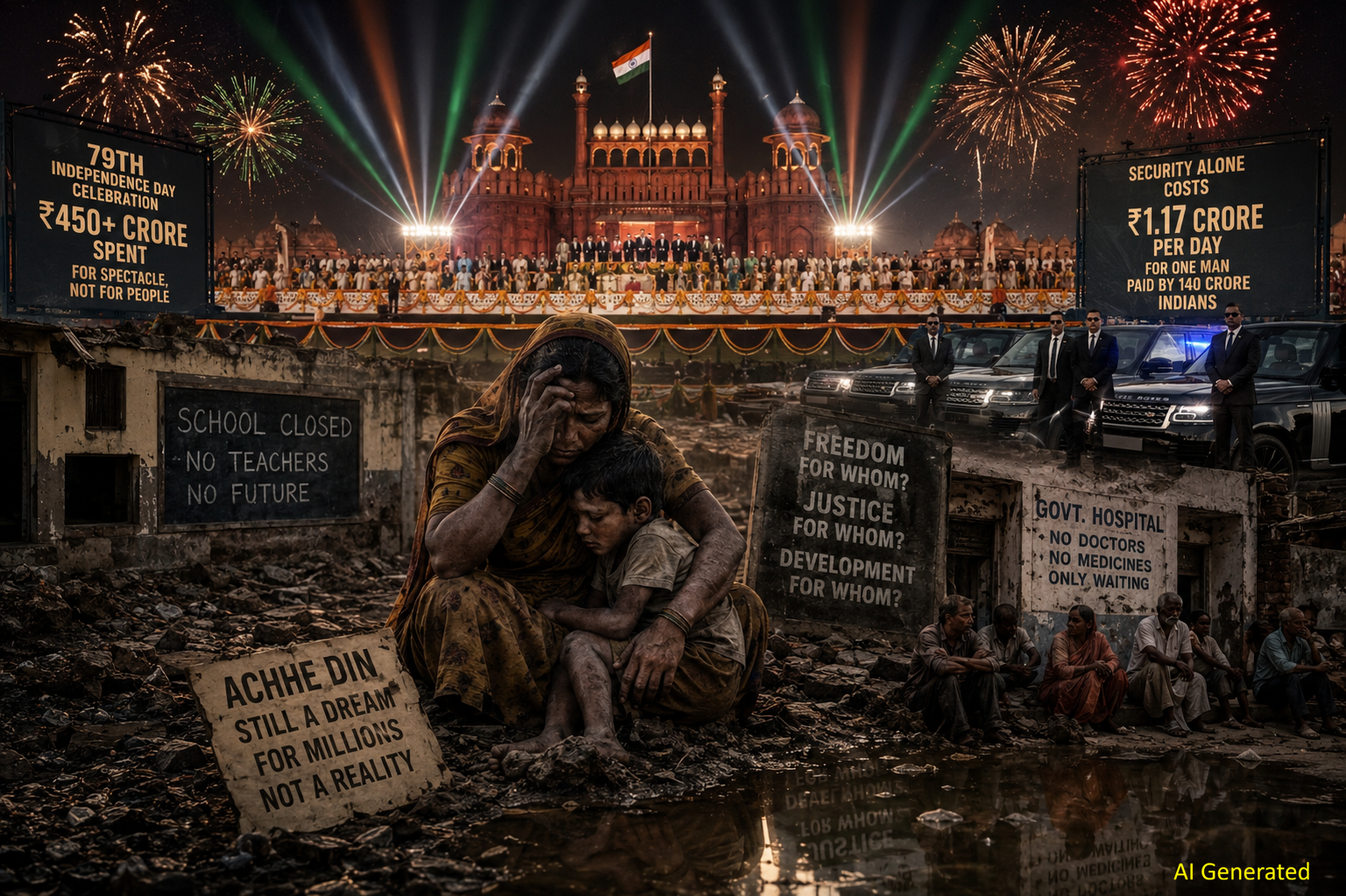
15 August 2026: As the last echoes of the national anthem faded and the sky over the Red Fort lit up with fireworks and laser displays, the Government of India and various state governments had once again spent staggering sums to commemorate the 79th anniversary of India’s Independence. Official estimates put the combined expenditure by the Centre and states on parades, cultural programmes, lighting, security, advertisements, and associated events at well over ₹450 crore. In Delhi alone, the grand show is believed to have cost more than ₹180 crore.
Yet behind the choreographed grandeur and soaring patriotic speeches lies a question that refuses to be silenced: Why does the ritual of celebration grow more lavish with every passing year, while the promise that once defined this nation - Swaraj and Achhe Din - remains cruelly elusive for the vast majority of its people?
Seventy-nine years after the midnight tryst with destiny, the lived reality for most Indians is one of quiet, grinding disappointment. Government schools continue to shut down or turn away students for lack of teachers and infrastructure. Government hospitals remain places where the poor wait for hours, sometimes days, only to be told that essential medicines are unavailable or specialists are absent. The air in our cities has become a slow poison. Clean water is a luxury. Safety for women, for farmers, for daily wage workers feels increasingly fragile.
Meanwhile, an entitled political and bureaucratic class has perfected the art of converting public resources into private comfort. For them, “Achhe Din” did arrive. The best healthcare in private hospitals, elite international schools for their children, Z-category security, sprawling bungalows, fleets of official vehicles, and pensions that ordinary citizens can only dream of all funded by the same exchequer that claims there is never enough money for basic public services.
The contradictions have become grotesque. A man who once famously identified himself as a humble tea-seller now reportedly costs the Indian taxpayer approximately ₹1.17 crore per day in security alone. Kings and emperors of old would envy the security apparatus, lifestyle, and institutional deference extended to today’s top political leaders, MPs, Rajya Sabha members, MLAs, councillors, and senior bureaucrats. Their lives appear to matter more than the collective dignity of 140 crore citizens.
While this political class and its favoured corporate allies thrive, national resources have been steadily transferred into private hands. Polluting industries operate with impunity if they enjoy the right connections. Toll roads multiply, private hospitals and educational institutions proliferate, and each new “development project” seems to further enrich those who fund and support the ruling dispensation. The ordinary citizen is left asking: Is this development for the nation, or development of wealth for those who rule and those who fund them?
India’s external debt has climbed to approximately $3.49 trillion as of August 2026. The question is no longer academic. Where has the money gone? Why, after seven decades of Independence, do private schools, private colleges, private hospitals, and paid highways continue to grow at breakneck speed while public institutions deteriorate? Why do 80 to 90 per cent of citizens still remain dependent on government subsidies for their most basic needs?
The freedom fighters who sacrificed everything did not imagine an India where Independence Day would become an annual exercise in competitive extravagance — an event where those in power celebrate their own insulation from accountability. They did not fight so that the children of the powerful could inherit the nation while the children of the poor inherit broken schools and polluted lungs.
This Independence Day, the most patriotic act for thinking Indians is not to clap for laser shows and rehearsed speeches, but to ask the uncomfortable questions:
- When will the health and education of ordinary citizens become a higher priority than the comfort and protection of the political class?
- When will the life of a common citizen be valued as much as that of a Member of Parliament or a Chief Minister?
- When will “development” means something more than the enrichment of those connected to power?
Until then, every grand celebration of Independence carries within it the bitter taste of betrayal - a reminder that for millions of Indians, the tricolour still flutters over a dream that has not yet been fulfilled.
The fireworks have faded. The stage is dark. But the anger, the disappointment, and the quiet demand for real change continue to burn in the hearts of those who still believe this country belongs to its people, not to a permanent ruling class that celebrates freedom while denying it to the very citizens who pay for their grand spectacles.
The question is no longer whether India is independent. The question is - independent for whom?
0 thoughts on “Independence Day 2026: Crores Spent on Spectacle While a Nation Still Waits for “Achhe Din””
Leave a Reply
Your email address will not be published. Required fields are marked *


RECENT NEWS
- Rashmika Mandanna performs 3.5-minute underwater fight without a body double in ‘Mysaa’
- Ohh My Dog OTT release date: Pankaj film hits streaming platform
- Anne Hathaway says her doctor advised her to stay away from spicy food
- Karnataka SIR: Deletion of voters using Form 7
- Allu Arjun wishes wife Sneha Reddy on her birthday with romantic selfie