Massive security deployment raises questions over citizens’ right to protest, taxpayers’ money and electoral transparency; Vadodara’s striking voting pattern demands scrutiny—not speculation
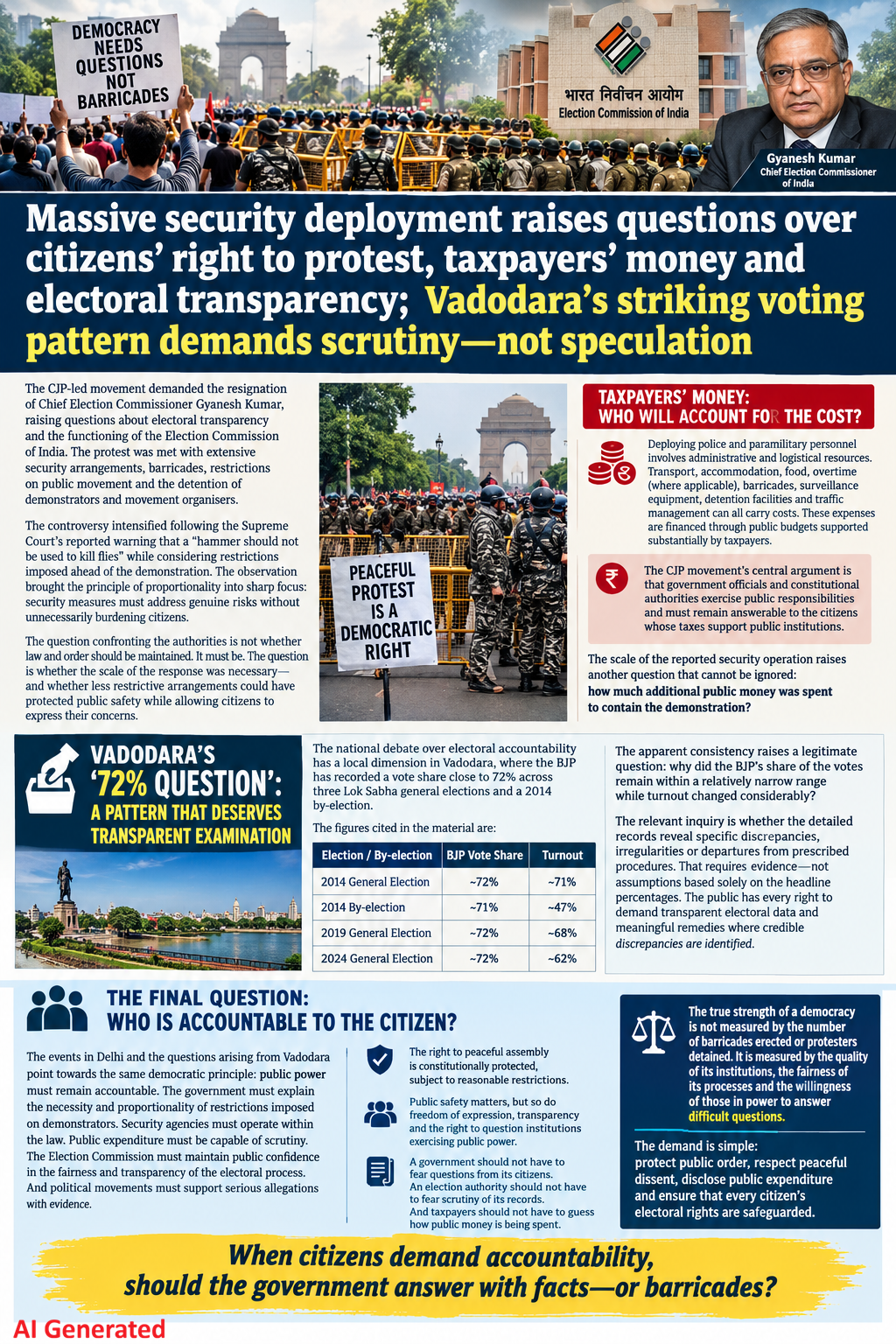
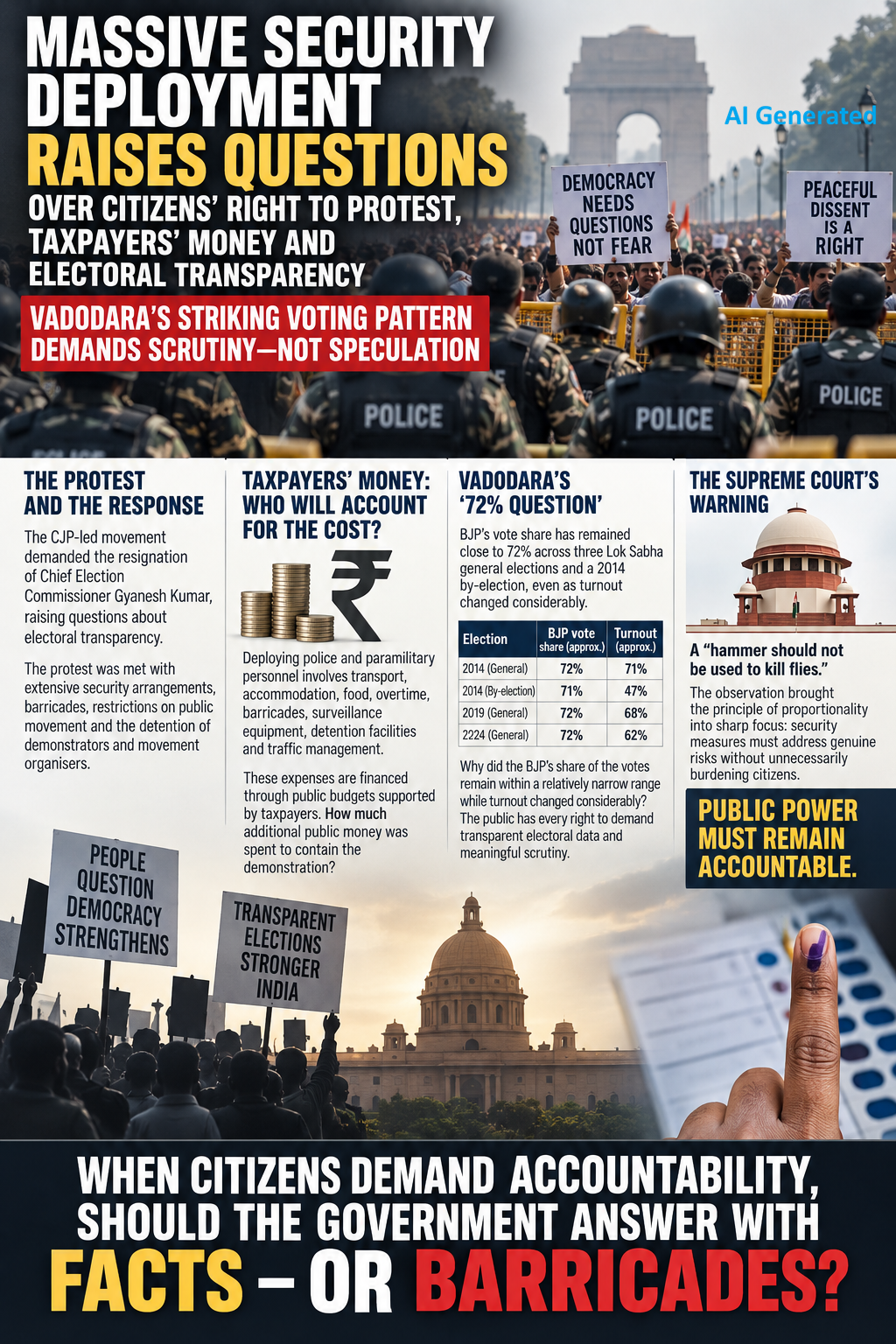
The CJP-led movement demanded the resignation of Chief Election Commissioner Gyanesh Kumar, raising questions about electoral transparency and the functioning of the Election Commission of India. The protest was met with extensive security arrangements, barricades, restrictions on public movement and the detention of demonstrators and movement organisers. The controversy intensified following the Supreme Court’s reported warning that a “hammer should not be used to kill flies” while considering restrictions imposed ahead of the demonstration. The observation brought the principle of proportionality into sharp focus: security measures must address genuine risks without unnecessarily burdening citizens.
The question confronting the authorities is not whether law and order should be maintained. It must be. The question is whether the scale of the response was necessary—and whether less restrictive arrangements could have protected public safety while allowing citizens to express their concerns.
TAXPAYERS’ MONEY: WHO WILL ACCOUNT FOR THE COST?: Deploying police and paramilitary personnel involves administrative and logistical resources. Transport, accommodation, food, overtime where applicable, barricades, surveillance equipment, detention facilities and traffic management can all carry costs. These expenses are financed through public budgets supported substantially by taxpayers. The CJP movement’s central argument is that government officials and constitutional authorities exercise public responsibilities and must remain answerable to the citizens whose taxes support public institutions.Public servants are entitled to their salaries. The issue is whether the machinery of government is being used efficiently, lawfully and proportionately.
The scale of the reported security operation raises another question that cannot be ignored: how much additional public money was spent to contain the demonstration?
VADODARA’S ‘72% QUESTION’: A PATTERN THAT DESERVES TRANSPARENT EXAMINATION
The national debate over electoral accountability has a local dimension in Vadodara, where the BJP has recorded a vote share close to 72% across three Lok Sabha general elections and a 2014 by-election.
The figures cited in the material are:
- 2014 general election: BJP vote share of approximately 72%, with turnout around 71%.
- 2014 by-election: BJP vote share of approximately 71%, with turnout around 47%.
- 2019 general election: BJP vote share of approximately 72%, with turnout around 68%.
- 2024 general election: BJP vote share of approximately 72%, with turnout around 62%.
The apparent consistency raises a legitimate question: why did the BJP’s share of the votes remain within a relatively narrow range while turnout changed considerably?
The relevant inquiry is whether the detailed records reveal specific discrepancies, irregularities or departures from prescribed procedures. That requires evidence—not assumptions based solely on the headline percentages. The public has every right to demand transparent electoral data and meaningful remedies where credible discrepancies are identified.
THE FINAL QUESTION: WHO IS ACCOUNTABLE TO THE CITIZEN?
The events in Delhi and the questions arising from Vadodara point towards the same democratic principle: public power must remain accountable. The government must explain the necessity and proportionality of restrictions imposed on demonstrators. Security agencies must operate within the law. Public expenditure must be capable of scrutiny. The Election Commission must maintain public confidence in the fairness and transparency of the electoral process. And political movements must support serious allegations with evidence.
The right to peaceful assembly is constitutionally protected, subject to reasonable restrictions. Public safety matters, but so do freedom of expression, transparency and the right to question institutions exercising public power. A government should not have to fear questions from its citizens. An election authority should not have to fear scrutiny of its records. And taxpayers should not have to guess how public money is being spent.
The true strength of a democracy is not measured by the number of barricades erected or protesters detained. It is measured by the quality of its institutions, the fairness of its processes and the willingness of those in power to answer difficult questions. The demand is simple: protect public order, respect peaceful dissent, disclose public expenditure and ensure that every citizen’s electoral rights are safeguarded.
When citizens demand accountability, should the government answer with facts—or barricades?
0 thoughts on “DEMOCRACY UNDER SIEGE? ‘HAMMER TO KILL A FLY’ WARNING AS DELHI POLICE DETAIN CJP PROTESTERS DEMANDING CEC GYANESH KUMAR’S RESIGNATION”
Leave a Reply
Your email address will not be published. Required fields are marked *


RECENT NEWS
- DEMOCRACY UNDER SIEGE? ‘HAMMER TO KILL A FLY’ WARNING AS DELHI POLICE DETAIN CJP PROTESTERS DEMANDING CEC GYANESH KUMAR’S RESIGNATION
- Indian Army to reach Siliguri in 3 hours instead of 18 hours: 4 security infrastructure projects to begin in 2029 after Doklam standoff
- N. Raghuraman's column: The impact of things that happen in midlife is not limited to that
- Rashmi Bansal's column: There is some energy, there is some talk... Hello India, good morning!
- Kamal Haasan says 'Mr Musk, India is not a slave of anyone': No billionaire can decide the policies of the country, the future of India will be decided by the people.