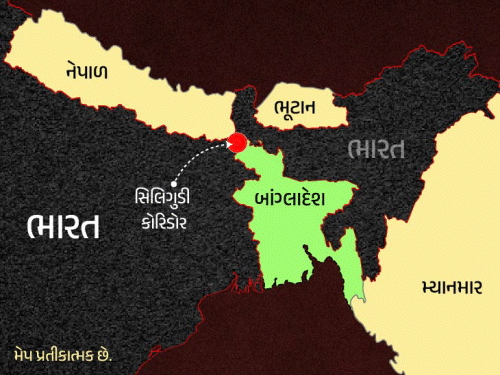
Preparations are underway to make the Siliguri Corridor the safest military route in the country in the next four years. After the Doklam standoff in June 2017, the central government has initiated about 4 major security-infrastructure projects in the Chicken Neck (Siliguri Corridor) and the Sikkim region. At present, it takes 12 to 18 hours to reach the border with heavy artillery and military forces due to difficult mountainous terrain and single-lane network. After the completion of these projects by 2029, this time will be reduced to just 3 hours. With this, the Indian Army will be able to give a befitting reply to any challenge from China. The purpose of this strategic fortification is to maintain the connectivity of 4 crore people of the Northeast with the rest of India. 36 Km long rail tunnel to be built 20 meters below ground The highlight of these projects is the 36 Km long rail tunnel to be built 20 meters below the ground. As per the draft of the Northeast Frontier Railway, this tunnel will be built from Three Mile Haat in North Dinajpur district of West Bengal to Rangapani near Siliguri. Trains will pass through this tunnel which will be built very close to the borders of India, Nepal and Bangladesh. It will not be affected by enemy air and drone attacks. During the war, cannons and essential material can be transported to forward posts of the army without any hindrance. Five underground command and control centers are being built The Chinese army is present near Nathu La Dara at an altitude of 19,000 feet in North Sikkim. So now the army is making the security system like an impenetrable fortress. Under Operation Fortress Siliguri, this 7-tier defense chakravyuth is being built at a cost of Rs 534 crore, 5 command centers, 6 communication centers, 12 air defense and ammunition storages, as well as 12 bomb shelters. The underground infrastructure, being developed in response to the new villages being set up by China on the Tibet border, will make the sensitive 'chicken neck' corridor connecting northeastern India completely protected and impenetrable from any missile, drone or air attack. Experts say the situation has changed after the new government came to power in Bangladesh Lt Gen (retd) Himalaya Singh said that the Siliguri corridor is a very fragile 'soft spot' surrounded by Nepal, Bangladesh, China and Bhutan. It can be directly monitored from China's Chumbi Valley. The situation has changed after the new government came to power in Bangladesh. China and Bangladesh together are studying the Teesta River and re-operationalizing the old airport of Lalmonirhat. Under these circumstances, these tunnels and a 7-layer defense system are very important for India. This will ensure the security of the North-East completely with the help of the army. The Siliguri Corridor is bordered by Bangladesh to the south and China's Chumbi Valley to the northeast. The Siliguri Corridor in Bengal is known as 'Chicken Neck'. This narrow road of just 22 km wide connects North-East India with the rest of the country. Bangladesh is to the south of this corridor and China's Chumbi Valley is to the northeast. Nepal is in the west and Bhutan is in the north. Due to its short width and surrounded by international borders, it is one of India's most sensitive and important military chokepoints.

RSS News
Divyabhaskar
0 thoughts on “Indian Army to reach Siliguri in 3 hours instead of 18 hours: 4 security infrastructure projects to begin in 2029 after Doklam standoff”
Leave a Reply
Your email address will not be published. Required fields are marked *



RECENT NEWS
- Indian Army to reach Siliguri in 3 hours instead of 18 hours: 4 security infrastructure projects to begin in 2029 after Doklam standoff
- N. Raghuraman's column: The impact of things that happen in midlife is not limited to that
- Rashmi Bansal's column: There is some energy, there is some talk... Hello India, good morning!
- Kamal Haasan says 'Mr Musk, India is not a slave of anyone': No billionaire can decide the policies of the country, the future of India will be decided by the people.
- INDIA bloc leaders meet President Murmu, submit 4-point memorandum; Rahul says she sought 'vote chori' proof