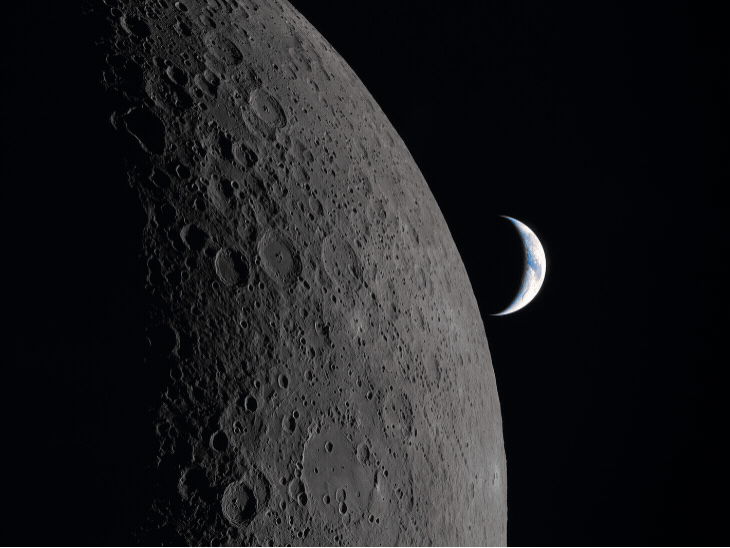
American businessman Elon Musk's company SpaceX has hit a giant uncontrolled rocket with the lunar surface. Weighing 4,000 kg and about the size of a 5-storey building, the rocket hit at a speed of about 8,690 km/h. NASA said, "There is no threat to Earth from this collision. However, this collision will be confirmed after the pictures are available." This uncontrolled piece of rocket was sent into space in January 2025 and is the upper part of SpaceX's 'Falcon 9' rocket. It was launched in January 2025 from Florida to send two lunar landers from the United States and Japan into space. This part of the rocket remained floating in space after the mission was over. During the last 18 months, its path gradually changed due to the gravitational pull of the Earth, Moon and Sun. Astronomers had already predicted by studying the data that the rocket was heading straight towards the moon and would collide with it. The collision took place near Einstein Crater, which is difficult to see even with binoculars. This region is in that part of the moon where daylight resides and which is visible from the earth. However, according to scientists, it was impossible to see it with a normal telescope, because the light produced at the time of the collision was very faint. Cambridge University astronomer Dr. According to Matt Bothwell, a large cloud of lunar dust may have risen as a result of the collision, which must have risen up to 100 km and lasted for several minutes. When this incident occurred, none of the spacecraft orbiting the moon were in the right position, so live images could not be found. South Korea's 'Danuri' Orbiter and NASA's 'Lunar Reconnaissance Orbiter' (LRO) will pass over the collision site in the coming days and take pictures. Scientists will identify new markings made on the lunar surface by comparing old and new images. The number of objects left or crashed by humans on the moon after this collision has risen to about 3,000. Their total weight has gone up to about 190 tons. In September 1959, the Soviet Union's Luna 2 was the first man-made object to reach the lunar surface. In addition, 796 objects associated with NASA's Apollo program alone are present on the moon. There is no atmosphere or environment on the Moon, so this waste does not harm any ecosystem there. However, scientists are concerned that the increased lunar traffic in the future may not harm the historic Apollo landing sites and increase the risk of collisions with new spacecraft. What will NASA and scientists gain from this collision? According to Libby Jackson, head of space at the Science Museum, this is a very exciting experiment for scientists because data on the speed, weight and shape of the rocket were already available. Usually when a natural meteorite hits the moon, scientists don't have its initial data. By studying the new craters and layers of dust that have been blown away by this collision, scientists will be able to understand how the moon and our solar system formed billions of years ago. The lower part of SpaceX's Falcon 9 rocket, which is set to fly for the 18th time, is reusable. It is called a booster and it returns to Earth after landing. The lower booster of the same rocket, which skidded off the upper part of the January 2025 mission and hit the moon, will be launched for the 18th time on August 10. Knowledge Part: What is Space Debris and Einstein Crater? The scattered pieces of rockets, inactive satellites and debris sent into space by humans are called space debris. On the western shore of the moon there is a large crater, which is about 170 km in diameter. It has been named Einstein Crater.

RSS News
Divyabhaskar
0 thoughts on “Elon Musk's Falcon 9 rocket was as big as a 5-storey building after colliding with the moon at a speed of 8,690 km/h”
Leave a Reply
Your email address will not be published. Required fields are marked *



RECENT NEWS
- Petrol bomb attack on Shakib Al Hasan's home hours after he attends Sheikh Hasina's presser
- Sheikh Hasina's son says Bangladesh has become another Pakistan on India's eastern border
- Elon Musk's Falcon 9 rocket was as big as a 5-storey building after colliding with the moon at a speed of 8,690 km/h
- 7 mysterious explosions in 20 minutes in Dubai Missile attack from Yemen feared
- 'Dog meat soup to escape the heat'! The North Korean government's strange recipe