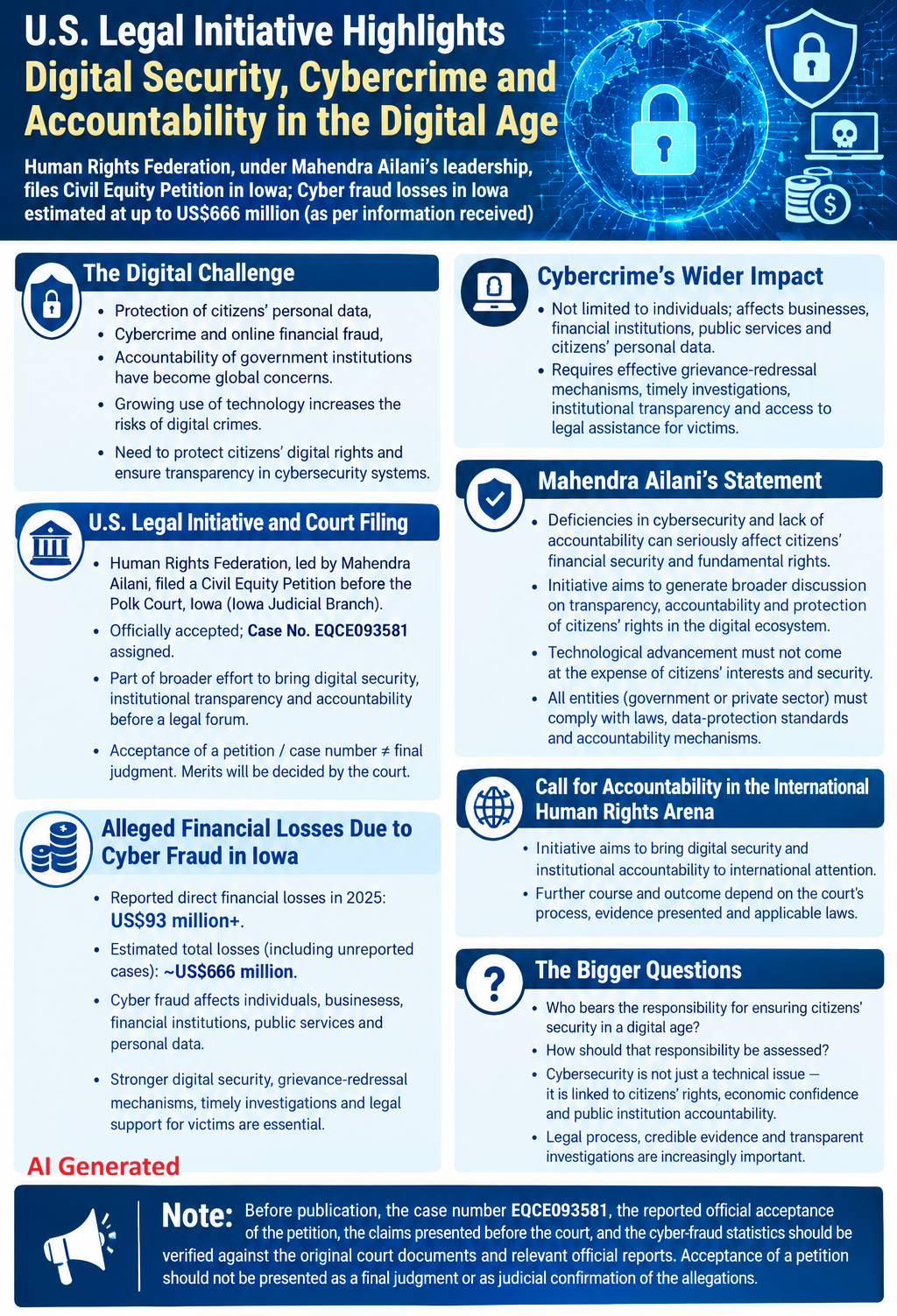
A new twist in the legal battle over citizens' digital rights, economic security, and government accountability under the leadership of international president Mahendra Aylani
In the modern digital age, the protection of citizens’ personal data, cybercrime, online financial fraud, and the accountability of government institutions have become matters of serious global concern. As the use of technology continues to expand, the risks associated with digital crimes are also increasing. In this context, the need to protect citizens’ digital rights and ensure transparency in cybersecurity systems has become increasingly important.
Against this backdrop, details have emerged of a legal initiative in the United States undertaken under the leadership of Mahendra Ailani, International President of the Human Rights Federation and an active figure in the field of human rights. According to the information received, a Civil Equity Petition filed before the Polk Court under the Iowa Judicial Branch has reportedly been officially accepted, and Case No. EQCE093581 has been assigned.
According to the Federation, this development represents an important stage in its efforts to bring issues concerning citizens’ digital security, institutional transparency, and accountability before a legal forum. However, the acceptance of a petition or the assignment of a case number does not, by itself, constitute a final judicial determination regarding the truth of the claims made. The merits of the case and the legal claims will be determined through the judicial process.
Alleged Significant Financial Losses Due to Cyber Fraud in Iowa: The state of Iowa has been cited in connection with figures highlighting the seriousness of cybercrime. According to the information presented, Iowa reportedly recorded more than US$93 million in direct financial losses due to cyber fraud and digital crimes during 2025. It has further been stated that, when unreported cases and incidents not reflected in official statistics are taken into account, the estimated total losses could reach approximately US$666 million. The scale of cyber fraud, its economic consequences, and the difficulties victims face in obtaining justice underscore the need to strengthen digital security systems.
Cybercrime is not limited to individual financial losses. It can also affect businesses, financial institutions, public services, and citizens’ personal data. Therefore, effective grievance-redressal mechanisms, timely investigations, institutional transparency, and access to appropriate legal assistance for victims are essential.
Mahendra Ailani’s Statement: Citizens’ Security Must Remain Paramount: Commenting on the legal initiative, Mahendra Ailani is reported to have stated that deficiencies in cybersecurity and a lack of accountability can seriously affect the financial security and fundamental rights of ordinary citizens. According to his statement, this initiative is not confined to a single legal case but seeks to generate broader discussion on transparency, accountability, and the protection of citizens’ rights within the digital ecosystem.
He is further reported to have emphasised that technological advancement must not come at the expense of citizens’ interests and security. Whether government institutions or private-sector organisations, all entities must comply with applicable laws, data-protection standards, and established accountability mechanisms.
Call for Accountability in the International Human Rights Arena: The Human Rights Federation’s initiative is being viewed as an effort to bring issues concerning citizens’ digital security and institutional accountability to international attention. The further course and outcome of the legal proceedings will depend on the relevant court’s process, the evidence presented, and the applicable laws.
This development once again raises an important question: In a digital age where citizens increasingly depend on technology for their personal information, financial transactions, and everyday services, who bears the responsibility for ensuring their security, and how should that responsibility be assessed?
Cybersecurity is no longer merely a technical issue. It is directly connected with citizens’ rights, economic confidence, and the accountability of public institutions. Consequently, efforts to establish accountability through due legal process, credible evidence, and transparent investigations are becoming increasingly important.
Note: Before publication, the case number EQCE093581, the reported official acceptance of the petition, the claims presented before the court, and the cyber-fraud statistics should be verified against the original court documents and relevant official reports. Acceptance of a petition should not be presented as a final judgment or as judicial confirmation of the allegations.

0 thoughts on “Human Rights Federation's legal move on cybersecurity and citizens' data privacy in the US: Civil equity petition accepted in Iowa court”
Leave a Reply
Your email address will not be published. Required fields are marked *



RECENT NEWS
- Kandinsky painting stolen by Nazis sells for $42M at auction
- Dev Rai founded a nonprofit at 15; it has helped 400 artisans, sold 900 products and mobilised 300 volunteers
- Pete Davidson sells Staten Island condo at a $400,000 loss after listing in 2026
- Who is next Republican nominee for US Prez? Vance expects endorsement; Trump says 'no'
- Musk deliberately ordered slowdown of Ukraine's Starlink network; kept Trump and Zelenskyy in dark: Report