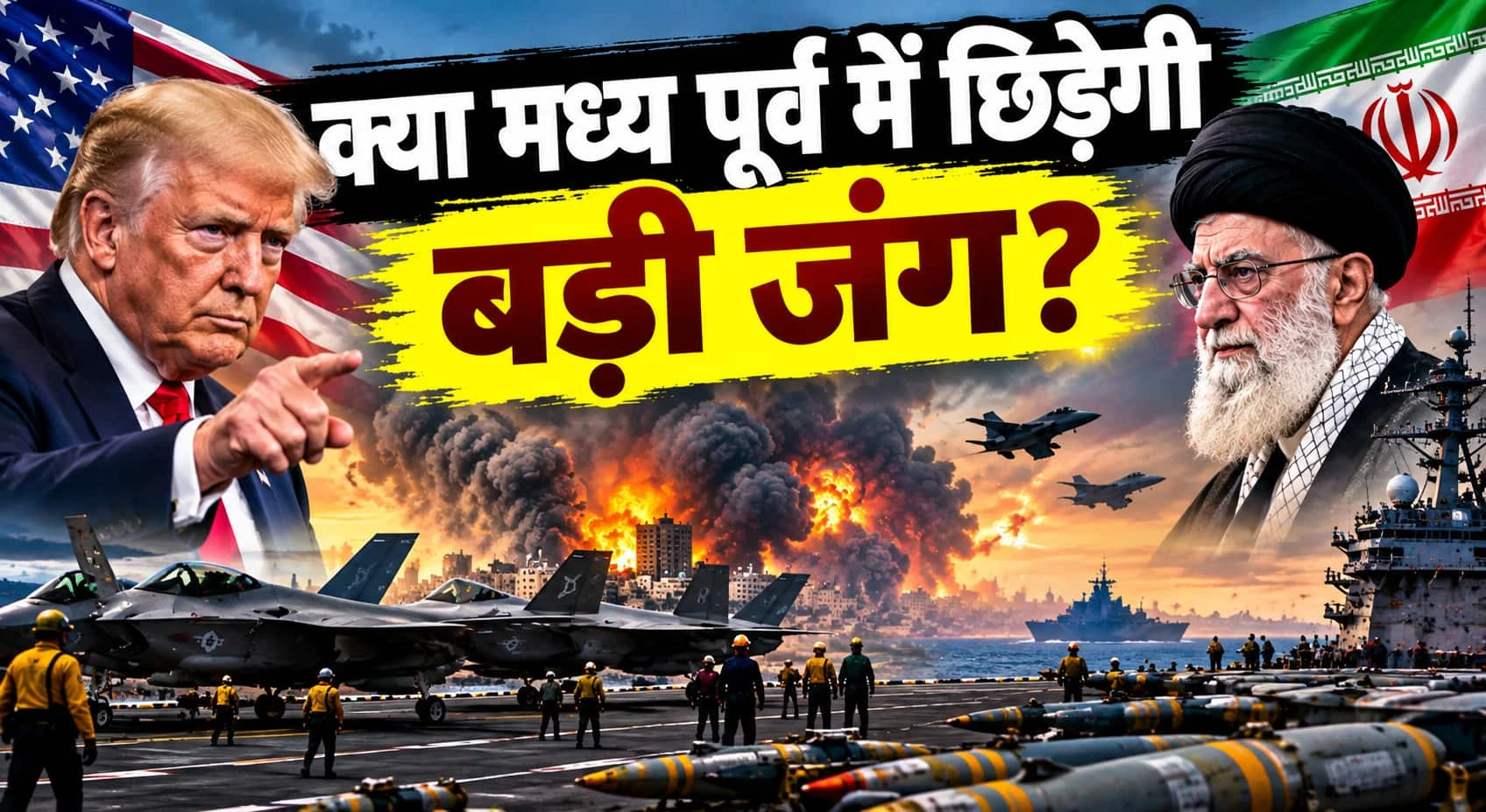
Amid a deepening military crisis in West Asia and an escalating direct confrontation with Iran, the US has raised its military presence in the Arab world and the Persian Gulf to its highest level ever. According to the Al Jazeera report, Washington has intensified the deployment of a large naval fleet, modern fighter jets and additional ground forces to lay an all-round siege of Iran and provide a security ring to its regional allies.
What is the geopolitical meaning of this large military build-up, how are the Arab countries grinding in the midst of this tension, and what impact will it have on the global economy? Let's understand it in detail.
What is the masterplan for 'Siege'?
The Al Jazeera report suggests that the Pentagon's strategy is not just to respond to any possible attack by Iran, but to completely paralyze its air, naval, and missile systems.
This is the first time in decades that the U.S. has deployed three aircraft carrier strike groups. The U.S. fleet, including the USS Abraham Lincoln, includes dozens of missile cruisers and guided-missile destroyers.
The US has multiplied the deployment of F-15E Strike Eagles and stealth fighters at the Muwafq Salti Air Base in Jordan and the Al-Udeidh military base in Qatar.
The Pentagon has landed Marine Expeditionary Units (more than 2,000 Marines) and Army Special Detachments in the area to provide security to important bases and shipping routes.
Strategic importance of the Strait of Hormuz and the Red Sea
The biggest focal point of the US move to encircle Iran is the Strait of Hormuz. and the Red Sea. About 20% of the world's total crude oil supply route passes through the narrow sea strip of Hormuz. According to the report, Iran has warned to gain control of this strategic route and disrupt the movement of tankers.
The priority of the naval vessels of the US and its allies is to provide security to oil tankers and cargo vessels so that a major earthquake in the global energy market does not occur
Arab World Trend: Gulf countries in double crisis
Arab countries like Saudi Arabia, the United Arab Emirates (UAE), Qatar, and Kuwait stand at the most sensitive juncture of this conflict. These countries rely on the US military umbrella for their national security and support the US presence for regional security.
According to Al Jazeera, the Gulf countries fear that if the US uses their military bases directly for major attacks on Iran, Iran and its allies (such as Yemen's Houthis or Iraq's Shiite militias) could target their oil infrastructures.
This is why countries like Saudi Arabia and Qatar are being cautious in giving the US the use of their airspace for direct offensive attacks and insisting on finding diplomatic avenues behind the scenes.
Iran's response
In response to this massive siege of the US, Iran has also fully activated its defense and offensive systems. Iran's Islamic Revolutionary Guard Corps (IRGC) has a huge stockpile of ballistic and cruise missiles as well as suicide drones. With the help of 'missile cities' and naval speedboats hidden under the mountains on Iran's southern coastline, it is strategizing to inflict heavy damage on American ships.
Iran-backed groups based in Lebanon, Syria, Iraq and Yemen continue to press on US bases.
What impact will this have on the global economy?
This large gathering of US forces in the Middle East and the confrontation with Iran have posed a major risk to the global economy. A slight military skirmish in the Persian Gulf could cause international crude oil prices to cross the $100 per barrel mark, which will increase inflation globally.
The insurance premium for ships passing through the Red Sea and Hormuz has increased manifold, making the transportation of consumer goods expensive.
The report makes it clear that the US strategy is to force Iran to withdraw completely from the show of military power. However, such a large US military deployment in the Arab world has put the entire region on a 'powder casket'. If diplomatic dialogue avenues are not explored immediately, a small military lapse could push the entire Middle East into a massive war that would engulf the entire world.

0 thoughts on “Explained: Is the US surrounding Iran from all sides? Big revelation - America's large military buildup in the Middle East”
Leave a Reply
Your email address will not be published. Required fields are marked *



RECENT NEWS
- Musk's Partner Shivon Zilis Confirms Breakup: Says - Talks Reached the End of Love Separation in a Week; The Two Have 4 Children
- Omani co-pilot who attacked Captain Machchhar, identified as Hamam Alhamami, spent most time in Syria: Report
- 'Most comprehensive': Ukraine backs India's proposal as Putin praises PM Modi's peace efforts
- Another conflict brewing in Middle East? Netanyahu vows to exact 'very heavy price' over flydubai incident
- 'There will be a heavy price to pay', says Netanyahu on Flydubai cockpit incident