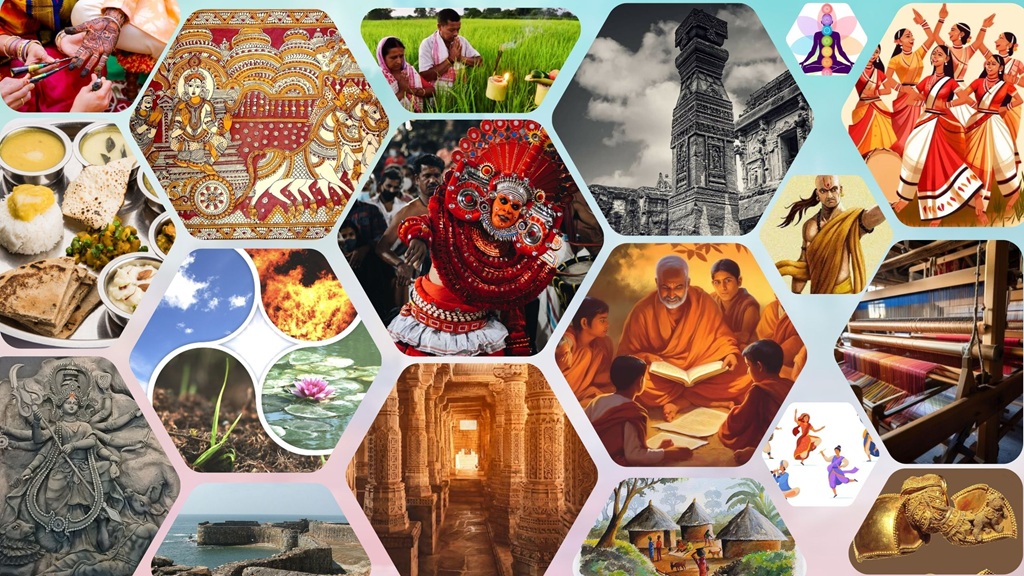
From handlooms and heritage festivals to streaming platforms and gaming, culture is emerging as a serious economic force—yet remains undercounted and underfunded. India’s vast network of artists, artisans, designers, filmmakers, writers and digital creators is quietly powering jobs, tourism and innovation. But despite its reach into every part of daily life—from village fairs to viral videos—the country’s creative economy is still treated as peripheral to “real” development.
International estimates suggest cultural and creative industries generate over USD 2.3 trillion globally, account for more than 3% of world GDP and employ around 50 million people, or roughly 6% of the global workforce. India’s share in this system is large in volume and diversity, but remains under-represented in economic data, export statistics and formal employment structures.
A System, Not a Single Sector
India’s cultural economy is less a single industry and more a dense web of practices: classical and folk arts, handicrafts, festivals, publishing, design, architecture, film, television, gaming and digital content creation. Together, they support livelihoods, preserve knowledge systems and increasingly drive growth in tourism, manufacturing, digital services and urban development. Yet policy and planning have largely treated culture as a soft add-on—valuable for identity and diplomacy, but rarely integrated into core economic, employment or infrastructure strategies.
Arts, Heritage and Festivals: Culture as a Livelihood Engine
India’s visual and performing arts—classical dance and music, folk theatre, ritual practices, painting and sculpture—sustain entire ecosystems: performers, teachers, accompanists, costume makers, set designers, sound and light technicians, event managers and cultural organisers. Festivals and cultural tourism multiply this impact, drawing visitors, generating seasonal employment and sustaining local hospitality and retail. Beyond economics, festivals play a distinctive role in shaping human life and well-being. Religious and cultural celebrations such as Diwali, Eid, Christmas, Durga Puja, Navratri, Onam and countless regional fairs:
- Reinforce community bonds and intergenerational ties
- Provide a shared rhythm to social life through rituals and public gatherings
- Offer emotional release and psychological relief, especially in times of stress or crisis
- Encourage acts of generosity, volunteering and mutual support
- Strengthen a sense of belonging, identity and civic pride
Urban festivals and literary, film or music events have become key platforms for dialogue and expression, particularly for younger generations. For many communities, these occasions are also critical markets, where artists, artisans and performers secure a major share of their annual income.
Yet income for performers and festival-linked workers is often irregular and dependent on patronage or one-off events. Most operate outside formal contracts, with little access to social security, health insurance or long-term career pathways. While their cultural value is widely acknowledged, their economic contribution is still poorly captured in national accounts.
Handicrafts and Traditional Knowledge: Millions Employed, Few Protected
Handicrafts remain one of the largest employment bases in India’s creative economy, especially in rural and semi-urban regions. Weaving, pottery, metalwork, wood carving, embroidery and other textile traditions rely on intergenerational skills and local materials, and employ millions of artisans—many of them women.
Yet most artisans receive only a small fraction of the final market price for their products. Fragmented supply chains, middlemen, lack of branding, limited access to credit and weak intellectual property protection keep incomes low. Tools such as Geographical Indications (GIs), design collaborations and e-commerce have improved outcomes in some clusters, but coverage remains limited relative to the scale of the sector.
Screens and Streams: Film, Media and Audiovisual Growth
India is the world’s largest film-producing country, responsible for nearly 30% of global film output. Each film typically generates 300–400 direct and indirect jobs, spanning actors, directors, writers, musicians, technicians, editors, designers and distributors. Regional cinema, in particular, plays a critical role in linguistic and cultural representation.
Television, radio and digital streaming platforms have further transformed the landscape, taking content across languages and borders. Streaming services have altered revenue models, boosted demand for series and films in regional languages and expanded opportunities for independent producers—while also raising questions about labour conditions, content diversity and platform governance.
Publishing, Literature and Knowledge Industries
India’s publishing industry sits at the intersection of culture and education. It supports authors, editors, translators, printers, distributors and booksellers across dozens of languages. Book fairs and literary festivals attract large crowds, functioning as cultural marketplaces and major tourism draws.
However, persistent challenges—weak copyright enforcement, patchy translation infrastructure, high distribution costs and fragile independent publishing—limit the sector’s reach, especially in regional languages and digital formats. Without stronger support, India risks underutilising its linguistic diversity as a driver of both knowledge and creative growth.
Design, Architecture and Creative Services
Design and architecture increasingly shape how Indians live, work and move through cities and digital spaces. They influence manufacturing, urban planning, infrastructure, branding and user experience. International research indicates firms that employ more creative professionals are significantly more likely to innovate.
In India, design-driven approaches could improve the sustainability, accessibility and cultural relevance of housing, transport, digital services and public spaces. But design and architecture remain under-integrated into mainstream development planning, often entering discussions only at late, cosmetic stages.
Digital Creativity, Gaming and New Media
With more than 500 million active social media users, India’s digital ecosystem has opened unprecedented avenues for creators from small towns and rural areas. Gaming, animation, digital art, online publishing and influencer content are among the fastest-growing segments of the creative economy, propelled by smartphones, affordable data and regional language content.
This growth, however, comes with new vulnerabilities: income volatility, dependence on platform algorithms, concerns over data ownership and limited social protection for digital creators, many of whom operate as freelancers or micro-entrepreneurs.
Policy Recognition Rises, Financing Lags
Policy attention is slowly catching up. During India’s G20 Presidency, culture was formally recognised as a pillar of sustainable development, linking creative industries with employment, inclusion and economic growth. Dedicated creative economy units, cultural mapping initiatives and discussions on intellectual property and digital rights are emerging across institutions.
Yet cultural and creative industries still receive less than 1% of global development financing, according to international assessments—a stark mismatch with their social and economic weight. Within India, gaps in data collection, inter-ministerial coordination and tailored financing continue to limit the sector’s potential.
The Road Ahead: Mainstreaming Culture in Development
India’s creative economy spans arts, handicrafts, heritage, festivals, media, publishing, design and digital innovation. Some segments—like film and streaming—enjoy global visibility; others—such as rural crafts or local performance traditions—remain informal, precarious and under-supported despite their scale.
Analysts argue that a new, more holistic approach is needed:
- Integrate culture and creativity into core economic and urban planning
- Build robust data systems to measure their contribution to GDP and employment
- Improve access to finance, social security and intellectual property protection
- Invest in skills across both traditional and digital domains
- Recognise festivals and cultural events as critical sites of both economic activity and human well-being
If these steps are taken, India’s cultural economy could move from the margins of policy to the centre of development strategy—delivering not only growth and jobs, but also social cohesion, mental well-being and a stronger, more inclusive sense of national and local identity.

IIIT Delhi | Prabodhini Policy Fellow | NET Qualified | AIPRIS - M.S. University | BRICS IF | Delhi University | UN V-force leader | Ministry of WCD, GOI|
0 thoughts on “India’s Creative Economy Steps Out of the Shadows, but Policy Gaps Persist: From Cultural Heritage to Economic Growth”
Leave a Reply
Your email address will not be published. Required fields are marked *


RECENT NEWS
- Is US‑Iran war ending soon? Donald Trump considers 'winding down' military efforts, lists 5 objectives
- US can 'take out' Iran's Kharg Island at any time, warns White House
- Clavicular breaks silence on contract claims as streamer VarisG reveals what really happened in Miami
- Middle East crisis: Trump says US 'close to meeting objectives', opposes ceasefire with Iran
- Barron Trump turns 20: Twenty things you never knew about the most mysterious Trump