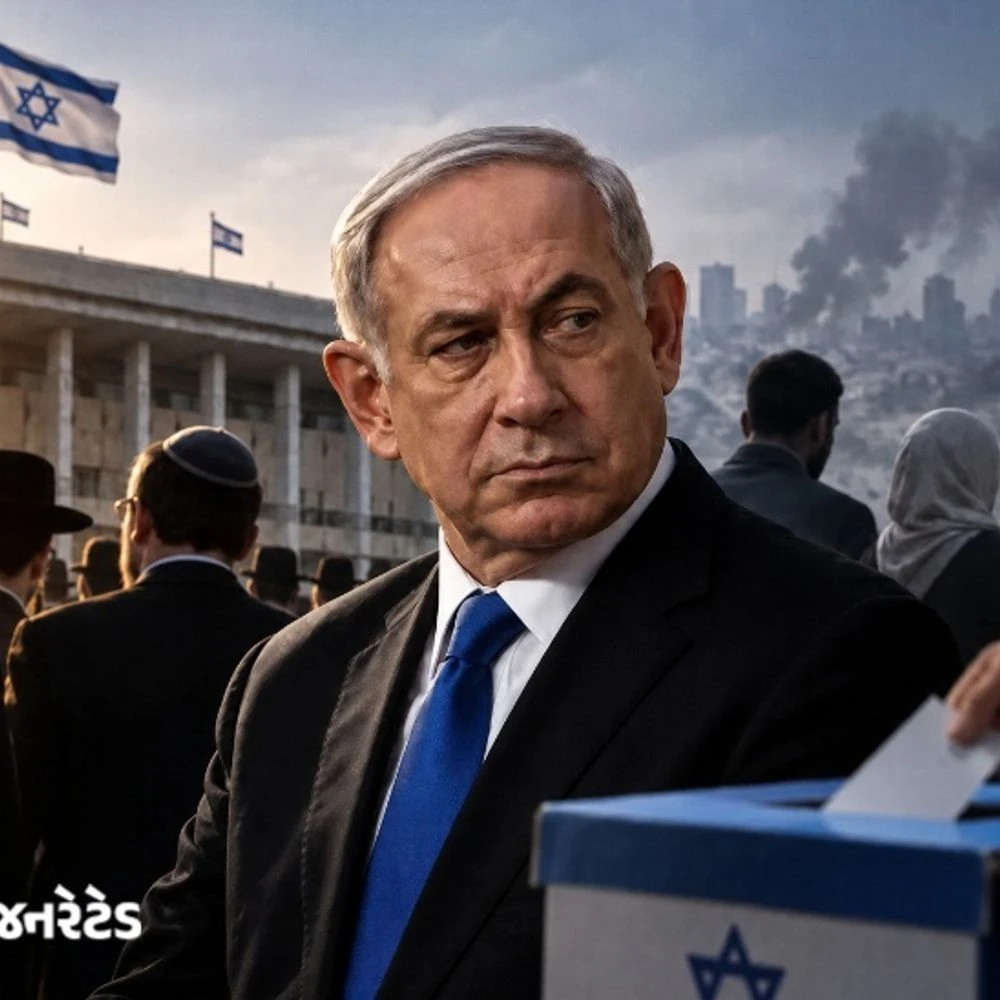
On October 7, 2023, about 6 thousand Hamas fighters attacked Israel. People were killed in houses and bunkers, many were burned alive, and more than 250 people were taken hostage and taken to Gaza. About 1,200 people were killed. In response, Israel launched an attack on Gaza. Even after three years, the impact of October 7 is not limited to war. This attack has also changed the agenda of Israeli politics. General elections are scheduled to be held in Israel on October 27. Earlier, issues such as inflation, house prices and the case against Netanyahu were the main topics of election discussion. Now the question of security, Hamas, the army and Palestine is at the forefront. This has already benefited from a strong right-wing politics. However, the threat of Prime Minister Netanyahu's defeat is looming. On the other hand, the left parties have been weakened and it has become difficult for the Arab parties to play the role of kingmaker in forming the government as before. This is the first election in the country after the Gaza war, the first national election to be held in this country after the Hamas attack. The question in this election is not just whether Netanyahu will become prime minister again or not. The attack that changed Israeli politics three years ago is now being answered from Netanyahu's government. Netanyahu was the prime minister at the time of the attack and he is under pressure to accept responsibility for the security lapses. His trouble is that this time he is facing a direct challenge from former army chief Gadi Eisenkot. In many recent surveys, Eisenkot's party appears to be equal to or ahead of Netanyahu's Likud. A recent poll shows Likud getting about 22-23 seats and Eisencott's party getting about 22 seats. On the other hand, the entire coalition of right-wing parties with Netanyahu is also trailing by a majority. On the average of recent surveys, his coalition is getting about 52-55 seats, while 61 seats are needed to form a government. The right wing was already strong, stronger after October 7 The right wing in Israel was already strong even before October 7. Netanyahu's Likud party and religious-nationalist parties were already in government. But after the Hamas attack, the issue of security became the biggest one. Right-wing leaders kept saying that Israel should take a tougher stance against Hamas and the Palestinians. Leaders like Itamar Ben-Gvir and Basel Smotrich got more space to make their point on the issue. Issues such as opposition to a Palestinian state, support for Jewish settlements in the West Bank, and a tough policy against Palestinians are now being raised more openly in Israeli politics. Left parties used to talk about peace, now talk about security and terrorism. 3 years ago, the Labor Party and Meretz were the most prominent names in Israel's left politics. Both parties talked about recognizing Palestine and peace. Meretz also advocated Israel's withdrawal from the occupied territories of the West Bank. But after the October 7 attacks, this politics got into trouble. The Hamas attack brought the issue of security and terrorism to the forefront of Israeli society. In the midst of these changes, Labor and Meretz joined forces in 2024 to form 'The Democrats' party. It is led by Yair Golan, a former army officer. The left party still talks to the Palestinians about a political solution and stopping the annexation of the West Bank, but at the same time emphasizes the need to end the Hamas regime and strengthen Israel's security. This is the biggest change in Israeli politics. The issue of security is no longer just an identity of right-wing politics; even the parties that oppose Netanyahu can no longer contest elections without answering this question. Arab parties used to be kingmakers, now they have become untouchables The biggest example of the power of Arab parties in Israeli politics was seen in 2021. In that election, no group got the 61 seats needed to form a government. Netanyahu remained the largest leader, but could not win a majority. After that, the different parties that stood against him joined hands. Right-wing leader Naftali Bennett and center leader Yair Lapid formed a coalition. In addition to the left and right parties, Mansour Abbas's Arab party Ra'am also joined. The government was formed with the support of 4 seats. In this way, Netanyahu, who had been prime minister for almost 12 years, was out of power. For the first time in Israel, an Arab party became part of the coalition that formed the government. In 2026, the picture is different. In the current surveys, Arab parties are seen getting about 13 seats. It has become much more difficult politically to include the Arab party in the government. By doing so, the party may face the wrath of Jewish voters. That is, in 2021, the Arab parties became the 'kingmaker' to oust Netanyahu from power. In 2026, they may have the necessary seats to form a government again, but after October 7, it has become more difficult to take them along in the changed political environment.

RSS News
Divyabhaskar
0 thoughts on “Israel votes after 20 days, Netanyahu may lose: Hamas attack changes country's politics; Left weakened, Arab parties become untouchable;”
Leave a Reply
Your email address will not be published. Required fields are marked *



RECENT NEWS
- Explained: Why is Scotch whiskey suddenly being sent into space? Know
- Donald Trump reacts to France protests, says 'This is about Islam wanting to take over'
- Trump admin proposes $70,000 fee for foreign students seeking US jobs in major immigration crackdown
- Israel votes after 20 days, Netanyahu may lose: Hamas attack changes country's politics; Left weakened, Arab parties become untouchable;
- Former Serbian President praises PM Modi's 25 years in govt, says 'India is important on global stage'