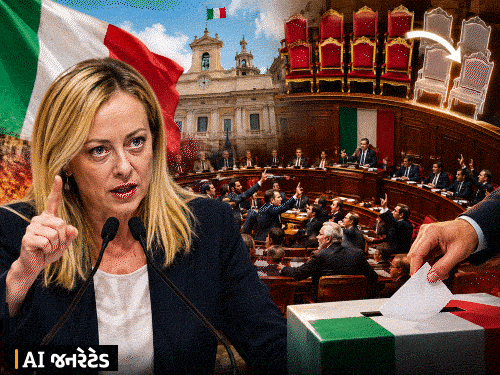
In Italy, a controversy has arisen over the proposal to give additional seats in parliament to the party or coalition that won the election. Prime Minister Giorgia Meloni's government wants to bring this law. Under this, the party or coalition that wins the election can get 105 additional seats in Parliament. However, for this, it will have to get at least 42% of the votes in both the houses. The government says that this will bring political stability in the country and governments will not fall repeatedly. On the other hand, the opposition alleges that this law will give more power to the coalition that won the election. The vote on this law is scheduled to be held in Parliament today. Meloni has clearly said that if the law is not passed, she will resign. In such a situation, this vote is considered important for her government. If the law is implemented, how will the seats be distributed? The Italian parliament has a total of 600 seats, including 400 seats in the lower house and 200 seats in the Senate. According to the proposal, if a party or coalition leads with at least 42% of the votes, it will be given 70 bonus seats in the lower house and 35 in the Senate. These seats will be divided within the total number. This does not mean that 70 seats will be added above 400 in the lower house. The total number of seats will be only 400. Let's understand this with an example: Suppose the winning party A coalition will get a bonus of 70 seats under the new rule in the election. The remaining seats will be divided among other parties. That is, Party A will get the benefit of bonuses in addition to the seats it gets based on its 43% of the votes, due to which the number of seats in parliament can be more than its vote percentage. Italy has had 68 governments in 80 years. Italy has a long history of unstable governments. Since Italy became a republic in 1946, there have been 68 governments. In 1954, a government lasted only 22 days. Last month, Giorgia Meloni set a record. After becoming the Prime Minister in September 2022, her government became the longest-running government in the history of Italy. The 5-year term of Meloni's current government is set to end next year. However, if there is a breakdown in the ruling coalition over this law, then elections can also be held in the country ahead of time. Opponents say that by getting additional seats, the coalition that won the election could have more power in parliament than necessary. This will allow it to make many big decisions without discussing it with other MPs. It also includes important matters like the appointment of judges and the president. It threatens democracy. Left-wing journalist and political analyst Massimo Giannini compared this law to a law made in 1923. This law helped the National Fascist Party to capture parliament at that time. Giannini said on his podcast, "After 103 years, the same method is being adopted again. Giving bonus seats to overwhelming majority in the electoral law changes the balance of democracy." Debate over the name of the law The supporters of the law have named it 'Stability'. They say that its purpose is to stabilize governments in Italy. The political history of Italy is not known for long-running governments. Many governments there have fallen after a short time. On the other hand, the opponents have named it 'Melonellum' by associating it with Meloni. They allege that an election law has been drafted to benefit Meloni, so that he can come back to power. If this law is passed, opposition parties and organizations are preparing to challenge it in the Constitutional Court of Italy. The name of the candidate for the post of Prime Minister will also be announced in advance. There is also a rule in the proposal that the coalition contesting the election will announce the name of its candidate for the post of Prime Minister before the vote. The government says that this will give voters in advance who will become the Prime Minister after winning. This will bring clarity and transparency in the election. But opponents say that the president has the right to choose the Prime Minister in Italy. The President is chosen by the Parliament and he also has some special powers related to law-making and the judicial system. Opponents feel that the rule of determining candidates in advance can weaken the role of the president. Six electoral laws have been enacted in Italy since 1993 to bring political stability. In the past, an attempt has been made to give additional seats to the winning party. An election law enacted in 2005 also had a similar provision, but in 2013 the Italian Constitutional Court declared it unconstitutional. The court said that no minimum percentage of votes was set to give additional seats.

RSS News
Divyabhaskar
0 thoughts on “Controversy over getting additional seats if Italy wins election: Vote in parliament today; Meloni says she will resign if the law is not passed”
Leave a Reply
Your email address will not be published. Required fields are marked *



RECENT NEWS
- Captain Smit Machchhar to be honoured with Israel's Presidential Award for averting flydubai tragedy
- Trump says he won't attack until midterm elections, says he's in meaningful talks with Iran
- Anne Carson won the Nobel Prize in Literature, specializing in connecting the ancient with modernity.
- 'We will not be attacking Iran': Trump rules out US strike before November 3
- Shehbaz did not agree, yet Munir is ready to send Pakistani army to Saudi Arabia