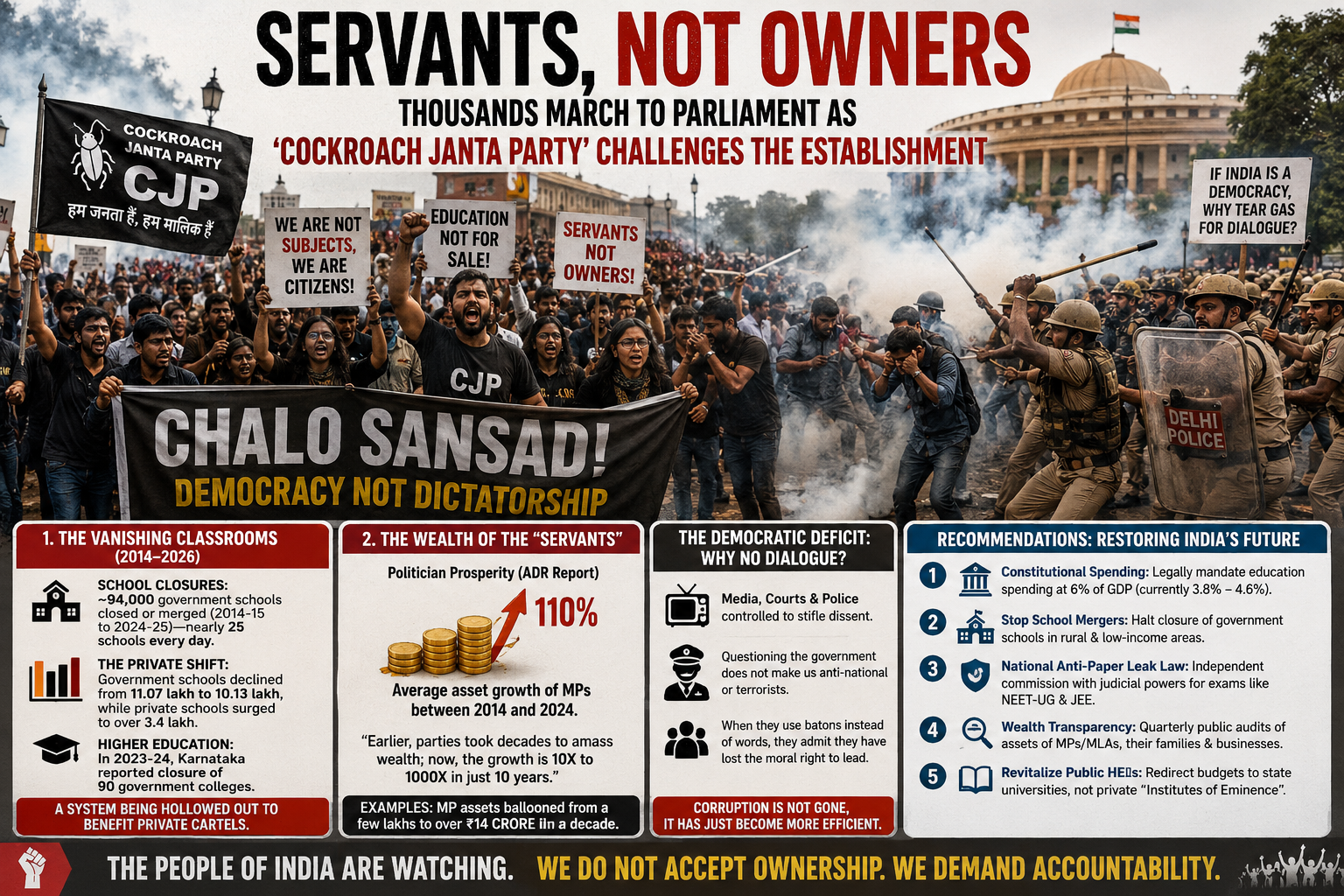

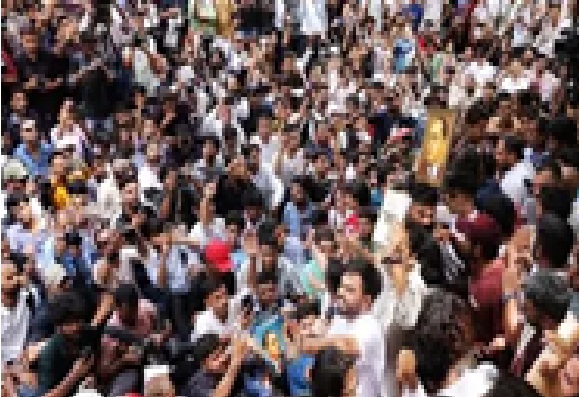
NEW DELHI — In a historic and emotionally charged confrontation at the heart of India’s capital, thousands of citizens under the banner of the Cockroach Janta Party (CJP) launched their 'Chalo Sansad' (March to Parliament) today. What began as a satirical youth movement has transformed into a powerful cry for accountability, as protesters remind the ruling elite of a fundamental democratic truth: they are the servants of the people, not the owners of the nation.
The march was met with a massive police crackdown, including tear gas and lathicharges, after authorities declared the gathering "illegal." As images of students and activists being detained circulate globally, the central question echoing through Jantar Mantar is: If India is a democracy, why is the response to a demand for dialogue always force?
A System for the Rich, By the Rich: The protesters’ grievances are backed by a staggering reality. While the ruling party presents a narrative of "Amrit Kaal," the data on the ground paints a picture of a public education system in retreat and a political class growing exponentially wealthier.
1. The Vanishing Classrooms (2014–2026): The marchers highlighted the systematic "rationalization" of public education. According to NITI Aayog and Ministry of Education data:
- School Closures: Between 2014-15 and 2024-25, approximately 94,000 government schools were closed or merged across India—an average of nearly 25 schools every single day.
- The Private Shift: While government schools declined from 11.07 lakh to 10.13 lakh, the number of private schools surged, now exceeding 3.4 lakh. This has forced millions of low-income families to choose between high-interest loans for private education or no education at all.
- Higher Education: In just one year (2023-24), states like Karnataka reported the closure of 90 government colleges. Protesters argue that the system is being deliberately hollowed out to benefit private education cartels.
2. The Wealth of the "Servants": One of the most emotional points of the march was the comparison of citizen struggles with politician "growth." Protesters cited reports from the Association for Democratic Reforms (ADR):
- Politician Prosperity: Re-elected MPs saw an average asset growth of 110% between 2014 and 2024.
- The "Smarter" Loot: Sentiments on the ground were clear: "Earlier, parties took decades to amass wealth; now, the growth is 10X to 1000X in just 10 years." Protesters pointed to specific examples where MP assets ballooned from a few lakhs to over ₹14 crore in a single decade.
The Democratic Deficit: Why No Dialogue?
The Cockroach Janta Party has accused the ruling party of controlling the "pillars of democracy"—the media, the courts, and the police—to stifle dissent.
"Questioning the government does not make us anti-national or terrorists," said a CJP spokesperson. "In a true democracy, the government talks to its people. When they use batons instead of words, they admit they have lost the moral right to lead."
The movement argues that the corruption which plagued India post-1947 has not been cured; it has simply become more efficient, with the education system being the primary victim of a "pro-business, anti-student" agenda.
Recommendations: Restoring India’s Future
To rebuild trust and the education system, the following measures are proposed for the Central Government:
- Constitutional Spending: Legally mandate education spending at 6% of GDP (currently fluctuating between 3.8% and 4.6%).
- Stop School Mergers: Immediately halt the closure of government schools in rural and low-income areas. Accessibility must take precedence over "efficiency."
- National Anti-Paper Leak Law: Establish an independent, high-level commission with judicial powers to oversee exams like NEET-UG and JEE to prevent the recurring "paper mafia" scandals.
- Wealth Transparency: Mandate quarterly public audits of the assets of all MPs and MLAs, including those of their immediate family members and affiliated businesses.
- Revitalize Public HEIs: Instead of funding private "Institutes of Eminence," redirect the budget to existing state universities to lower the burden of fees on common citizens.
As the sun sets over a barricaded Delhi, the message from the 'Chalo Sansad' march remains clear: The people of India are watching, and they no longer accept a government that acts as an owner while they are treated as subjects.
0 thoughts on “"Servants, Not Owners": Thousands March to Parliament as 'Cockroach Janta Party' Challenges the Establishment”
Leave a Reply
Your email address will not be published. Required fields are marked *


RECENT NEWS
- Miya George shares picture with Mammootty
- Sylvester Stallone talks about starring in ‘Tulsa King’ along with his daughter
- Tiger Shroff firing incident prompts FWICE security advisory
- ITBP Raising Day: PM Modi praises ‘Himveers’ as India-China border management remains in focus
- 'Jailer 2' faces controversy in Tamil Nadu