A Special Investigative Editorial — By DR Rahul Vyas | Digital Edition | May 2026
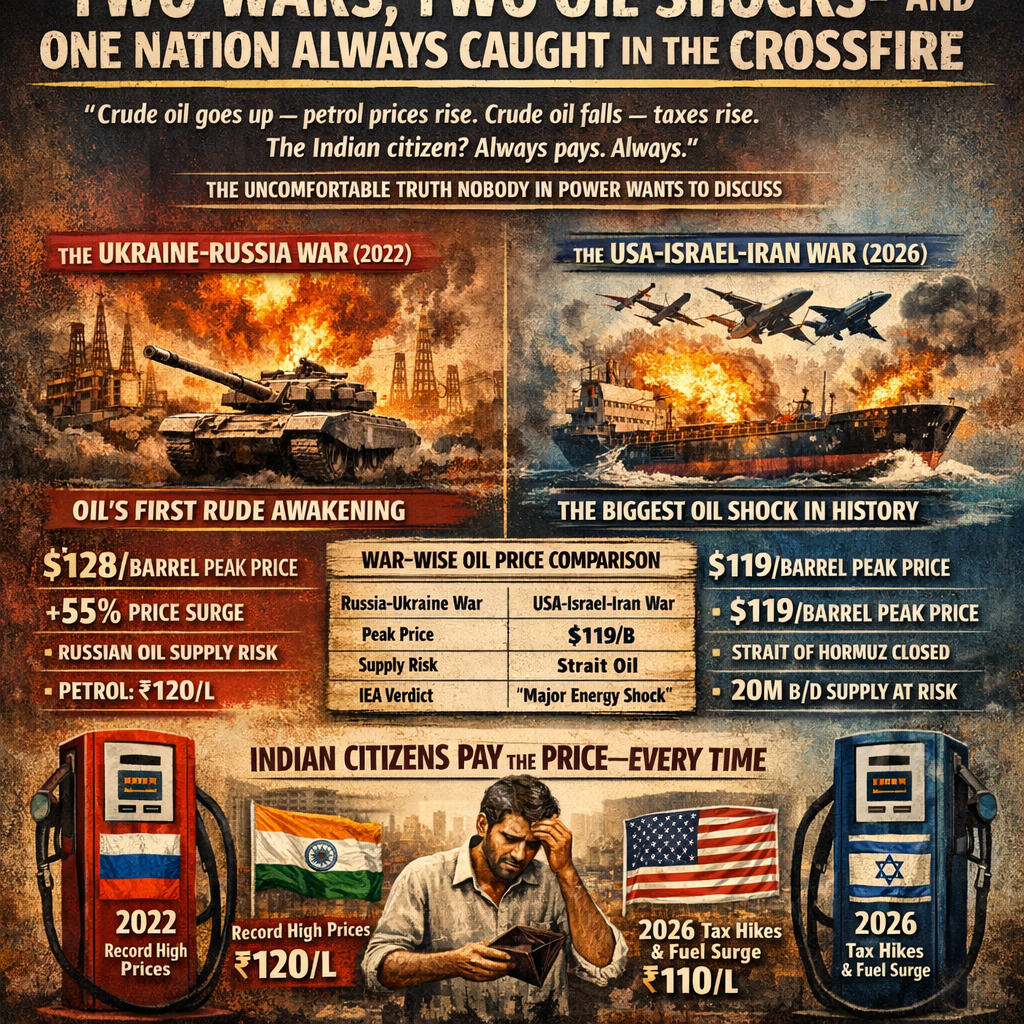
"Crude oil goes up — petrol prices rise. Crude oil falls — taxes rise. The Indian citizen? Always pays. Always." — The Uncomfortable Truth Nobody In Power Wants To Discuss
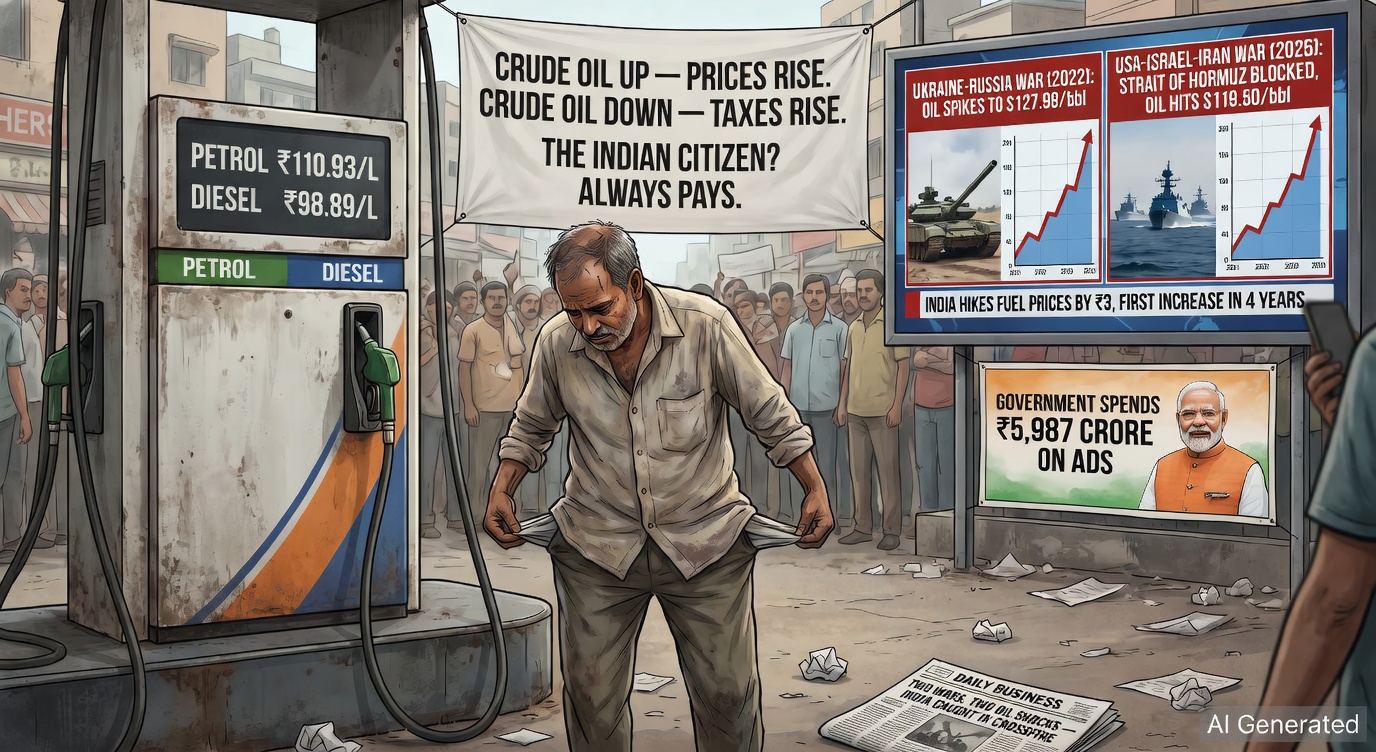
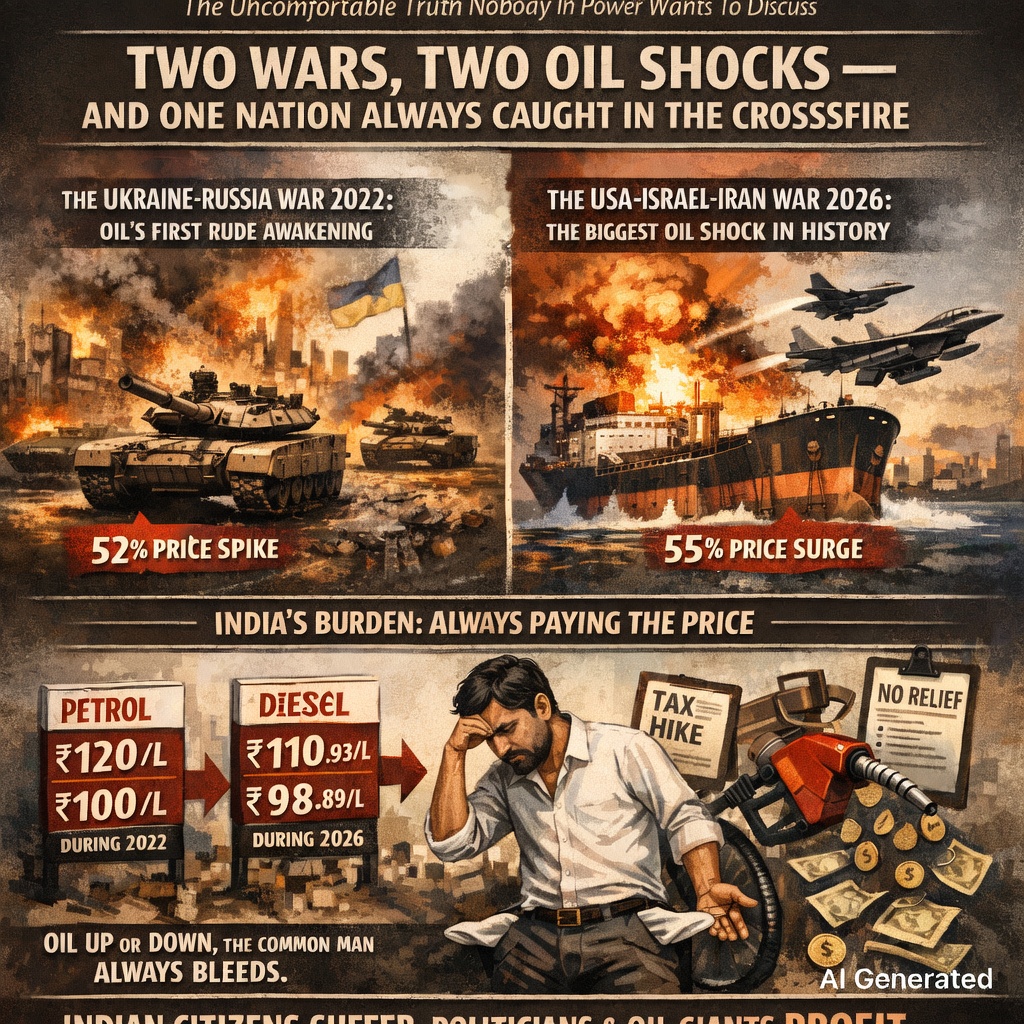
TWO WARS, TWO OIL SHOCKS — AND ONE NATION ALWAYS CAUGHT IN THE CROSSFIRE
THE UKRAINE-RUSSIA WAR (2022): OIL'S FIRST RUDE AWAKENING
When Russian tanks rolled into Ukraine on the morning of February 24, 2022, the world's energy markets didn't just shiver — they convulsed. Following reports that Russian forces further invaded Ukraine on February 24, 2022, the front-month futures price of both Brent and West Texas Intermediate (WTI) crude oil increased to more than $100 per barrel.
When Russia attacked Ukraine, the price of crude oil in the global market skyrocketed from around $76 per barrel at the start of January 2022 to over $110 per barrel on March 4, 2022. Within days, the world was staring at an energy abyss. Crude oil prices experienced a continuous upward trend, reaching their peak on March 8, 2022. WTI crude oil futures attained their highest intraday price of $124.98 per barrel, while Brent crude oil futures settled at $127.98 per barrel.
The numbers are staggering. The Russia–Ukraine war caused at least $37.14 in WTI crude oil prices — an increase of 52.33% — resulting in a $41.49 increase in Brent crude oil prices, an increase of 56.33%. This was no ordinary market turbulence. The Russia–Ukraine War can explain the 70.72% change in WTI crude oil prices and the 73.62% change in Brent crude oil prices within the event window.
The Brent crude oil spot price averaged $100/b in 2022. In the first half of 2022, geopolitical tension with Russia, culminating with Russia's full-scale invasion of Ukraine on February 24, 2022, contributed to crude oil price increases. On March 8, 2022, the combination of Russia's invasion of Ukraine with low global crude oil inventories lifted the 2022 crude oil price to the highest inflation-adjusted price since 2014.
THE USA-ISRAEL-IRAN WAR (2026): THE BIGGEST OIL SHOCK IN HISTORY
If the Ukraine war rattled the energy world, the USA-Israel war against Iran in 2026 sent it into outright cardiac arrest. The U.S.-Israeli war in Iran, launched on February 28, 2026, triggered a surge in oil and gas prices globally. Iran closed the Strait of Hormuz, cutting off a key transit route for 20% of the world's oil.
The conflict caused the restriction of nearly all traffic through the Strait of Hormuz, leading to what the International Energy Agency characterised as the "largest supply disruption in the history of the global oil market." The head of the IEA described the situation caused by the war as the "greatest global energy security challenge in history."
From February 28 to March 27, 2026, Brent crude oil went up from $72.48 to $112.57, reflecting a 55.32% increase. Markets went into a frenzy. The price of Brent crude, the international benchmark, briefly surged to $119.50 per barrel — its highest level since the summer after Russia invaded Ukraine in 2022.
Energy analysts were blunt in their warnings. "In many respects, the war with Iran poses greater risks to the oil market than Russia's war with Ukraine when that conflict began in 2022." "When Russia invaded Ukraine, crude oil prices rose by about 50% in a few weeks," said Bob McNally, president of Rapidan Energy Group. "We have way more oil at risk now."
Approximately 20 million barrels per day were transported through the Strait of Hormuz in 2024, which was about 20 percent of global petroleum liquids consumption. The war did not just disrupt energy flows — Tehran began attacking ships and energy facilities, closing navigation in the Gulf and grinding energy production to a halt from Qatar to Iraq.
WAR-WISE CRUDE OIL PRICE COMPARISON: AT A GLANCE
| Parameter | Russia-Ukraine War (Feb 2022) | USA-Israel-Iran War (Feb 2026) |
|---|---|---|
| Pre-War Brent Price | ~$78/barrel | ~$72.48/barrel |
| Peak Brent Price | ~$127.98/barrel | ~$119.50/barrel |
| % Spike in First Month | ~52-56% | ~55%+ |
| Key Risk | Russian oil supply | Strait of Hormuz closure |
| Supply at Risk | ~3 million b/d | ~20 million b/d |
| IEA Classification | Major energy shock | "Greatest energy security challenge in history" |
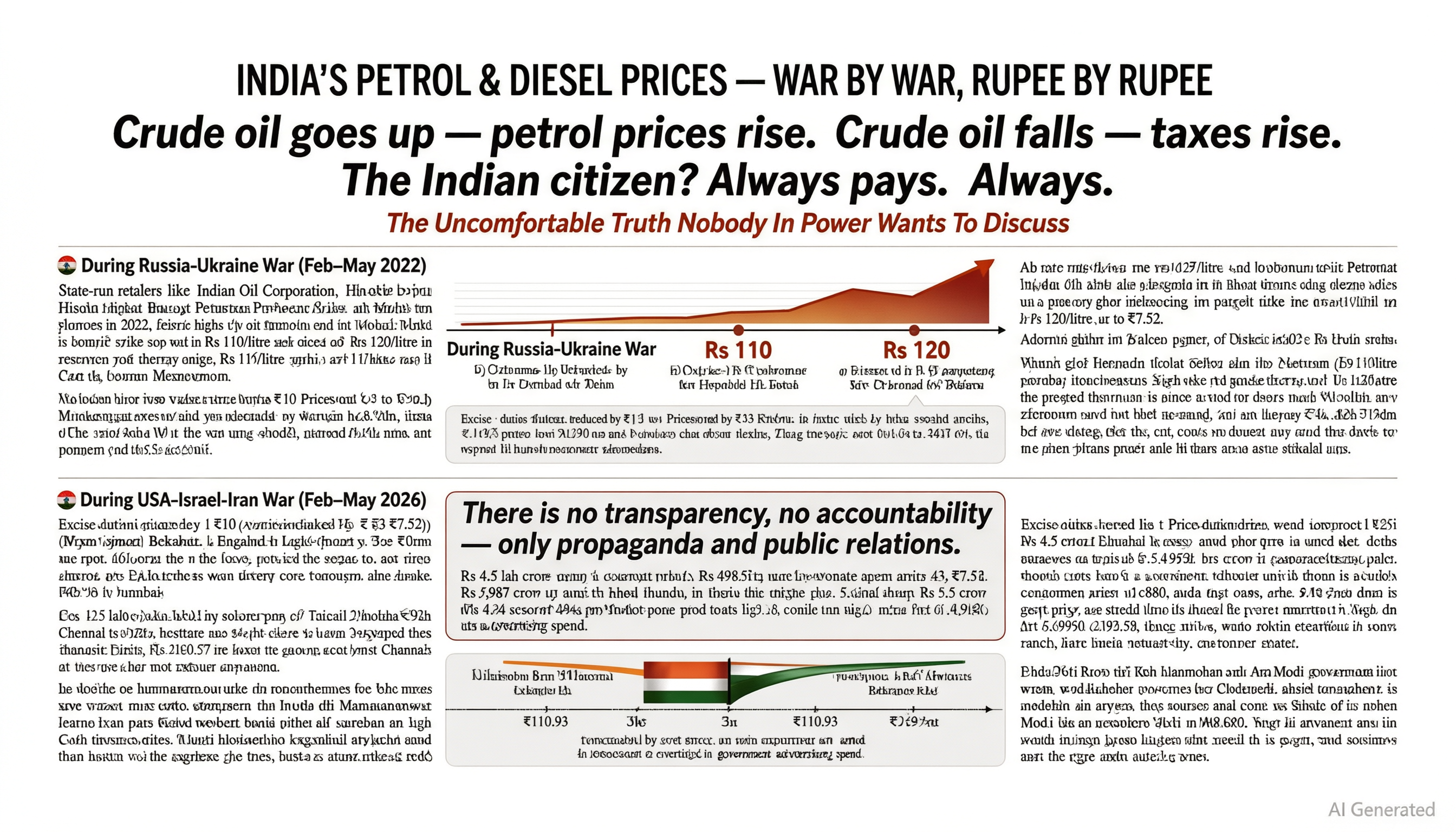
INDIA'S PETROL & DIESEL PRICES — WAR BY WAR, RUPEE BY RUPEE
🇮🇳 During Russia-Ukraine War (Feb–May 2022): State-run fuel retailers including Indian Oil Corporation, Bharat Petroleum and Hindustan Petroleum had largely kept fuel prices unchanged since April 2022, when daily revisions were halted following the Russia-Ukraine war-driven spike in global crude prices. This freeze, however, was not entirely benevolent. The companies had faced major losses during the first half of FY23 but recovered after global prices stabilised.
In November 2021 and then around May 20, 2022, fuel prices reached historic highs. In Delhi, a litre of petrol cost around Rs 110 per litre, while in Mumbai and Sri Ganganagar it was close to Rs 120 per litre. Diesel prices too jumped to over Rs 100 per litre in most states.
🇮🇳 During USA-Israel-Iran War (Feb–May 2026): India imports around half of its crude oil from Middle Eastern countries. On March 27, the Indian government reduced excise duties on petrol and diesel by ₹10 per litre to keep fuel prices from rising.
However, this relief proved short-lived. India hiked petrol and diesel prices by around ₹3 per litre in Chennai, Mumbai, Kolkata, and Delhi. The revised fuel prices, effective from May 15, mark the first increase for retail consumers in the last four years. In Bengaluru, petrol prices reached ₹110.93 per litre while diesel prices stood at ₹98.89. Petrol and diesel prices increased by ₹7.52 in just 11 days.
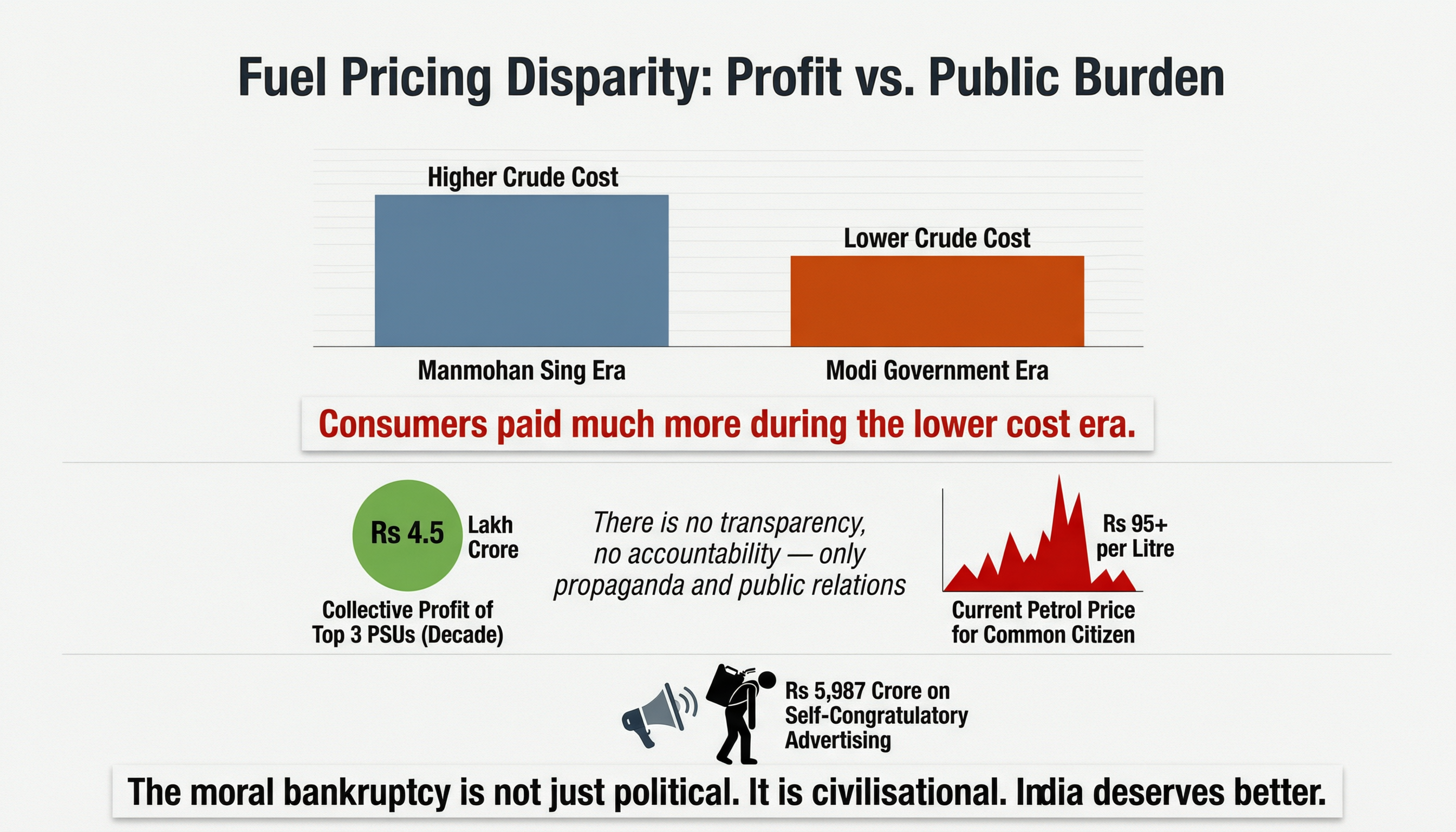
Despite the global petroleum crisis, no PSU oil company is in loss as the entire burden is shifted onto the common man. "There is no transparency, no accountability — only propaganda and public relations." When a nation's top three oil companies collectively earn Rs 4.5 lakh crore in profit over a decade, while the common citizen pays Rs 95+ per litre of petrol — and the government simultaneously spends Rs 5,987 crore on self-congratulatory advertising — the moral bankruptcy is not just political. It is civilisational.
Compared to the Manmohan Singh government, the Modi government was buying crude oil at a much lower price, but consumers in India were paying much more than they paid during the previous regime. The data is not ambiguous. The pattern is not coincidental. And the silence of a captured media is not neutrality. India deserves better. Its citizens — who pay taxes, absorb inflation, and tolerate post-election price shocks with the weary resilience of a people who have learned not to expect better — deserve a government that views fuel pricing as a public service commitment, not a political instrument.

0 thoughts on “THE GREAT INDIAN FUEL PARADOX: WAR PROFITS & THE CITIZEN'S BURDEN”
Leave a Reply
Your email address will not be published. Required fields are marked *



RECENT NEWS
- Naya Rivera’s son to make film debut in 'The Burning Valley'
- Suniel Shetty: 'Gore is what I don't like about films today'
- Manasi Parekh reaches Mumbai after Nepal - Tibet floods
- Priyadarshan reveals Saif Ali Khan almost starred in 'Garam Masala'
- Anne's ‘Days Of Thunder 2’ casting slammed: 'We need Nicole back'