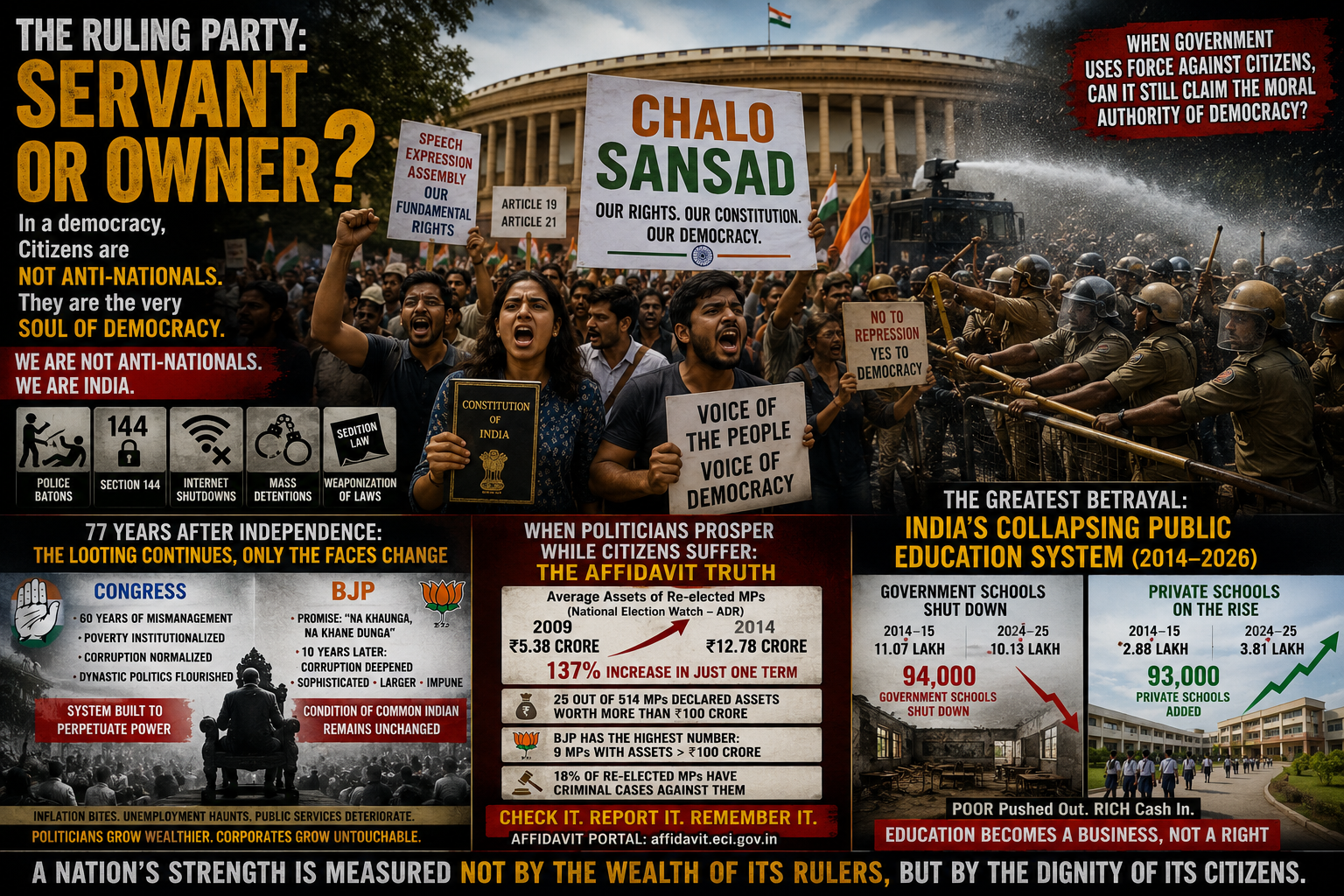
THE RULING PARTY — SERVANT OR OWNER?: In a democracy, a fundamental truth remains non-negotiable — elected representatives are the servants of the people, not their rulers. Yet, the ruling establishment in India in 2026 continues to behave as though the nation is its personal inheritance. When citizens dare to raise their voices, they are met not with dialogue or democratic engagement, but with police batons, Section 144, internet shutdowns, and the weaponization of sedition laws.
This raises a question every thinking citizen must ask: If India is truly a democracy, why does the government refuse dialogue?
The 'Chalo Sansad' marchers did not carry weapons. They carried the Constitution. They did not threaten violence. They demanded their fundamental rights — enshrined in Articles 19 and 21 of the Indian Constitution — the right to speech, expression, and peaceful assembly.
Let this be stated clearly and for the record: Citizens who protest against their government are not anti-nationals. They are not terrorists. They are the very soul of democracy. The right to peaceful protest is a recognized human right under Article 20 of the Universal Declaration of Human Rights.
THE IRON FIST— FORCE AGAINST CITIZENS: Reports from the ground paint a chilling picture. Police forces were deployed in overwhelming numbers. Water cannons, barricades, and mass detentions were used to suppress what was a constitutionally protected march. Senior CJP leaders were taken into preventive custody hours before the march even began.
The critical question the nation must answer: When a government uses the machinery of the state — police, judiciary, media — to silence its own citizens, can it still claim the moral authority of democratic governance?
India's mainstream media, largely controlled by corporates deeply aligned with the ruling political establishment, blacked out live coverage of the march. Independent journalists were harassed. Social media trends were reportedly suppressed. The "free press" in India has, by many accounts, become a palace press.
77 YEARS AFTER INDEPENDENCE: THE LOOTING CONTINUES — ONLY THE FACES CHANGE: India received its hard-won independence on August 15, 1947 — freedom earned through the blood and sacrifice of millions. Yet, nearly eight decades later, the ordinary Indian citizen asks in despair: "What has truly changed?"
Congress: Governed India for nearly 60 of its first 75 years. Under its watch, poverty institutionalized, corruption normalized, and dynastic politics flourished. The system was built not to serve citizens, but to perpetuate political power.
BJP: Rode to power in 2014 on the promise of "Na Khaunga, Na Khane Dunga" (I will neither be corrupt nor allow corruption). Yet a decade later, critics and independent economists argue that what Congress achieved in 60–70 years of economic mismanagement and institutional decay has been accelerated and deepened in just 10–11 years — with greater sophistication, greater scale, and greater impunity.
The condition of the common Indian remains unchanged. Inflation bites. Unemployment haunts. Public services deteriorate. But politicians grow wealthier, and their corporate allies grow untouchable.
WHEN POLITICIANS PROSPER WHILE CITIZENS SUFFER: THE AFFIDAVIT TRUTH: Every election in India, candidates are required to submit financial affidavits to the Election Commission of India declaring their assets. The numbers tell a story no political speech ever will.
National Election Watch (NEW) and the Association for Democratic Reforms (ADR), which analyzed data of 165 re-elected MPs, found that the wealth of these Lok Sabha members increased from an average of ₹5.38 crore in 2009 to an average of ₹12.78 crore in 2014 — a rise of 137% in just one term.
The average asset value declared by 165 re-elected MPs from the 2014 Lok Sabha showed a rise of 137%. Common people do several things to become rich, yet most of the time their financial conditions remain unchanged.
A report by poll rights watchdog ADR revealed that out of 514 sitting Lok Sabha MPs, 25 declared assets worth more than ₹100 crore. Among these 25, BJP had the highest number of rich MPs, with nine of them having declared assets of over ₹100 crore.
According to analysis, there was even an increase in criminal cases against MPs. The criminal records of 18% of re-elected MPs with self-declared criminal cases showed a surge from the previous Lok Sabha elections — 13 out of 71 re-elected MPs who declared criminal cases showed an increase in self-declared criminal cases in the 2014 Lok Sabha elections.
The bitter truth: India's political class — across all parties — enters Parliament as public servants and exits as multi-millionaires. The affidavit portal of the Election Commission of India (affidavit.eci.gov.in) is publicly accessible. Every citizen must check it. Every journalist must report it. Every voter must remember it.
THE GREATEST BETRAYAL: INDIA'S COLLAPSING PUBLIC EDUCATION SYSTEM (2014–2026)
Perhaps no single policy failure captures the moral bankruptcy of the Indian ruling class more vividly than what has been done to public education — the one tool that could genuinely lift millions out of poverty. Instead, the system has been deliberately allowed to decay, forcing families into the arms of expensive private institutions.
Government Schools: A Nation Abandoning Its Children
India's school education network has undergone a significant transformation over the past decade, with 94,000 government schools ceasing operations between 2014–15 and 2024–25, according to a recent NITI Aayog report. Government schools fell from 11.07 lakh in 2014–15 to 10.13 lakh in 2024–25, while government-aided schools also saw a decline.
Government-aided institutions also witnessed a marginal fall, dropping from 83,000 to 79,000, while the number of private schools increased from 2.88 lakh to 3.39 lakh, reflecting a gradual shift in the composition of India's school system.
Between 2014–15 and 2019–20, around 74,500 schools were shut. Another 18,700 schools closed between 2020–21 and 2024–25, taking the total closures past 93,000. States such as Madhya Pradesh and Uttar Pradesh accounted for a substantial portion of the reduction, with roughly 30,000 and 25,000 closures respectively. Total enrolment dropped from 26.95 crore in 2014–15 to 24.69 crore in 2024–25, indicating that 2.26 crore fewer students are enrolled in schools compared to a decade ago. More than 65,000 government schools now have fewer than 10 students, and over 5,000 reported zero enrolment in the 2024–25 academic year.
The transition rate from upper primary to secondary school also declined from 91.58% in 2014–15 to 86.6% in 2024–25, indicating that student retention beyond elementary education remains an area requiring attention.
The Devastating Human Cost: Education activists argue that closing neighbourhood schools can increase travel distance for young children, affect attendance in remote areas, and disproportionately impact girls and economically disadvantaged students. When a government school shuts, the state's presence in that community diminishes — a change that carries particular weight in marginalised habitations.
Education Budget: Numbers That Shame a Nation
Union Budget 2025–26 allocated ₹1.28 trillion to the education sector, a 6.5% hike compared to the previous year and the lowest in the past four years. However, the overall spending on education remained below the suggested 6% of GDP spending in the National Education Policy (NEP) 2020. While absolute allocations grew, education's share of the Union Budget declined from 3.5% in 2015–16 to 2.5% in 2025–26. The combined Centre-State education spend remains stuck at approximately 2.9% of GDP — far short of the NEP 2020 target of 6%.
Over the past ten years, while the budget for the Department of School Education increased by 32.46%, as a percentage of the total budget estimate, the share was reduced by 50% — from 3.07% to 1.53%. Over the past decade, India's education spending has hovered between 3% and 4% of GDP, with fluctuations depending on economic conditions and government priorities.
Higher Education: Privatised for the Privileged: According to the All-India Survey on Higher Education (AISHE) 2021–22, two-thirds of all colleges (65.3%) are private unaided colleges, and 40.4% of all universities are private unaided universities. In 2021–22, 78% of all colleges are privately run and 66% of college enrolment is in privately-run colleges.
Within the reduced budget for higher educational institutions, spending on elite engineering/management colleges has been greatly increased, constituting three-fourths of the higher education budget. Corporate houses are entering the higher education sector and opening elite universities and colleges that cater exclusively to the children of the rich.
The utilisation of funds under RUSA (Rashtriya Uchha Shiksha Abhiyan — India's key scheme for state higher education institutions) has been consistently low since 2017–18. The Standing Committee on Education noted that targets under RUSA 2.0 have been lower than those set under RUSA 1.0.
THE WAY FORWARD: RECOMMENDATIONS FOR A JUST EDUCATION SYSTEM:
The 'Chalo Sansad' movement demands not only accountability but also a concrete roadmap for change. Here are evidence-based, people-centric recommendations for the Central Government:
1. Honour the 6% GDP Commitment — No More Excuses: The NEP 2020, crafted by the government's own experts, mandated 6% of GDP for education. The NEP 2020 vision of 6% GDP spending remains a distant aspiration. The government must legislatively commit to this target with a time-bound roadmap by 2028.
2. Immediately Halt the Closure of Neighbourhood Government Schools: The only acceptable path is managed consolidation — closures paired with transport support, strict distance norms for early grades, strengthened teacher posts, and investment in foundational learning infrastructure — where access and quality advance together. Any closure without guaranteed alternative access must be declared unconstitutional.
Invest in Teachers: Hire, Train, Retain: Thousands of government schools operate with a single teacher or no teacher at all. A national emergency teacher recruitment drive must be launched immediately — targeting 5 lakh posts within 2 years, with a focus on rural, tribal, and backward regions.
4. Mandate Free and Quality Education Up to Class 12: The Right to Education Act covers only up to Class 8. It must be immediately extended to Class 12, ensuring that no child is forced to drop out due to poverty.
5. Regulate Private School Fees — End Education Profiteering: The NEP 2020 recommended treating educational institutions at the standards of a non-profit organisation, involving public disclosure of fees, prohibition of arbitrary fee increases, and transparent, capped fee structures. This must be enforced with criminal penalties for violations.
6. Revive and Reform RUSA With Full Fund Utilisation Accountability: The Rashtriya Uchchatar Shiksha Abhiyan (RUSA) was launched to fund the upgradation of infrastructure and quality of Higher Education Institutions. Its chronic under-utilisation of funds must be addressed through **independent audits, public dashboards, and district-level implementation committees** that include civil society.
7. Establish a National Education Emergency Fund: A dedicated, ring-fenced fund of ₹50,000 crore must be established for the next 5 years, specifically for rebuilding government school infrastructure in the 100 most educationally backward districts of India — prioritizing Uttar Pradesh, Madhya Pradesh, Bihar, Jharkhand, Gujarat and Odisha.
8. Digitalise and Democratise: The Union Budget's emphasis on expanding Atal Tinkering Labs, AI-driven education, and broadband connectivity in government schools is described as “a decisive step toward future-ready learning.” However, this must reach the last child in the last village — not just urban elite schools. Every government school must have electricity, toilets, clean water, internet, and a library by 2027.
9. Scholarship Revolution for the Marginalized: The government must prioritize spending for students from marginalised sections of society, rather than directing the bulk of the higher education budget toward elite institutions. A universal scholarship scheme for all SC, ST, OBC, minority, and BPL students must be funded without political conditionality.
10. Appoint an Independent National Education Ombudsman: A constitutional, independent body — insulated from political interference — must be established to receive complaints, audit spending, monitor school closures, and hold both Central and State governments accountable on education outcomes annually.
THE FINAL WORD: TO THE CITIZENS OF INDIA: The 'Chalo Sansad' march is not the cry of anti-nationals. It is the cry of a nation that remembers its worth. It is the voice of the mother who walked 10 kilometres because the government closed her child's school. It is the anger of the young man who took a ₹10 lakh education loan for a degree that got him no job. It is the grief of the teacher who was never hired. It is the frustration of the farmer whose child cannot afford private school fees.
The Constitution of India begins with three words: “WE, THE PEOPLE.” Not “We, the Party.” Not “We, the Corporates.” Not “We, the Rulers.”

0 thoughts on “The streets echoed with one unified cry: "We are not anti-nationals. We are India."”
Leave a Reply
Your email address will not be published. Required fields are marked *