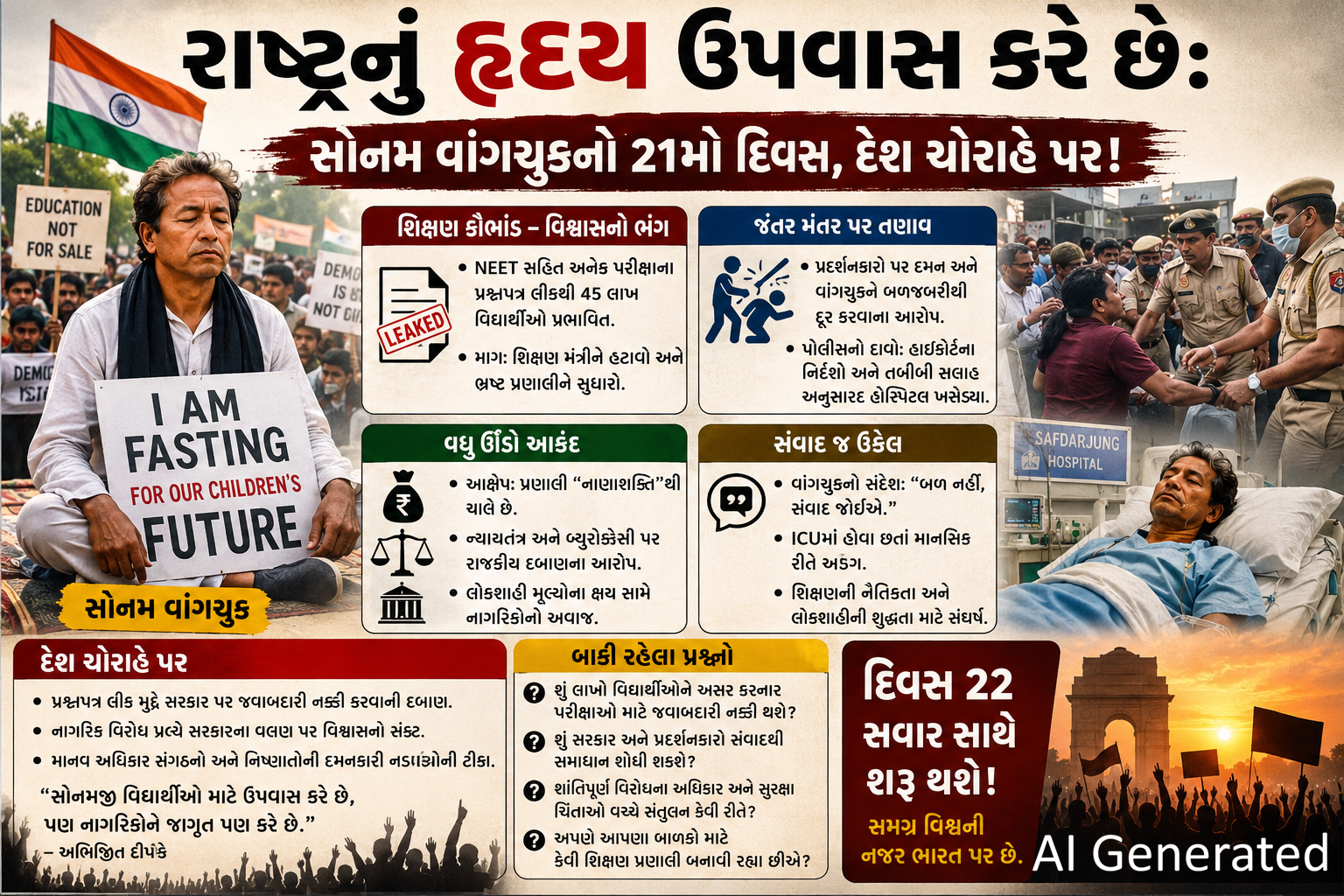
Heart of a Nation Fasting: As the scorching sun set over Jantar Mantar on Saturday, July 18, 2026, the air was thick with a palpable mix of hope and anxiety. Climate crusader, innovator, and beloved educator Sonam Wangchuk entered the 21st day of his indefinite hunger strike, his frail body bearing the weight of a moral crusade that has sparked a national debate far beyond the improvement of India's education system.
The examination paper leaks—affecting multiple competitive exams including NEET and state-level tests—have impacted an estimated 4.5 million students across India this year alone, according to education advocacy groups. What began as a plea for the academic integrity of millions of students has evolved into a searing indictment of governance, touching upon the deepest nerves of democracy, judicial independence, and the ethical decay perceived within India's political establishment.
Tensions at Jantar Mantar: Crackdown or Care? The peaceful protest turned volatile this afternoon as tensions escalated at the site. Leaders and volunteers accused law enforcement of a heavy-handed approach. CJP leader Abhijeet Dipke leveled serious allegations against the authorities, claiming a crackdown on demonstrators and the forcible removal of the activist. "The police didn't just remove him; they crushed the spirit of a peaceful protest," Dipke stated in a heated press briefing outside the gates, his voice trembling with emotion. "Sonam-ji is fasting for the future of India's children, yet the state responds with batons and suppression. This is not the behavior of a government that respects its citizens."
Delhi Police, however, issued a starkly different narrative. A senior police spokesperson confirmed that Wangchuk was shifted to Safdarjung Hospital, not as an act of force, but in strict compliance with directions from the Delhi High Court and on the urgent advice of medical experts. "Mr. Wangchuk's health has deteriorated significantly, particularly his heart condition. The shift was a medical necessity to preserve his life," the spokesperson added, emphasizing that all protocols for the safety of the hunger striker were followed.
The Education Scandal - A Betrayal of Trust: The catalyst for Wangchuk's fast is the scandalous leak of examination papers that occurred months ago, a disaster that has left lakhs of students in a state of limbo and anxiety. For Wangchuk, this is not merely an administrative failure but a systemic collapse. The demand sheet remains non-negotiable: the sacking of the Education Minister under whose watch the leak occurred and a complete dismantling of the system that prioritizes profit over the future of the nation's youth. "How can we expect integrity in our youth when the system that tests them is rotten at the core?" Wangchuk had asked in his last public statement on Day 15. "These papers were not just leaked; the trust of millions was sold. Until the architect of this failure is held accountable, the hunger will continue."
The Deeper Cry - Money Power, Judiciary, and the Democratic Deficit: As the strike enters its third week, the narrative has expanded. For many Indians, Wangchuk's fast has become a proxy for a broader frustration with the perceived erosion of democratic values. The protest site has become a gathering point for citizens demanding a return to ethics, principles, and genuine dialogue.
Critics and supporters of the strike argue that the government's response reflects a deeper malaise: a system allegedly driven by “money power” and a corrupt legal framework. Accusations have surfaced alleging that the judiciary and bureaucracy are no longer independent guardians of the constitution but are bowing to political will, motivated by future benefits like Members of Parliament, Rajya Sabha seats, or Governor posts in various states. "The government is running not on the mandate of the people, but on the leverage of wealth and coercion," protesters argued. "The judiciary, which should be the shield of the citizen, is acting like an extension of the ruling party. This is a new definition of India: pay money to the corrupt ruling party, and bureaucracy acts without using brains or thinking what is right or wrong. They are only concerned with salary, good postings, and where money and power are available," Frustrated protester argued. “We compare this to the British East India Company, but in some ways, this feels worse,” said a student volunteer at the site, holding a placard reading “Democracy is Not a Monopoly.” “The British took our wealth; today, the system threatens to take our voice and our future.”
A Call for Dialogue and Democratic Values: Amidst the accusations, the central plea remains one of dialogue. Wangchuk, known for his rational and solution-oriented approach, has repeatedly emphasized that communication is the only path forward. “The best way to deal with any issue is to sit and talk,” Wangchuk's medical note from Safdarjung Hospital read. “Brute force against a hunger striker is the language of fear. A democratic country must have the courage to listen to its conscience. India is a republic in name, but if we silence those who speak for the helpless, we lose our soul.”
The emotional weight of the situation is heavy. Wangchuk's condition, now monitored in the ICU, serves as a grim reminder of the cost of civil disobedience. Volunteers report that despite his physical weakness, Wangchuk remains mentally resolute, asking them to “keep fighting for the ethics of education and the purity of democracy.”
Nation Watches as Day 21 Ends: As Day 21 comes to a close, the nation stands at a crossroads. The government is under immense pressure to respond to the legitimate grievances regarding the education leak, while simultaneously facing a crisis of trust regarding its handling of civil dissent. The contrast between the peaceful intent of the hunger striker and the alleged heavy-handed response has drawn sharp criticism from human rights groups, legal experts, and opposition leaders. They argue that cracking down on a protest against educational corruption undermines the very values India claims to uphold. “Sonam-ji is fasting for the students, but he is also waking up the citizen,” Dipke concluded. “We demand the education minister be held accountable. We demand the system be cleaned. We demand our democracy be restored. And we demand the government stop hiding behind police force and start showing the courage to engage in dialogue,” Frustrated protester argued.
For now, all eyes are on Safdarjung Hospital and the corridors of power. The question hanging over New Delhi is not just about the health of a climate activist, but about the health of India's democracy, its education system, and its collective moral compass.
The Questions That Remain: As this story unfolds, several questions linger in the national consciousness:
- Will there be meaningful accountability for examination failures that affected millions?
- Can the government and protesters find common ground through dialogue?
- How will India balance security concerns with constitutional rights to peaceful protest?
- Most importantly: What education system are we building for our children?
Day 22 begins at dawn. The world is watching.
0 thoughts on ““Our Children Deserve Better”- Education Reformer Sonam Wangchuk's Day 21 Ignites Soul-Searching Over Education Crisis, Police Action, and the Erosion of Democratic Trust”
Leave a Reply
Your email address will not be published. Required fields are marked *