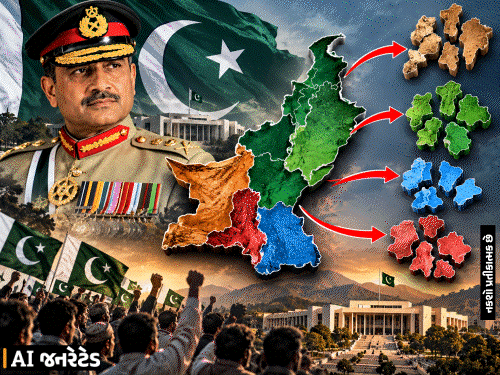
Pakistan's army chief Asim Munir wants to change the entire math of politics by dividing the country's 4 provinces into 12 to 15 parts. According to a report in the British magazine 'The Economist', the move could break the dominance of strong political parties in Punjab and Sindh. At present, the governments of these provinces have the power to challenge the Centre. The creation of smaller provinces will distribute this power and increase Islamabad's interference. This may give the army an opportunity to increase its grip on the country's politics and government. The political power of Punjab and Sindh will decrease Pakistan's Punjab province is a stronghold of the Pakistan Muslim League-Nawaz (PML-N), while Sindh is dominated by the Pakistan People's Party (PPP). The strength of both the parties comes from their strong grip on large provinces. If these provinces are divided into smaller parts, the current political equations can change. Parties will have to prove their strength in different small provinces. This can reduce the influence of big leaders and give the central government more opportunities to intervene in provincial politics. What is the rationale behind smallening the provinces According to 'The Economist', Munir believes that the provinces of Pakistan are so large that the administration is not running properly there. About 12.8 crore people live in Punjab, while in terms of area, the largest province is Balochistan, which has a population of about one and a half crore. It is difficult to reach government facilities to the people in large areas. In rural Punjab, people have to travel long distances for basic services. Even in Balochistan, it is challenging to reach out to remote areas. But Pakistan's deteriorating economy, inflation and debt problems are not just due to the large size of the provinces. In such a situation, the question is how much the division of provinces will change the lives of the common people and who will benefit from the power. In Pakistan, the army is already powerful and the army has directly assumed power many times. Even today, it has a lot of influence in major issues like national security and foreign policy. The army also has land, business and huge resources. In such a situation, if the division of provinces weakens the existing political power, then the dominance of the army and the central government can increase. Instead of the powerful leaders of the big provinces, the Centre will have to deal with many smaller governments. This can reduce the collective power of the provincial leadership. The idea of creating 15 small provinces or giving more power to districts is being discussed in Pakistan on two fronts. First, dividing 4 provinces into 12 to 15 new provinces. Second, giving more powers to about 160 districts, so that people do not have to go far for their work. Planning Minister Ahsan Iqbal has already mentioned both these options. The constitution will have to be changed to create new provinces. On the other hand, giving more powers to the districts will make it easier for people to get government facilities without dividing the existing provinces. What new provinces can be formed? The official map has not yet been released by the government of Pakistan, but the areas under discussion are as follows: Punjab: North Punjab, Central Punjab, South Punjab Sindh: Karachi Sindh, Central Sindh, Upper Sindh KP: Northern KP, Southern KP, Tribal KP/PHATA Region Balochistan: East Balochistan, West Balochistan, Southern Balochistan Sindh is already opposing the proposal The Sindh Assembly passed a resolution on September 3 opposing the division of the province and bringing any part of it under the Centre's control. According to the Constitution of Pakistan, changing the boundaries of a province requires the approval of at least two-thirds of its members of its assembly. The approval of the parliament will also have to be obtained. Sindh is located in Karachi, which is Pakistan's main business center. Changing the boundaries here can lead to a big dispute over political representation and distribution of resources. If the map changes, the calculation of power will also change. The administration can reach closer to the people by making the provinces smaller, but the real question is how many powers the new units will get. If money and decision-making power remain with the center, then the smaller provinces will be separate only in name. The biggest political impact of this whole exercise could be on the current strength of Punjab and Sindh. The weakening of the political grip of large provinces can benefit the Centre and the Army.

RSS News
Divyabhaskar
0 thoughts on “Munir wants to increase his power by changing the map of Pakistan: Ready to divide 4 provinces into 15 parts; The political power of Punjab-Sindh will be weakened.”
Leave a Reply
Your email address will not be published. Required fields are marked *



RECENT NEWS
- Earthquake of magnitude 7.7 and 6.6 shook Panama, collapsed buildings, cracked roads
- Trump fumes over 2026 Nobel Peace Prize to Navi Pillay, calls it 'disgraceful and embarrassing decision'
- 7.6 magnitude earthquake hits Panama
- Munir wants to increase his power by changing the map of Pakistan: Ready to divide 4 provinces into 15 parts; The political power of Punjab-Sindh will be weakened.
- Indian-origin Navanethem Navi Pillay receives Nobel Peace Prize 2026