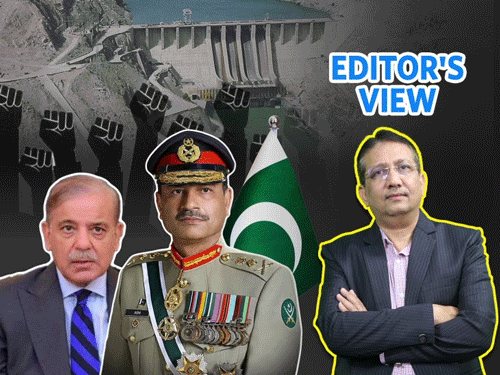
Today we have to talk about a neighbouring country which is now badly trapped in a pit dug by its own hands. Yes, we are talking about Pakistan. The period between 2025 and 2026 has come about a major and historic turning point in the politics of South Asia. At present, Pakistan is in such a terrible cycle from which it sees no way out. From within, the country is crumbling economically, ordinary people are starving, and from the outside its national security is being threatened. You might have heard about different incidents in the news. Somewhere in PoK, people have taken to the streets against the Pakistan Army and are fighting a bloody war. Somewhere Pakistan is trying to hold secret talks with India. At the same time, a fierce preparation is going on for a big water war for the water of rivers. At first glance, these may seem like different issues, but if you dig a little deeper, you will find that they are all links in the same chain. All this points to the shameful downfall of Pakistan. So let's understand the whole incident in a very straightforward and simple way. Hello... Pakistan, which is deceptively calling Azad Kashmir in front of the world, is now raising slogans of independence of its territory in Pakistan-occupied Kashmir (PoK). Since 1947, Islamabad has only exploited its people. But the discontent that began in 2023 has now turned into a revolution by the year 2026. Now this is not just a strike against inflation, it has become an open rebellion. The entire movement is being led by an organization called Joint Awami Action Committee (JAAC). Ordinary businessmen, lawyers, college students and drivers have joined it and they have taken directly to the shores of the Pakistan government. This mass anger did not erupt overnight, there are many terrible reasons at its core: "We don't need Pakistan." After enduring all this torture, the economic opposition to the PoK quickly turned into a political revolution. Thousands of people gathered at the Rawalakot ground and near the border. From here came a voice that disturbed the sleep of the rulers of Pakistan. Sardar Aman Khan, the leader of the JAAC movement of the PoK, openly roared, "The PoK is not a part of Pakistan. We don't need Pakistan, on the contrary, Pakistan needs us." Pakistan's agriculture and economy depend entirely on water from PoK. If Kashmiris stop the water, Pakistan will be finished in a few days. The PoK leaders directly threatened Pakistan that if they starved us, we would be forced to open the LoC towards India and would also start historic trade with India. Hearing this, the Pakistani army lost their senses. When the Pakistan Army saw that people were threatening to turn towards India, out of fear, on June 5, 2026, this peaceful organization JAAC was directly declared a terrorist organization. The Pakistan government has announced a reward of Rs 1 crore each for the capture of the four big leaders. The biggest face was 52-year-old Shaukat Nawaz Mir. Shaukat Mir compared the Pakistan Army to a cruel witch who is eating her own children. Eventually, after a major operation, he was arrested from the Dhirkot area and charged with sedition. The arrest led to an outbreak of violence across PoK, in which more than 30 innocent people were killed in firing by Pakistani Rangers. Look at the Pahalgam massacre and Operation Sindoor, we have to go into flashbacks to fully understand the way Pakistan is currently being trapped in PoK. Because, along with the internal rebellion, Pakistan also made a big mistake on the border, and perhaps the biggest mistake in its history. It's April 22, 2025. In the beautiful Baisaran valley of Anantnag district of Kashmir, which we know as Pahalgam, there was a horrific terrorist attack that transcended the limits of India's patience. This attack was not just a firing, but a conspiracy hatched in the name of a religion. It was noon and terrorists of the Pakistan-backed The Resistance Front (TRF) entered the field through the forests in military uniforms. All these terrorists also had deadly M4 carbines guns. They shot at innocent Indian tourists one after the other. The brutality of the attack was such that the terrorists separated the tourists by asking them for their religion. Look at the fanatical mentality, he asked tourists to read the Islamic scripture for identification. Pahalgam's revenge with Operation Sindoor After that, these mobs brutally targeted only Hindu and Christian tourists. Many of the men were shot at point-blank range in front of their wives. A total of 26 innocent people lost their lives in this massacre. Among them were 25 Indian tourists and one brave local Kashmiri Muslim, who tried to snatch the gun from the terrorists. Investigations revealed that the entire attack was carried out at the direct behest of Lashkar-e-Taiba (LeT) commander Sajid Jatt based in Pakistan. Take a look at how many high-tech items were used by the terrorists in this attack: India's fire rained down on the terrorists from the sky After this brutal massacre, the whole country was outraged. This was the biggest shock since the 2008 Mumbai attacks. The central government has decided that now the water is gone from the head. At midnight on May 7, 2025, the Indian Air Force launched Operation Sindoor. This was no ordinary surgical strike. India directly carried out precision missile strikes on 9 major terror camps deep in Pakistan and PoK. Bases like Bahawalpur and Muridke, which were considered to be extremely safe for Pakistan, were demolished by India overnight. When Pakistan tried to retaliate, India taught it a lesson that it will never forget. On May 9 and 10, India launched a full-fledged strike and destroyed 11 military and airbases in Pakistan. India fired BrahMos and Scalp missiles at major bases like Sargodha and Jacobabad. In this horrific military operation, 20% of the Pakistan Air Force was destroyed permanently. Pakistan's DGMO, who had been beaten up by the surrender of Pakistan and the blow of India, finally had to beg against India on May 10 and requested an immediate ceasefire. In this operation, 6 of our brave soldiers sacrificed their lives and their sacrifices could not go in vain. In the month of July, under Operation Mahadev, our army killed all three terrorists of the Pahalgam attack in the forests of Dachigam. After this entire episode, the Indian government has drawn an iron red-line for Pakistan on the international stage. India has made it clear that this is the reason why Pakistan is now trying to convince India through diplomacy. Did Pakistan hold a secret meeting with India? Now that he had no other option, he had to show the world that India was ready to sit with him at the table and that relations were improving. By June 2026, the international and Pakistani media, especially newspapers like The Express Tribune, suddenly began to publish sensational reports and news that back-channel or track-2 diplomacy between India and Pakistan had resumed in third countries. Rumours were rife that big heads of the two countries were secretly meeting in Bangkok in Thailand and Colombo in Sri Lanka. There was a big and significant difference in the meeting that took place in Colombo, which you must understand. The only difference is that the government of Pakistan had direct and official interference in it, while the Indian government had nothing to do with it. The people of India who went there only gave their personal views and not as an official representative of the Government of India. When these rumours gained momentum in India's political circles, the Indian government immediately took action for damage control. Our Foreign Secretary Vikram Misri accompanied Prime Minister Narendra Modi on a historic visit to Victoria, the capital of Seychelles. From there, he gave a befitting and harsh reply to Pakistan. Vikram Misri told the world in straightforward, clear and clear terms that these meetings were private. There was no support, support or involvement of the Government of India. He went so far as to say in strong language that according to our country's top defence experts, like Shishir Gupta, Pakistan wanted to show the world that we were holding positive talks with India through the back door to bring peace in our country. But India sternly shattered this illusion and convinced Pakistan in its own language that terrorism and talks can never follow the same track. Pakistan will have to pay for its sins. Now let's talk about the biggest game of geographical chess, which is called hydrological warfare or water war in Gujarati. In today's modern times, if you control the main resources of the enemy rather than sending troops and shooting directly, it proves to be more lethal and deadly. India has adopted the same strategy. On the one hand, India started pressing Pakistan's water pipes from the east, and on the other hand, Afghanistan also suffocated Pakistan from the west. Pakistan is now in the grip of a double water crisis from which it is almost impossible to escape. In 1960, the World Bank brokered the Indus Waters Treaty, in which Pakistan received more than 80 per cent of the water of the three western rivers free of cost. For 6 decades, India has shown unilateral generosity with a very big heart and has faithfully complied with this agreement. But after the blood of our innocent tourists was shed in Pahalgam, India suspended this historic agreement without any respect or humility. Just imagine, the entire economy of Pakistan, 25% of its GDP and the lives of more than 230 million people depend on the waters of these rivers. As soon as the water stopped, the fields of Punjab and Sindh province have started drying up. This is proving to be a living economic carnage for the farmers. Pakistan is now crying on global forums after being hit by a fatal blow. Earlier, Pakistan's Defense Minister Khawaja Asif had threatened India, saying that on the other hand, Pakistan's Deputy Prime Minister Ishaq Dar and PPP leader Bilawal Bhutto were going to the world and venting their anger that India was weaponizing water and doing weaponization of water. But India paid no heed to their cries and accelerated the construction of dams on the rivers on a war footing. At a time when India is blocking Pakistan's water from the east, Afghanistan has also opened a new and dangerous front for Pakistan from the west. The biggest and most shocking thing is that the Taliban government of Afghanistan is getting direct strategic and economic support from India. There is no formal water-treaty between Afghanistan and Pakistan over the Kabul River basin, and the same loophole is now being exploited. Afghanistan is building a huge dam on the Kabul River. This is a huge project of 236 million dollars, and the entire project is being built with Indian money and with the help of India's technology. The Kabul River is a lifeline and lifeline for Pakistan's Khyber Pakhtunkhwa province. If all these dams in Afghanistan are completed, then the water received by Pakistan will be reduced by 16 to 17 percent. Pakistan's experts have understood that India is also controlling the flow of water on Pakistan's western borders by investing in Afghanistan. This is called strategic encirclement. The meetings in Kabul in May 2025 show that this is not just a development project, but a murderous strategy to destroy Pakistan. Now combine all these events together and understand India's wonderful grand strategy. PoK insurgency, stiff refusal of secret negotiations, Operation Sindur and East-West water-war. In view of all this, India has a very precise, aggressive and impressive grand strategy of 2026. There was a time when Pakistan used to dream of breaking India with proxy war and terrorism. But today, India has used its smart power to trap Pakistan badly in the web of its own internal disputes and geographical boundaries. There are four parameters of this strategy, which are very important to understand: first, the unrest in PoK and the complete elimination of Pakistan's Kashmir propaganda. Pakistan had been crying falsely in the name of Kashmir at the United Nations for decades. But now the people of PoK are openly raising slogans that Kashmir is not a part of Pakistan. Second, two-pronged water-tightening and economic embarrassment. India has made water a formal weapon. This is India's amazing and terrifying ability to economically cripple Pakistan without firing a single shot. Thirdly, Operation Sindoor proved that Pakistan could no longer fight a conventional war with India. The Taliban on the Afghan border, the insurgency in Balochistan, the terrorist attacks in the Khyber Pakhtunkhwa province and now the opposition to PoK. Pakistan, which is fighting on so many internal fronts, will be permanently torn to pieces if it takes on India. Fourth, during Operation Sindhur, the President and Vice President of the United States of America, J.D. Vance ruled out any US interference, terming it as a territorial matter of India. Russia, France and Japan are also fully with India. At the international level, no one weighs India and Pakistan on the same scale. The bitter truth is that the grave that Pakistan had dug for itself by walking on the path of terrorism is now buried in the form of the PoK insurgency and water war. The big question now is whether Pakistan will survive in the future of South Asia. On the other hand, India is moving towards becoming a global superpower in the year 2026. And finally... Himachal Pradesh Governor Kavinder Gupta said that Pakistan is making a big mistake in PoK like Bangladesh in 1971. So Pakistan is now going to cut itself into pieces. First Bangladesh was separated and now it is almost PoK's turn. Monday through Friday, every night at 8 p.m., stay tuned to Editor's View. See you again tomorrow, Namaskar. Research & Analysis: Sameer Parmar | Samir Parmar)

RSS News
Divyabhaskar
0 thoughts on “Editor's View: The fire of insurgency ignited in PoK: Pakistan is in danger of being broken up, a new game of secret talks with India has been played, accurate analysis of three links to the collapse”
Leave a Reply
Your email address will not be published. Required fields are marked *


RECENT NEWS
- Wife assaults husband in house quarrel: Wife beats husband on the head with a wooden stick for refusing to keep his son, husband files police complaint against wife
- Traffic diversion for flyover operation on Sama-Savli Road: Motorists will have to use alternate routes for the next three-and-a-half months
- 'I want to tell the government to give us justice, if a big man had died, the accused would have been in jail'
- Tarot Horoscope for July 02: The most beautiful phase of love life for Cancer, Aries will remove the clouds of illusion and doubt
- Editor's View: The fire of insurgency ignited in PoK: Pakistan is in danger of being broken up, a new game of secret talks with India has been played, accurate analysis of three links to the collapse