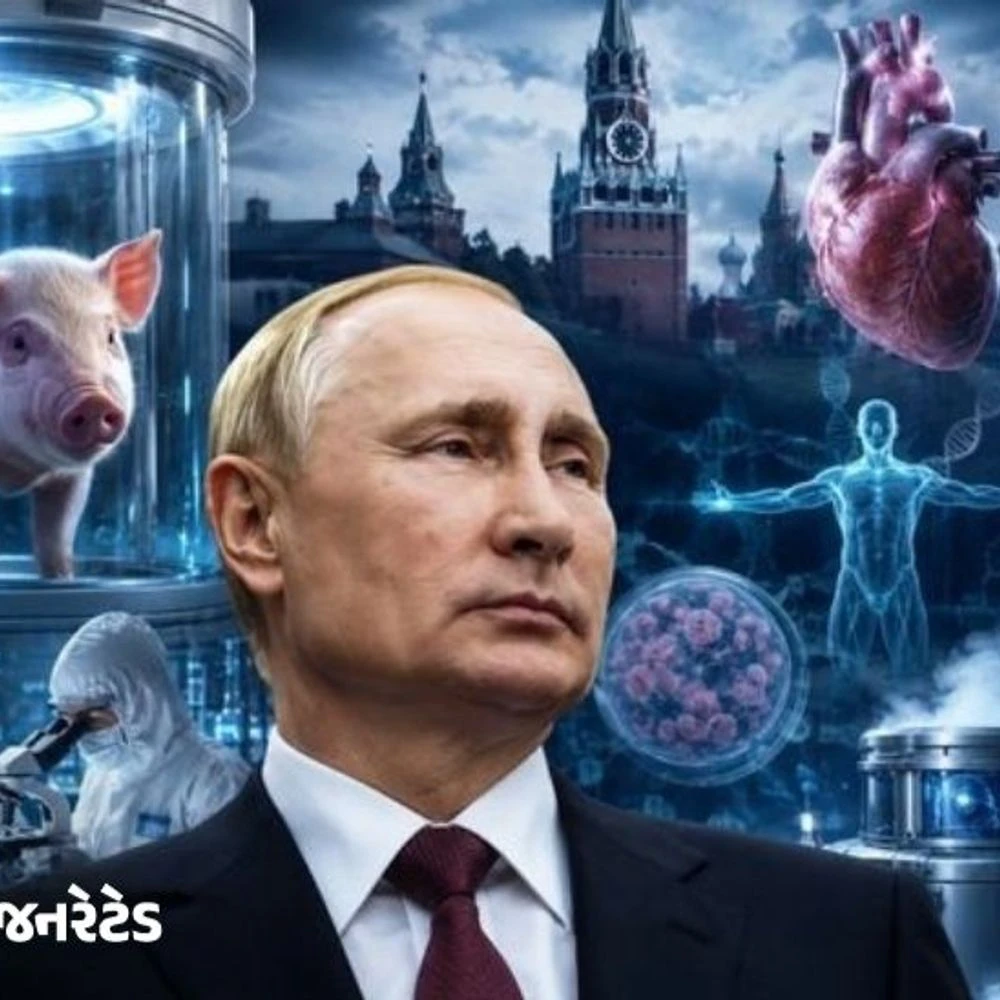
Russian President Vladimir Putin has launched a massive government project worth $ 26 billion (about Rs 2.47 lakh crore) to prevent ageing and physical weakness. The program, called 'New Health Preservation Technologies', will focus on techniques such as growing human organs inside mini-pigs. According to a report in The Wall Street Journal, the project will also work on techniques such as gene therapy, preparing human organs in the lab and cryotherapy at very low temperatures. The Russian government claims that the mission aims to slow down the aging process and save the lives of about 1.75 lakh people by the end of the decade. Russia's Deputy Science Minister Denis Sekirinsky said in April that scientists were developing gene therapy that could slow down the aging process of the body's cells. He called it one of the most important research in the direction of anti-aging. A large part of this project is based on bioprinting. In this, living tissues and organs are prepared with the help of a 3D printer. Russian scientists claim that they have already prepared human cartilage and the thyroid gland of mice. The goal is to complete human organ replacement by 2030. At the same time, Russia is also working on developing human liver, kidneys and hearts inside genetically modified mini-pigs. Scientists believe that this could address the shortage of organ transplants in the future. According to reports, Putin has been undergoing cryotherapy and peptide therapy for a long time. Russian scientist Vladimir Khavinson gave Putin special peptides made from calf tissue. They supported anti-aging treatment through peptide therapy. He claimed that a person can live up to 120 years. It is said that Putin also uses cryotherapy to keep himself young. In this, the body is kept at a temperature of about minus 112 degrees Celsius for a while. Former Austrian Chancellor Sebastian Kurz said Putin explained the benefits of the therapy to him in detail during a Kremlin meeting in 2018. Putin and Chinese President Xi Jinping discussed 'living 150 years' with Xi Jinping During a military parade in Beijing last year, there was a lot of discussion. However, he was heard talking about extending life by transplanting human organs and the possibility of humans living up to 150 years. The conversation was recorded on a hot-mic recording. At the time, it was considered a casual conversation between the two elderly leaders, but now it is being linked to Russia's longevity government plan. The 73-year-old Putin has long portrayed himself as a powerful and fit leader. His photographs of horseback riding, ice hockey, hunting and motorcycle riding have been doing the rounds frequently. Many of Putin's closest associates are now over 70 years old. In such a situation, this anti-aging mission is considered not only a scientific experiment, but also related to the personal concerns of the top leadership of Russia's power. The average age of men in Russia is only 68 years, which is much lower than in the United States (76 years) and Europe (80 years). Putin's dream project is being handled by his doctor daughter Maria Vorontsova and his closest scientist Mikhail Kovalchuk. Maria Vorontsova is an endocrinologist (specialist doctor in hormones and diabetes) and is involved with several government genetics programs in Russia. The other big face is Mikhail Kovalchuk, the head of the Soviet-era Kurchotov Institute. He is considered to be the main ideological face of this anti-ageing mission. Kovalchuk has said many times that science will soon give humans the ability to constantly change and repair body parts. Scientists raise questions Many questions are also being raised on this project of Russia. Alexander Ostrovsky, a scientist involved in bioprinting research, says that if the results of the research are not being published in major international journals, it is difficult to fully trust these claims. Ostrovsky said Russian scientists have been largely cut off from the world due to sanctions from Western countries. It is not easy to advance in science in isolation from the world, it may be that Putin is being told the same things he wants to hear in order to get funding. According to reports, Russia's anti-aging research is based on less verified studies than in Western countries. However, the scientists involved in this project are considered very powerful and influential in Russia.

RSS News
Divyabhaskar
0 thoughts on “Putin's Rs 2.47 lakh crore anti-aging project: Work begins on growing human organs inside mini-pigs, aims to slow down aging”
Leave a Reply
Your email address will not be published. Required fields are marked *


RECENT NEWS
- Report: Iranian President Pazzakian sends resignation to Supreme Leader: Blame-Power under the control of IRGC commanders; Senior official rejects claims of resignation
- Balen Shah's 'Nepal encroached India's territories' remark triggers row. What did he actually say?
- Trump claims Iran agreed to 'no nuclear weapons' but Tehran says no deal unless 'rights secured'
- Kenneth Law was found guilty of 14 counts of inciting people to commit suicide, sending 1,200 poisonous packets to 41 countries.
- Putin's Rs 2.47 lakh crore anti-aging project: Work begins on growing human organs inside mini-pigs, aims to slow down aging