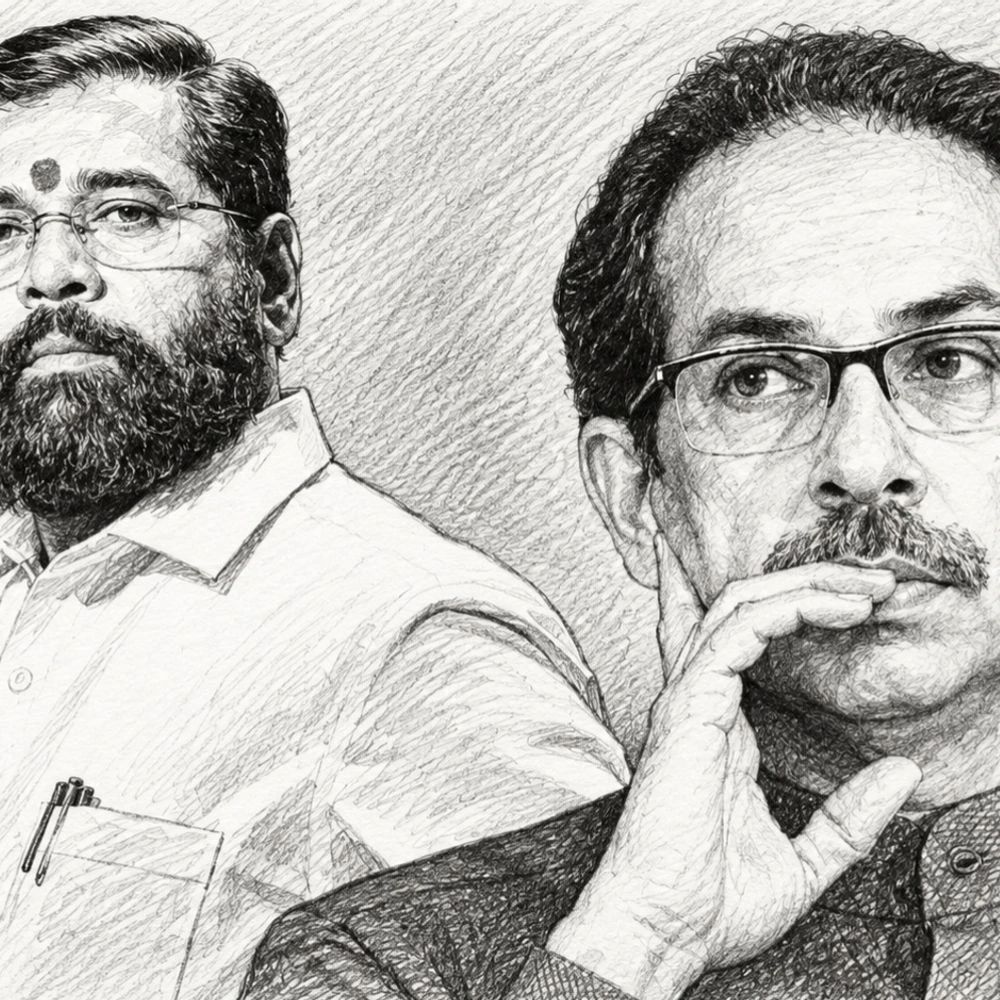
The Supreme Court heard the Shiv Sena's election symbol controversy. The court asked how the spirit of the party symbol would apply to defectors. A bench of Chief Justice Surya Kant, Justice Joymallya Bagchi and Justice V. Mohana raised the question. The bench was hearing petitions challenging the Election Commission's decision to give the bow-arrow symbol to the Eknath Shinde group. During the hearing, Shinde group's counsel Neeraj Kishan Kaul argued. He said that the decision taken by the Election Commission on the basis of the MLA majority was legally appropriate and relevant. The Supreme Court had earlier also asked whether the Election Commission could have refused to give the reserved bow and arrow symbol to both the groups. The court also questioned whether the number of MLAs whose membership cancellation proceedings are underway can be considered as a safe basis for a majority. Justice Bagchi's question Justice Bagchi asked how the party's election symbol would work if the members facing disqualification proceedings later lose their membership. "The political party has freedom. If the disqualified members leave, the remaining members get a separate election symbol. You just had to read Sadiq Ali's judgment." Justice Bagchi then asked, "Will the spirit of the election symbol apply to those who have committed a constitutional sin? Or for those who have complained of a constitutional sin?" He also questioned the determination of ground support on the basis of the number of members of the organisation. Justice Bagchi said that it may be difficult to do so in the confused situation of Indian politics. Neeraj Kishan Kaul, arguing for the Shinde group, referred to several Supreme Court judgments. He supported relying on the test of the Election Commission's legislative majority. Kaul said the criterion for determining which group is a political party under the Election Symbols (Reservation and Allocation) Order is legally appropriate and relevant. Citing a judgment, Kaul said it did not say that the effect of disqualification would necessarily apply from a retrospective date. He said that the judgment pertained to a situation in which the party was considered to be split even before the disqualification petitions were decided by the Speaker. The court directed that the decision on disqualification should be taken on the basis of the circumstances at the time the petitions were filed. Kaul also referred to the Constitution Bench's judgment in the Subhash Desai case. He said the judgment did not prohibit the use of the MLA majority test. He said that while deciding disqualification petitions under Section 2(1)(a) of the Tenth Schedule of the Constitution, the Speaker may first have to decide which of the opposition groups is a political party. According to Kaul, the Speaker should examine the constitution of the party and the rules related to its leadership. If different versions of the party's constitution come to light, the version submitted to the Election Commission should be considered before the groups are separated. He said that after examining all the necessary aspects, if a constitutional authority deems it appropriate, the legislator majority test can be applied. The senior counsel said that the election symbol should be given to the group which proves that it is the real political party. If no group can prove this claim, the situation will be different," he said. Justice Bagchi asked if the party's constitution does not provide a clearly democratic organisational structure, can the organisational test adequately reflect ground support. Argue on majority figures Kaul said that the 40 MLAs supporting Shinde represent 76 per cent of the total votes cast in favour of the 55 Shiv Sena MLAs who won the 2019 Maharashtra Assembly elections. He also cited the Lok Sabha figures. Kaul said the 13 MPs supporting Shinde represent 73 per cent of the total votes cast in favour of the party's winning 18 MPs. He said that the Election Commission cannot be prevented from taking a decision on the dispute over the party's election symbol under Article 15 just because the disqualification proceedings are pending. Kaul also said that the 2019 Maharashtra Assembly has been dissolved. A new assembly has already been formed after the 2024 elections. What is challenged in the petitions The main petition has been filed by Sunil Prabhu of the Uddhav Thackeray faction. It has challenged the decision of the Maharashtra Assembly Speaker on January 10, 2024. The Speaker refused to disqualify the MLAs of the Shinde group under the Tenth Schedule. A related petition filed by Uddhav Thackeray has challenged the Election Commission's decision to recognise the Shinde group as the official Shiv Sena. Under the same decision, the Shinde group was also allotted the party's bow and arrow election symbol. The hearing in the Supreme Court could not be completed. The hearing in the matter will continue on Wednesday as well.

RSS News
Divyabhaskar
0 thoughts on “Shiv Sena's election symbol controversy, Supreme Court says defection is a constitutional sin: Election Commission could have given different symbols to both; The controversy has been going on for 4 years.”
Leave a Reply
Your email address will not be published. Required fields are marked *


RECENT NEWS
- Kiren Rijiju, who disliked Kapil Sibal, praises him, says 'I am now he...'
- West Bengal DGP Siddha Nath Gupta's tenure extended
- Kumar Rohit's column: The dream of a developed India will not be fulfilled without the development of Bihar.
- Shekhar Gupta's column: Is India really a "soft-state"?
- India lost to Australia by 125 runs, the entire team was all out for 149 runs.