When Every Anti-Corruption Crusade Becomes the Very System, It Swore to Dismantle, India Must Ask Harder Questions About Power, Money, and Accountability
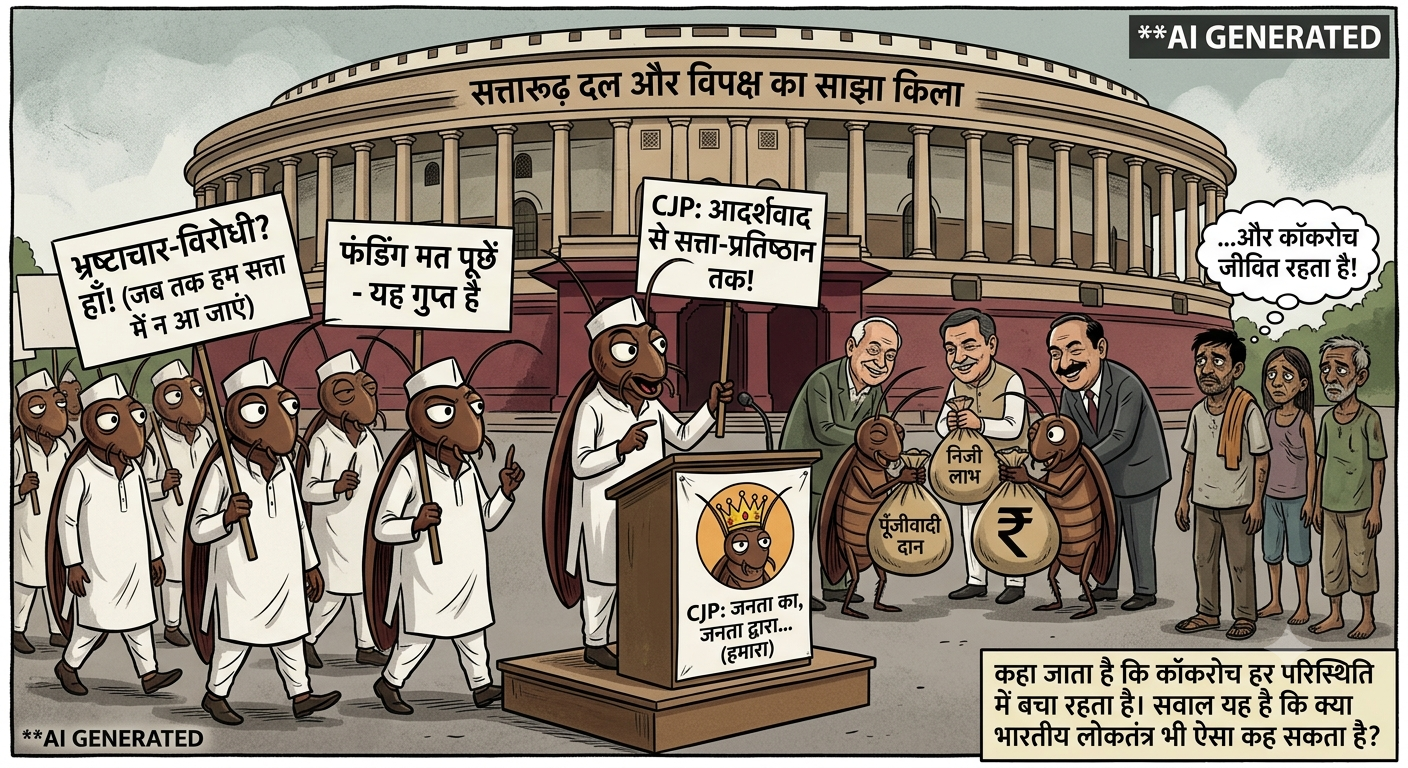
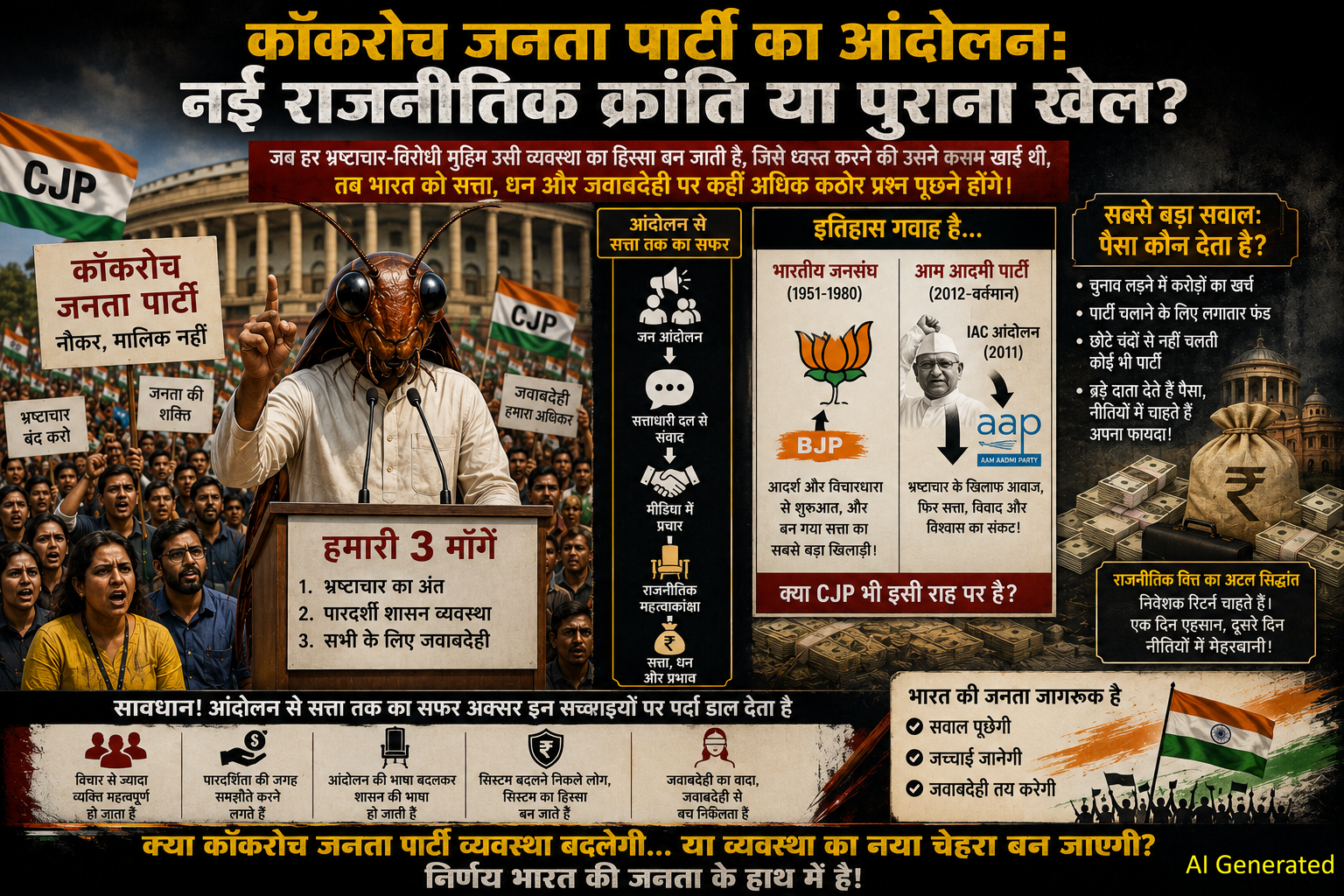
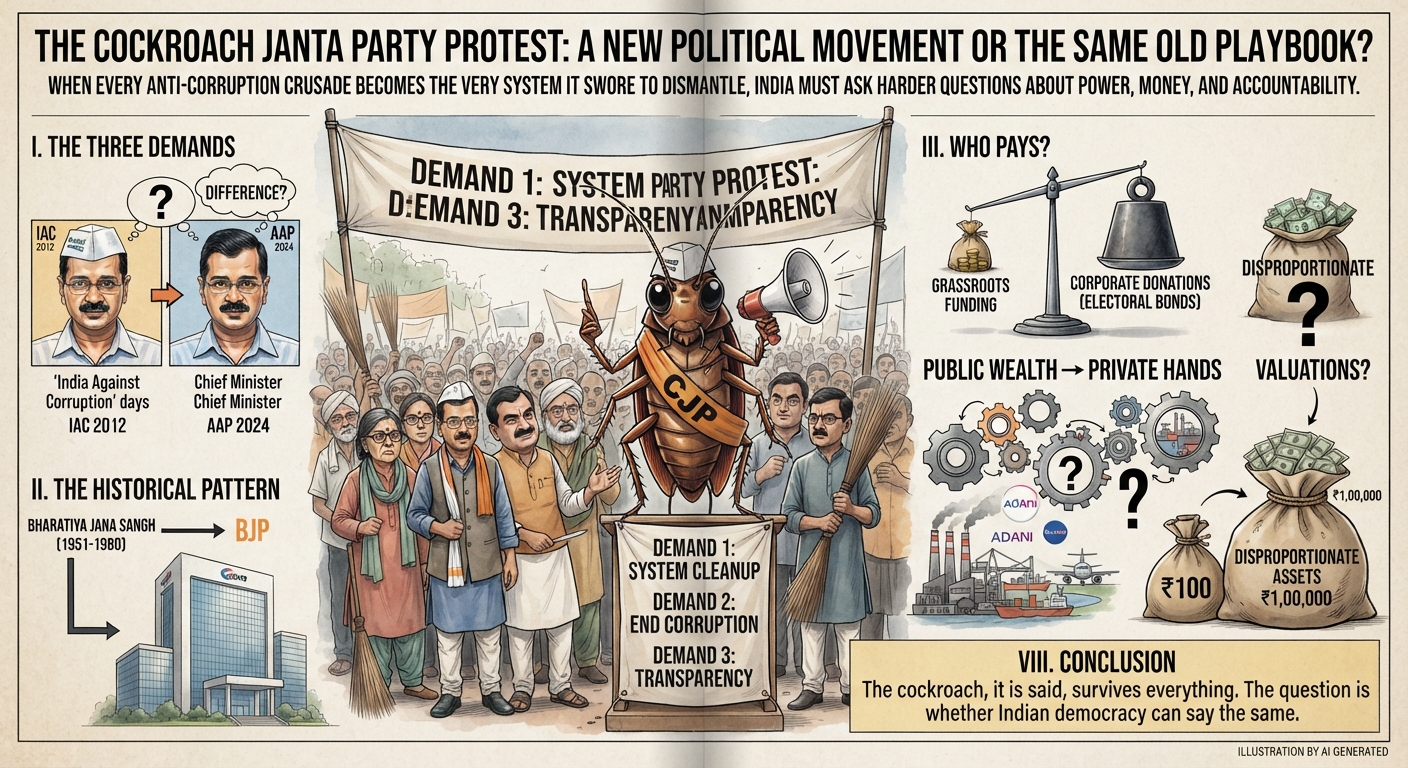
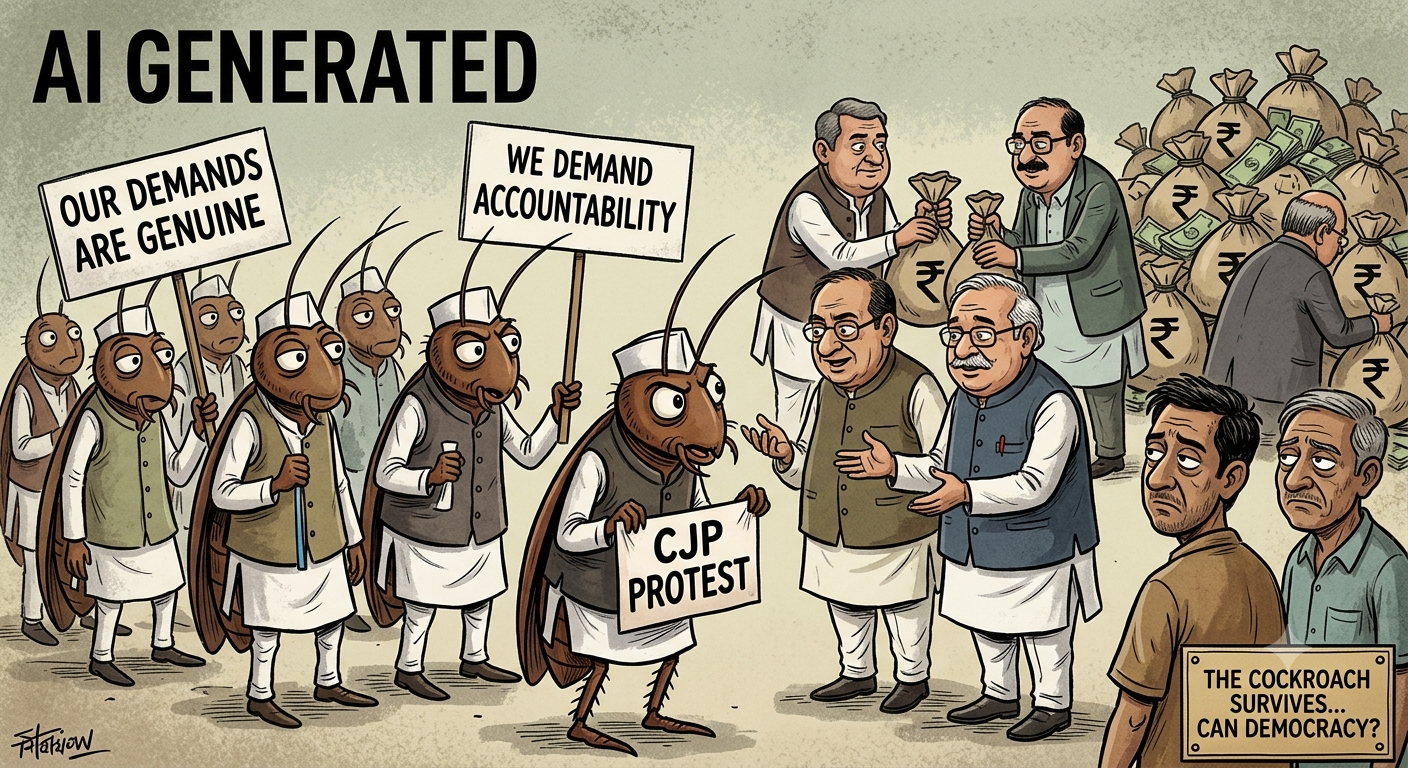
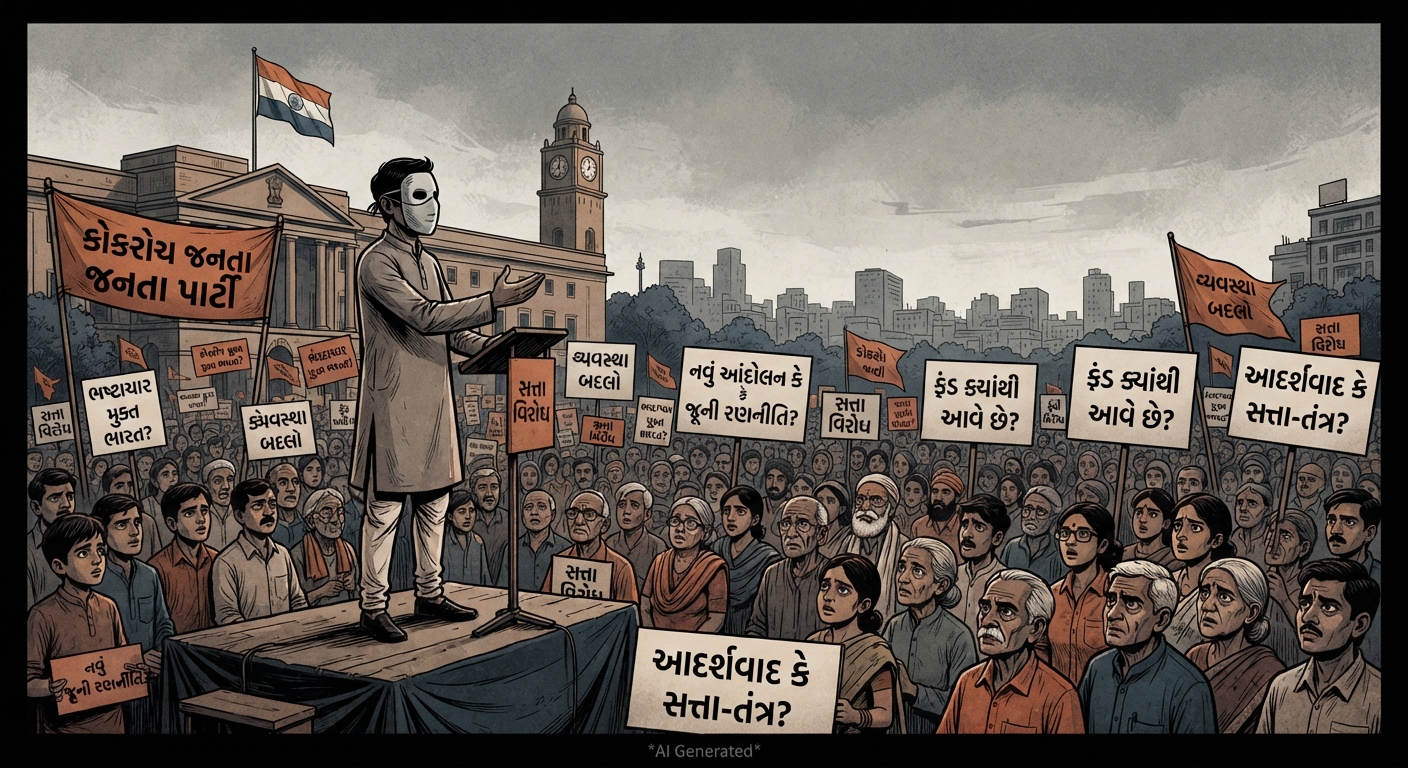
In a familiar tableau that has played out repeatedly across India's democratic landscape, the Cockroach Janta Party (CJP) has launched a high-profile public protest, complete with demands directed at the ruling dispensation, media-friendly optics, and the unmistakable ambition of political relevance. The party has put forward three demands and entered into public discussions with the ruling party — moves that, on the surface, suggest genuine civic engagement.
But beneath the choreographed outrage lies a pattern so deeply embedded in Indian political history that it demands rigorous, unflinching scrutiny: Is the CJP a genuine force for systemic reform, or is it the latest iteration of a well-worn strategy — leveraging anti-corruption sentiment to build a political career, attract financing, and ultimately reproduce the very corruption it claims to oppose? This is not cynicism. This is evidence.
I. THE THREE DEMANDS: SUBSTANCE OR SPECTACLE?
The CJP's three demands - presented through structured dialogue with ruling party representatives - have garnered significant media attention. The party's leadership has positioned itself as the voice of ordinary citizens demanding accountability from an entrenched political establishment.
However, seasoned political analysts and governance experts have raised a pointed question: Are these demands designed to solve problems, or to generate headlines?
"The strategy is textbook," said a senior political scientist at the Centre for Policy Research, speaking on condition of anonymity. “You identify a genuine public grievance, you articulate demands that sound reasonable, you force the ruling party into a public conversation, and suddenly you are a 'national figure.' The demands themselves become secondary to the visibility they generate.”
The critical distinction between activism and political ambition is this: activism seeks resolution; political ambition seeks perpetuation. A movement that genuinely wants its demands met would welcome quiet, effective negotiation. A movement that wants to remain in the news requires unresolved conflict, ongoing drama, and a permanent enemy. The Indian public must ask: What does the CJP truly want?
II. THE HISTORICAL PATTERN: FROM IDEALISM TO ESTABLISHMENT
The CJP's trajectory is not without precedent. India's post-independence political history is littered with movements that began as anti-corruption crusades and ended as power structures indistinguishable from those they replaced.
A. Bharatiya Jana Sangh (1951–1980): The Bharatiya Jana Sangh, founded in 1951 by Syama Prasad Mukherjee, positioned itself as an ideological alternative to the Congress system - rooted in cultural nationalism and clean governance. After merging into the Janata Party in 1977 and subsequently reconstituting as the Bharatiya Janata Party (BJP) in 1980, the movement evolved from an ideological crusade into one of the most powerful political machines in global democracy.
B. The Aam Aadmi Party (2012–Present): Perhaps the most instructive - and cautionary - parallel is the Aam Aadmi Party (AAP). The India Against Corruption (IAC) movement, led by Anna Hazare beginning in 2011, mobilised millions of Indians around a single, powerful demand: the enactment of the Jan Lokpal Bill, an anti-corruption ombudsman with prosecutorial teeth. Arvind Kejriwal, a former Indian Revenue Service officer and Ramon Magsaysay Award recipient, was among the movement's most prominent faces. In November 2012, Kejriwal formally launched the AAP, converting civic activism into electoral politics. The party's founding promise was radical transparency, participatory democracy, and zero tolerance for corruption. Arvind Kejriwal became Chief Minister of Delhi - a VVIP of the Indian Republic, with security detail, official residence, government machinery, and all the apparatus of state power. And then came the questions. Allegations of financial irregularities, controversies over the Delhi excise policy, arrests of senior party leaders, and internal dissent began to erode the party's foundational claim of being "different." Whether these allegations are politically motivated or substantively valid is a matter for courts to adjudicate. But the perception - the gap between promise and practice - has been devastating.
III. THE CJP AND THE INEVITABLE QUESTION: WHO PAYS?
This brings us to the most uncomfortable truth in Indian democracy, one that no political party- ruling or opposition, old or new - has ever adequately addressed: Running a political party requires money. And money demands return. The CJP, like every political formation before it, must answer a fundamental question: Who is financing this movement, and what do they expect in return? This is not an accusation. This is an economic reality.
The Mathematics of Political Funding in India - Consider the basic economics: Election campaigns require crores of rupees - for advertising, rallies, transportation, voter outreach, and the extensive ground machinery necessary in a nation of 1.4 billion people. Party infrastructure - offices, staff, communication systems, legal teams - requires sustained funding. No political party in India has ever been fully funded by small individual donations. Despite claims of grassroots financing, the reality is that large donors - corporate houses, business interests, wealthy individuals - provide the bulk of political funding. The now-defunct electoral bonds scheme revealed that anonymous, large-scale corporate donations formed the financial backbone of virtually every major political party in India.
The iron law of political finance is this: investors expect returns. A corporation that donates ₹100 crore to a political party does not do so out of patriotic sentiment. It does so because it expects policy outcomes - mining leases, spectrum allocations, infrastructure contracts, regulatory forbearance, tax concessions - that will generate returns many multiples of its investment. This is not corruption in the narrow, legal sense. This is corruption as a structural feature of the system.
The CJP's leadership must be asked — publicly, repeatedly, and with insistence:
1. What are your funding sources?
2. What commitments, explicit or implicit, have been made to your funders?
3. How will you ensure that financial dependence does not compromise your stated principles?
If the answers are evasive, the public should draw its own conclusions.
IV. THE REAL CRISIS: PUBLIC RESOURCES SOLD TO PRIVATE INTERESTS
Beyond the CJP's immediate protest lies a far deeper malaise that no single political party has shown the willingness or capacity to address: the systematic transfer of public wealth to private hands at rates that defy market logic, competitive fairness, and public interest.
The Evidence Is in Plain Sight
Reliance Industries: In the period 1980–1985, during the later years of Indira Gandhi's government and the early tenure of Rajiv Gandhi, Dhirubhai Ambani's Reliance Industries grew from a textile trading company to a petrochemical conglomerate of staggering scale. This growth was enabled by:
- Preferential allocation of industrial licenses under the License Raj.
- Import permits and customs duty structures that favoured Reliance over competitors.
- Access to government decision-makers that smaller enterprises could not match.
The Bajaj Group: Similarly, the Bajaj Group benefited enormously from the scooter and automobile licensing regime of the 1970s and 1980s, where government-granted monopolies or near-monopolies allowed selected industrial houses to dominate markets not through competition, but through regulatory exclusion of competitors.
Adani Group (2002–Present): The most contemporary and politically charged example is the Adani Group's extraordinary expansion beginning in year 2002 — coinciding with Narendra Modi's ascent as Chief Minister of Gujarat and later as Prime Minister.
The facts:
- Adani's market capitalisation grew from approximately ₹1,000 crore in the early 2000s to over ₹20 lakh crore at its peak - a growth rate that even the most optimistic business projections struggle to explain through market forces alone.
- The group received land allocations, port concessions, airport contracts, power purchase agreements, and mining leases from both state and central governments.
- The Hindenburg Research report (January 2023) alleged stock manipulation, accounting fraud, and improper use of offshore entities — allegations the Adani Group has denied, and which are under examination by Indian courts and regulatory bodies.
- The pattern across decades and political dispensations is consistent: select business houses receive public resources - land, spectrum, minerals, infrastructure contracts – at valuations that appear to be significantly below market rates, generating extraordinary private wealth from what was, by right, public property.
This is not capitalism. This is oligarchy enabled by political patronage. And it occurs under Congress, BJP, regional parties, and - if the AAP experience is any guide - under self-proclaimed anti-corruption parties as well.
V. THE WEALTH THAT NO ONE CAN EXPLAIN
Perhaps the single most damning indictment of India's governance system is the inexplicable wealth accumulation of its public servants.
A Hypothetical That Is Not Hypothetical at All: Consider a government official - a bureaucrat, an MP, an MLA, a municipal councillor, or a mid-level government employee - whose annual declared salary is, illustratively, ₹100. After a career of public service, this individual's accumulated wealth is ₹1,00,000 - one thousand times their legitimate income.
How?
This is not a rhetorical question. It is an evidentiary one. And in case after case, across every state, every party, and every level of government, the answer is the same:
- Land deals at below-market rates, facilitated by insider knowledge of upcoming infrastructure projects.
- Government contracts awarded to family members or associates.
- Bribes and commissions on procurement, licensing, and regulatory approvals.
- Benami (proxy) ownership of properties, businesses, and financial assets.
- Disproportionate assets - the legal term for wealth that cannot be explained by known sources of income.
The Numbers: According to the Association for Democratic Reforms (ADR):
- Over 40% of elected MPs in the 18th Lok Sabha (2024) are crorepatis, with an average declared asset base exceeding ₹50 crore.
- The average declared assets of winning candidates have increased by over 600% in the last two decades.
- Numerous sitting and former chief ministers, union ministers, and senior bureaucrats have faced disproportionate assets cases, though conviction rates remain abysmally low.
- The system does not merely tolerate this. The system incentivises it. Entry into politics is, for many, an investment decision - the anticipated returns on the "investment" of contesting elections (which itself costs crores) are factored into the decision to enter public life.
Zero Accountability - Zero Explanation: Despite constitutional provisions, the Right to Information Act, the Lokpal and Lokayuktas Act, and various anti-corruption statutes, there is no effective, enforced mechanism that compels public servants to explain the gap between their income and their wealth.
- Asset declarations are filed but rarely audited.
- Lokpal investigations are slow, under-resourced, and politically constrained.
- The Enforcement Directorate and CBI are perceived - rightly or wrongly - as instruments of ruling party power rather than independent investigative bodies.
- Judicial processes take decades, by which time the wealth has been laundered, transferred, or consumed.
The ₹100 to ₹1,00,000 gap is not a mystery. It is a confession - written in property registries, bank statements, and corporate filings - that the Indian state is being systematically looted by those entrusted to serve it.
VII. IS A CORRUPTION-FREE INDIA POSSIBLE? THE RADICAL ARGUMENT
Given this entrenched, self-perpetuating system, some governance scholars and constitutional thinkers have advanced a radical proposition: A corruption-free India is structurally impossible as long as political parties exist in their current form.
The argument, stripped to its essentials, is this:
1. Political parties require money.
2. Money comes from those who seek favourable policy outcomes.
3. Favourable policy outcomes for donors necessarily mean unfavourable outcomes for the public (since public resources are finite — every sweetheart deal for a corporate donor is a loss for the public treasury).
4. Therefore, the very existence of privately funded political parties guarantees corruption.
The Dissolution Proposal: Some constitutional theorists - though this remains a fringe position - have suggested that the President of India or the Chief Justice of India should be empowered to dissolve political parties that fail to meet stringent transparency, accountability, and ethical standards.
What is not debatable is the underlying diagnosis: India's political party system, as currently structured and financed, is inherently corrupting. No individual - however honest, however idealistic - can enter this system and remain untransformed by it. The AAP experiment has demonstrated this conclusively.
VIII. CONCLUSION: THE SYSTEM IS THE SCANDAL
The Cockroach Janta Party's protest is, ultimately, a symptom - not a solution. The real scandal in Indian democracy is not any single party's corruption. The scandal is the system itself:
- A system where public resources worth lakhs of crores are transferred to private interests at sub-market valuations.
- A system where political parties are funded by the very interests they are supposed to regulate.
- A system where public servants accumulate wealth one thousand times their legitimate income with no accountability.
- A system where around 800 million citizens depend on government subsidies while a handful of politically connected oligarchs accumulate wealth that rivals the GDP of small nations.
- A system where every anti-corruption movement eventually becomes a corruption-enabled political party, because the gravitational pull of money and power is stronger than any individual's idealism.
- India does not need another political party. India does not need another protest. India does not need another leader who promises to be different.
- India needs a structural transformation of its political financing, its accountability mechanisms, and its relationship between public resources and private power.
Until that transformation occurs - through constitutional reform, judicial activism, or sustained citizen mobilisation that refuses to be co-opted into party politics - the cycle will continue.
New parties will rise. They will protest. They will make demands. They will win elections. Their leaders will become VVIPs. Their funders will receive their returns on investment. And the citizens of India will continue to subsidise both their own poverty and their leaders' wealth. The cockroach, it is said, survives everything. The question is whether Indian democracy can say the same.
0 thoughts on “The Cockroach Janta Party Protest: A New Political Movement or the Same Old Playbook?”
Leave a Reply
Your email address will not be published. Required fields are marked *



RECENT NEWS
- Miya George shares picture with Mammootty
- Sylvester Stallone talks about starring in ‘Tulsa King’ along with his daughter
- Tiger Shroff firing incident prompts FWICE security advisory
- ITBP Raising Day: PM Modi praises ‘Himveers’ as India-China border management remains in focus
- 'Jailer 2' faces controversy in Tamil Nadu