On October 19, 2014, the Narendra Modi government announced with great fanfare that petrol and diesel prices would henceforth be "deregulated" and linked to international market prices. It sounded like a reform. It turned out to be a one-way valve — open to price hikes, permanently sealed against price cuts.
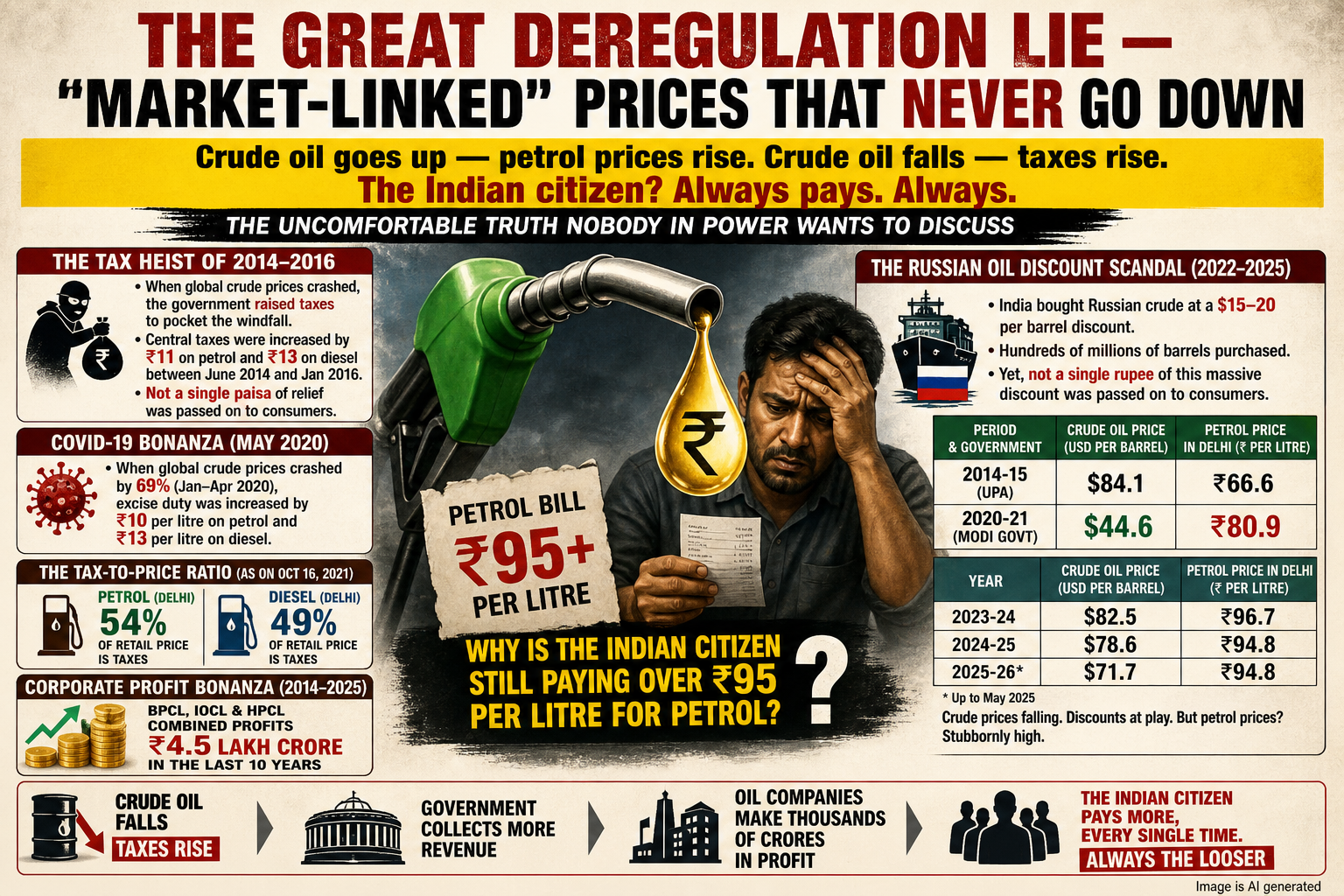
The Tax Heist of 2014–2016: The evidence is damning and in the public domain. Between June 2014 and October 2018, the retail selling prices did not adhere to changes in global crude oil prices. The global prices fell sharply between June 2014 and January 2016, and then subsequently increased between February 2016 and October 2018. However, the retail selling prices remained stable during the entire period. This disparity was because of the subsequent changes in taxes. Central taxes were increased by Rs 11 and Rs 13 between June 2014 and January 2016 on petrol and diesel respectively.
To put it plainly: when global crude prices crashed, the government swiftly raised taxes to pocket the windfall — leaving Indian consumers with not a single paisa of relief. Why did petrol prices rise significantly after 2014? The government increased excise duties to increase revenue, while global crude oil price fluctuations and currency depreciation also contributed to price hikes. Then came the COVID-19 bonanza. During January–April 2020, following a sharp decline of 69% in the global crude oil prices, the central government increased the excise duty on petrol and diesel by Rs 10 per litre and Rs 13 per litre, respectively in May 2020. The tax-to-price ratio became grotesque. The break-up of retail prices of petrol and diesel in Delhi (as on October 16, 2021) shows that around 54% of the retail price of petrol comprised central and state taxes. In the case of diesel, this was close to 49%.
The Russian Oil Discount Scandal (2022–2025): Here is perhaps the most glaring example of governance duplicity in independent India's energy history. After Western nations sanctioned Russia, India quietly became one of the largest buyers of deeply discounted Russian crude oil. Russia was still able to find a market for the majority of its production by offering discounts in the order of $15–20 per barrel. India bought hundreds of millions of barrels of this discounted oil. OPEC+ nations ramped up production over 2025, adding to a supply glut. The excess crude is why West Texas Intermediate was safely trading below $60 a barrel until recently.
Yet not a single rupee of this massive discount was passed on to the Indian consumer. The arithmetic tells the story with brutal clarity: During the tenure of Manmohan Singh, the price of crude oil stood at USD 110 per barrel. At that time, the retail prices of petrol and diesel in India hovered around Rs 60. However, when PM Modi's government came to power, the price of crude oil dropped from USD 110 to USD 40 per barrel; yet the retail price of petrol surged from Rs 60 to Rs 90.
Crude oil prices in the last three years of the Modi government were: $82.5 per barrel in 2023-24, $78.6 in 2024-25 and $71.7 in 2025-26. The per litre petrol prices in Delhi in these three years respectively were Rs 96.7, Rs 94.8 and Rs 94.8. Compared to the Manmohan Singh government, the Modi government was buying crude oil at a much lower price until now, but consumers in India were paying much more than they paid during the previous regime. In 2014-15, when the Congress-led government was buying crude oil at $84.1 per barrel, the petrol price in Delhi was Rs 66.6 per litre. In 2020-21, when the Modi government was buying crude oil at $44.6 per barrel — almost half of what the previous government paid six years earlier — people in Delhi were buying petrol at Rs 80.9 per litre, Rs 14 more than what they were paying six years back.
Additionally, over this period, the monthly and quarterly reports submitted to the stock market by companies like BPCL, IOCL, and HPCL reveal profits running into thousands of crores. Over the last ten years, these companies have collectively earned a profit of Rs 4.5 lakh crore. The question that screams from every petrol pump receipt: If companies are making Rs 4.5 lakh crore in profit, if India is buying Russian oil at a $15–20 per barrel discount, if crude prices have fallen to $60 or below — why is the Indian citizen still paid over Rs 95 per litre for petrol?
For over a decade, Indian citizens have been repeatedly told that fuel prices are determined by global markets, yet whenever crude oil prices fell dramatically — whether during the 2014–2016 crash, the COVID-19 collapse, or the era of discounted Russian oil — the benefits rarely reached ordinary people. Instead, taxes increased, oil companies reported record profits, and households continued to struggle under rising transportation, food, and living costs. For millions of middle-class families, farmers, small businesses, delivery workers, and daily wage earners, every fuel price hike silently pushes them closer to economic insecurity and poverty. The lawmakers of this country must therefore answer a fundamental democratic question: if India can buy crude oil cheaply, why are citizens still paying among the highest effective fuel costs in the nation’s history? India urgently needs a transparent and accountable fuel pricing system — one where excise duties, state taxes, refinery margins, and global crude costs are publicly disclosed in real time, and where reductions in international oil prices automatically translate into relief for consumers. In a democracy, economic policy cannot become a mechanism for extracting revenue from citizens while shielding decision-makers from scrutiny. The demand today is not charity, but fairness, transparency, and a system that protects the economic dignity of every Indian citizen.
0 thoughts on “THE GREAT DEREGULATION LIE — "MARKET-LINKED" PRICES THAT NEVER GO DOWN”
Leave a Reply
Your email address will not be published. Required fields are marked *

RECENT NEWS
- 'This is not corruption, this is Yusuf Pathan's 'development'!' – In Vadodara, common people are crushed by taxes, and the MP gets a 'Diwali gift'!
- A young man from Ghanad village of Haldad ended his life by consuming poisonous medicine, the Halhad police registered a case of accidental death and further investigation is underway.
- Untouchables: Roads were built on Bill-Atladara Canal Road but no street lights were installed, residents lit torches
- Tarot Horoscope for October 11: Leo people will have an easy day.
- DPS Harni Wins Champion Trophy at Inter-School SciPoTech Competition 2026–27: Maahi Vyas and Ashka Nougai of Class XII A shine among 70-plus teams from 31 schools, bringing pride and honour to DPS Harni.