As election euphoria fades and winning politicians settle comfortably into the corridors of power, millions of ordinary Indians are bracing themselves for something far less celebratory — the inevitable rise in fuel prices that follows every general election with the quiet certainty of a landlord arriving on rent day. It has happened again. And almost nobody is surprised.
The Ritual Nobody Dares Name:
In March 2024, weeks before the Lok Sabha polling began, the BJP government announced a ₹2 per litre reduction in petrol and diesel prices. It was projected as consumer relief. It was welcomed by households. It made headlines. What made fewer headlines was the near-certainty, among seasoned political observers and ordinary voters alike, that the reduction was temporary — a carefully timed gesture dressed as governance.
The election concluded. The results were declared. And right on schedule, fuel prices began their upward journey. "This is not economic policy," said spokesperson of the Political Party. "This is ritual. When global crude oil prices were falling, consumers received no proportionate relief. But the moment elections end, market forces suddenly reawaken. Every citizen today is paying a daily BJP inflation tax."
For tens of millions of Indians, that description does not feel like political rhetoric. It feels like lived reality.
What “Acche Din” Actually Costs in 2026:
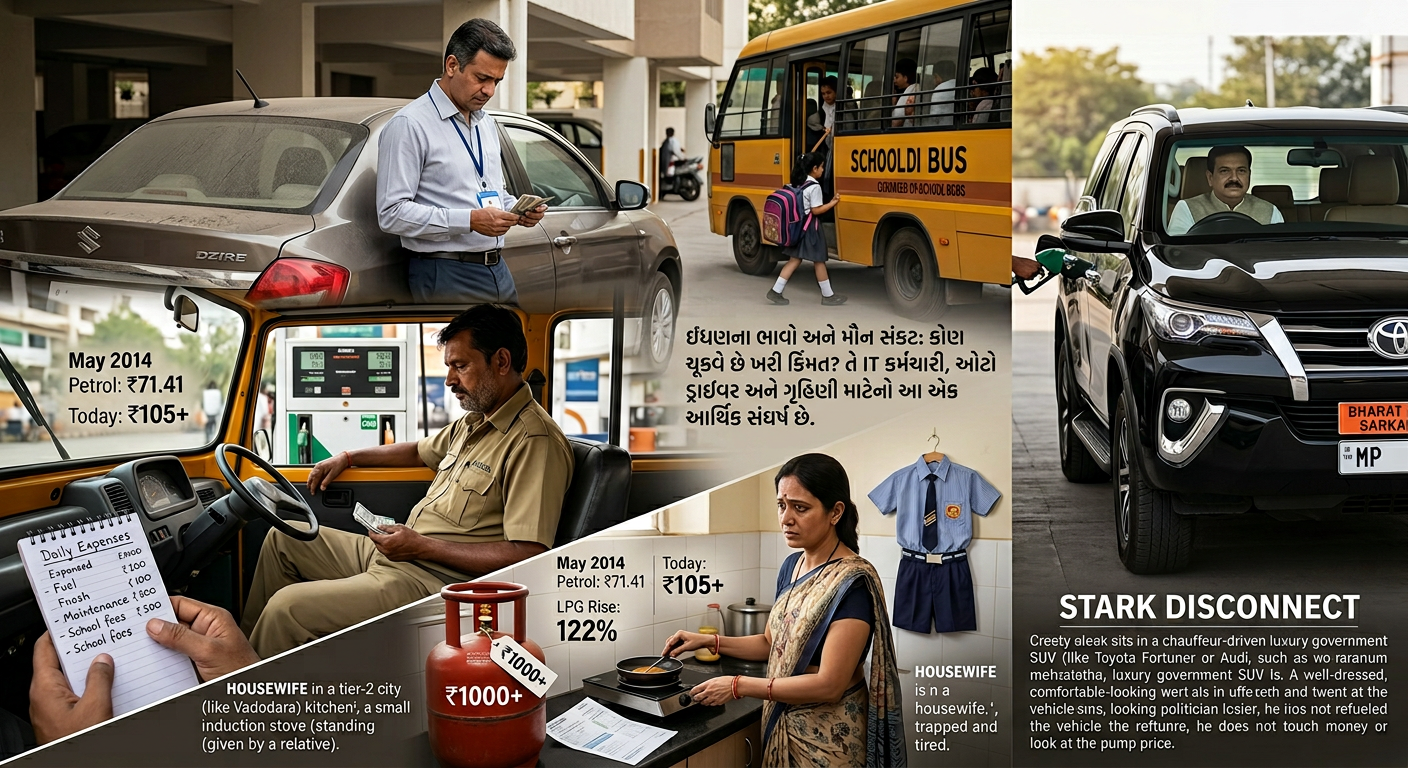
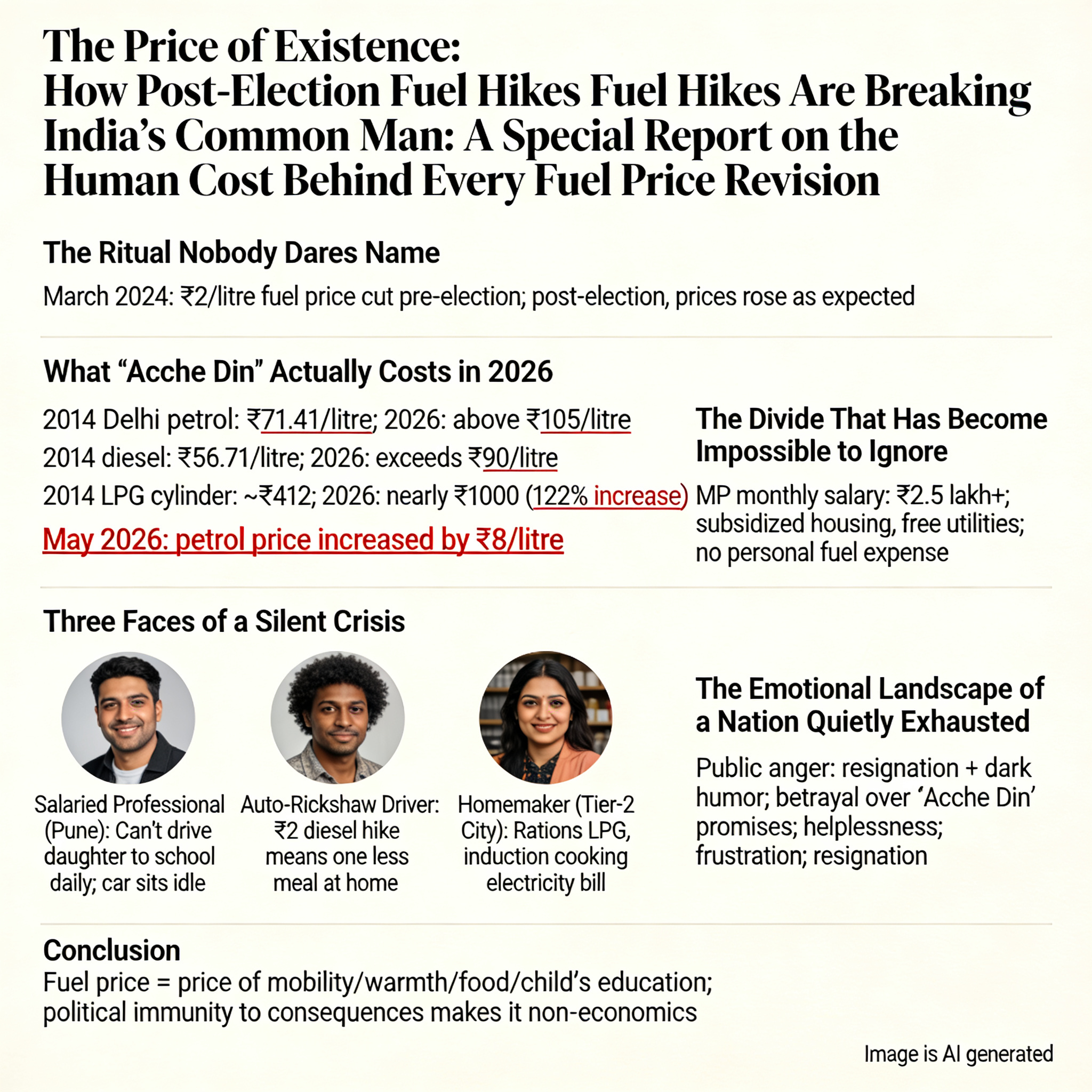
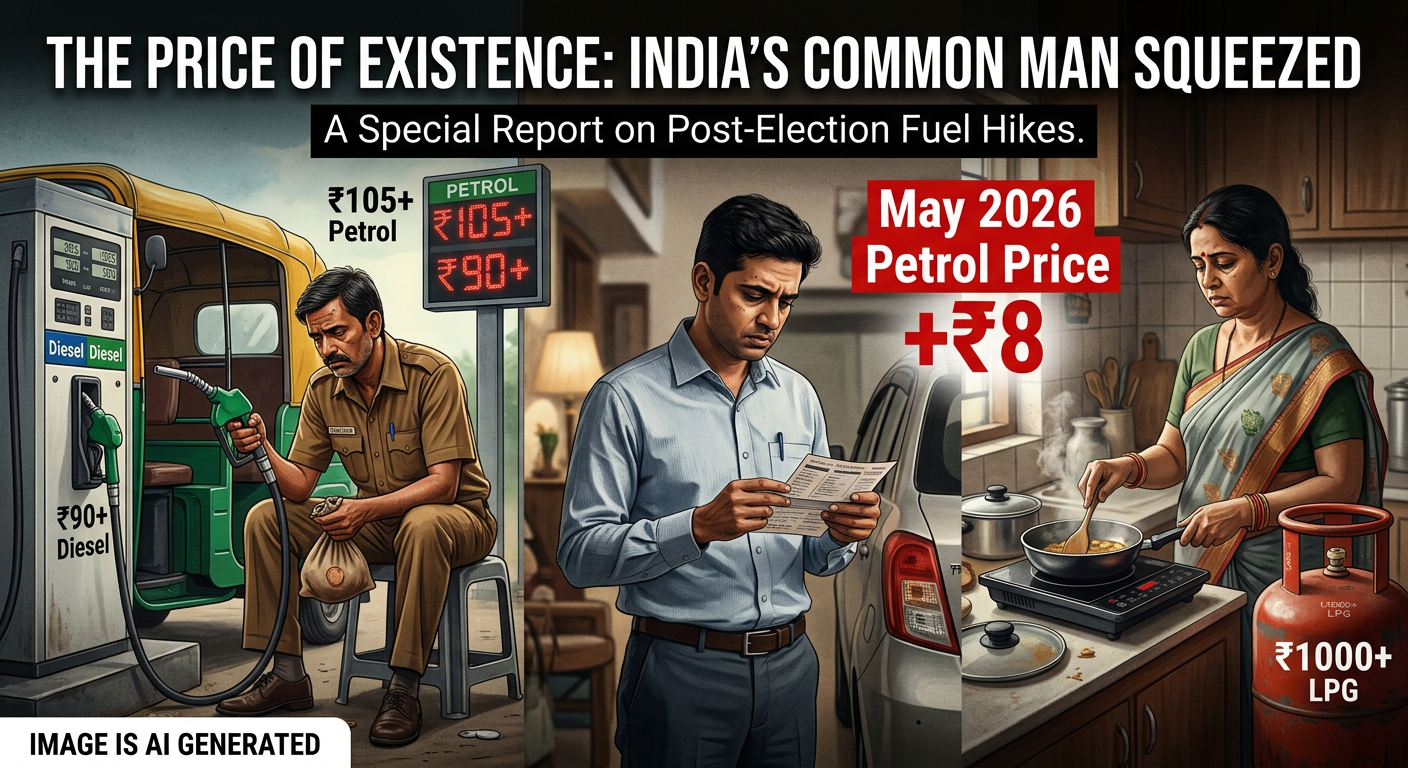
Consider the numbers first, because numbers have a way of stripping comfortable arguments bare. When the United Progressive Alliance (UPA) government left office in May 2014, petrol cost ₹71.41 per litre in Delhi. Diesel was ₹56.71. A domestic LPG cylinder was priced at approximately ₹412. Today, petrol retails above ₹105 per litre in most major cities. Diesel exceeds ₹90. An LPG cylinder now costs nearly ₹1000 — a staggering increase of 122 percent over a decade during which the ruling party promised not just stability but transformation.
The government argues that global crude volatility, currency fluctuations and massive social welfare expenditure justify current pricing. Opposition leaders counter that India's fuel taxes remain among the highest in the region, and that excise revenues collected during periods of low global crude prices were rarely passed on to consumers.
Both arguments contain degrees of truth. Neither argument pays a household's bills.
Three Faces of a Silent Crisis
The Salaried Professional: A mid-level IT employee in Pune supporting a family of four — no longer drops his daughter to school by car on most mornings. The calculation is brutally simple. Petrol at ₹105 per litre, school located six kilometres away, office in the opposite direction. With no salary revision for two years and grocery costs climbing monthly, the car sits idle more often than not. His daughter travels by auto-rickshaw. On days when even that feels expensive, she takes the school bus.
"People think a software job means you are comfortable," he said quietly. "What they don't see is that everything costs more but our salaries are standing still. I am not poor. But I feel poorer every month."
This is not poverty in the conventional sense. It is the slow compression of a middle-class life — aspirations narrowing, contingency funds depleting, small luxuries evaporating one by one.
The Auto-Rickshaw Driver: Auto-rickshaw driver has been driving an auto-rickshaw for eleven years. He begins his calculation before sunrise. Diesel to fill the tank. Earnings target for the day. Subtract fuel cost, subtract vehicle maintenance, subtract the daily permit fee. What remains must cover groceries, his children's school supplies, his wife's medication and, on good months, a small addition to savings.
"Some days I make the money. Some days I just about break even," he said, speaking outside a tea stall near the railway station. "When diesel goes up even by two rupees, that is one less meal at home. People in big offices don't understand what two rupees means to us."
He has not taken a holiday in four years. His youngest child's school fee is three months overdue. He does not blame the government entirely, he said. He simply cannot afford to think politically. He is too busy surviving.
The Homemaker in a Tier-2 City: Homemaker manages a household of five on her husband's government school teacher salary. The LPG cylinder that once cost ₹412 now costs around ₹1000. She rations cooking gas with the precision of an accountant — fewer meals prepared on the stove, more reliance on a small electric induction cooktop gifted by her brother-in-law.
Last month, the electricity bill arrived with a shock. The induction cooking had pushed consumption sharply higher.
"I moved from gas to save money. Now the electricity bill has eaten whatever I saved," she said with a tired laugh that contained no real humour. "I am running from one problem and landing in another. There is no winning."
She has not bought a new saree in two years. Her youngest son's school uniform is two sizes too small and has been extended with a piece of matching cloth stitched along the hem. She considers herself neither poor nor comfortable. She considers herself trapped.
The Divide That Has Become Impossible to Ignore
While common citizens navigate these daily calculations, the political class that governs them operates within an entirely different economic reality — one so insulated from market forces that fuel prices, electricity bills and grocery costs simply do not register as personal concerns.
A sitting Member of Parliament (MP) earns a monthly salary exceeding ₹2.5 lakh. Beyond salary, the entitlements include subsidised housing in some of the most expensive real estate in the country, free electricity, free telephone facilities, complimentary air travel for themselves and family members, access to premium government healthcare, a daily constituency allowance, an office expense allowance, and a pension for life — regardless of how many terms they serve.
Senior Indian Administrative Service officers and ministerial staff reside in government bungalows in New Delhi's Lutyens zone, where maintenance, security and utilities are covered by the public exchequer. Government vehicles carry them across the city. Fuel for those vehicles is not their expense. It is yours.
This is not stated as personal criticism of individuals within the system. It is stated as structural context — because it is impossible to understand the fuel price debate without acknowledging who bears its consequences and who does not.
An MP debating fuel pricing policy has never stood at a petrol pump calculating whether to fill a full tank or half. A minister reviewing LPG subsidy structures has never stared at a cylinder price wondering whether to delay the refill by another week. A bureaucrat drafting excise duty frameworks has never asked his child to wait another month for new school shoes because the grocery bill came in higher than expected.
The lived distance between those who set prices and those who pay them has never been wider.
The Emotional Landscape of a Nation Quietly Exhausted
Public anger over fuel prices in India has undergone a transformation. In the early years of price deregulation, protests were loud — union demonstrations, political rallies, opposition shutdowns. That kind of anger required energy and the belief that noise would produce results.
Today, the anger is quieter. And in many ways, more alarming. Across tea stalls, office cafeterias, residential colony parks and social media threads, the dominant sentiment is not outrage but resignation layered with dark humour. Indians joke about fuel prices with the tired fluency of people who have long stopped expecting the joke to end.
The sentiment beneath the humour is genuine and multi-layered. There is betrayal — the particular sting of promises not kept. "Acche Din" was not merely a campaign slogan. For millions of aspirational, first-generation middle-class Indians, it was a belief. The belief that their vote could produce economic dignity. That petrol would become affordable. That the LPG cylinder would not become a luxury calculation. That managing a household would get easier, not harder.
There is helplessness — the exhausting recognition that electoral choices have not visibly altered the fundamental economic trajectory. Prices rose under UPA governments too, voters note, but the rate and the broken promises give this iteration a distinctive bitterness.
There is frustration — particularly among working professionals who followed every prescribed path. Studied hard. Secured employment. Paid taxes without complaint. And still find themselves squeezed between stagnant wages and accelerating costs, watching the gap between their economic reality and their parents' expectations grow quietly wider.
And there is resignation — perhaps the most dangerous political emotion of all. Not the resignation of people who have given up caring, but of people who care deeply and have concluded that caring changes nothing.
"The election cycle has become more predictable than the monsoon," said a schoolteacher in Vadodara who requested anonymity. "Want cheap petrol? Wait for elections. Want expensive everything? Wait for results. This is just how it works now."
The Cycle Continues
"Before elections, they freeze the price," observed a policy analyst. "After elections, it is your bank account that unfreezes — outward."
Whether the current round of price adjustments proves sustained or temporary depends on global oil markets, monsoon performance affecting food prices, and the government's appetite for fiscal consolidation versus political management. What does not depend on these variables is the experience of the millions of Indians for whom each price revision is not a news story but a household crisis — recalibrated silently, absorbed without protest, managed with diminishing reserves of patience and money.
Conclusion: The Real Price
Fuel prices are, in the end, a proxy for something larger: the question of whose comfort the state considers its primary responsibility. For IIT employee, who parks his car to save money for his daughter's school fees, the answer feels clear. For auto-driver, who calculates diesel costs before deciding whether his family eats well that evening, it is clearer still. For Homemaker, managing a household between an unaffordable gas cylinder and an unexpected electricity bill, it requires no analysis at all.
The price of fuel in India is not merely the price of petrol or diesel or LPG. It is the price of mobility, of warmth, of cooked food, of a child reaching school. When that price rises on a political schedule while those who set it remain entirely immune to its consequences, it ceases to be economics. And India's common citizens — exhausted, quietly furious, darkly humorous and deeply resigned — know exactly what to call it.
0 thoughts on “The Price of Existence: How Post-Election Fuel Hikes Are Breaking India's Common Man: A Special Report on the Human Cost Behind Every Fuel Price Revision”
Leave a Reply
Your email address will not be published. Required fields are marked *


RECENT NEWS
- Organizational changes in the Human Rights Federation: Mahendra Ailani appointed as International President, Hitesh Thakkar given responsibility for Saurashtra
- ‘Rent garba partners’ online posts come under police lens in Surat
- Andhra BTech student falls to death from 10th floor of varsity hostel in Rajkot
- Rs 19 crore deal, death threats, and ‘hotel arrest’: Ahmedabad businesswoman files complaint
- Rajkot man kills 5-year-old daughter, stores body in fridge; ends life