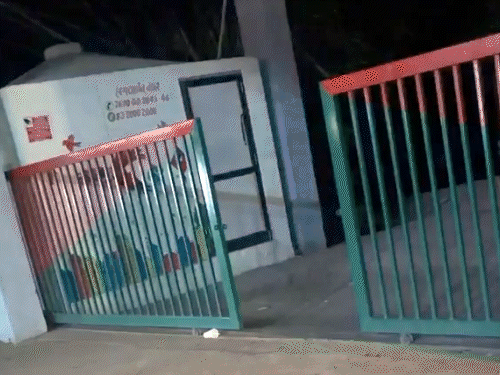
A few days ago, there was a rush in the forest department due to the spread of a disease called Babisia among the lions of Gir. Within a week, there were reports of lions attacking humans at three places. While the matter has not yet been settled, shocking information about the leopard has come to light. The government and the forest department talk a lot about the protection of wild animals like leopards and lions, but the reality is quite different. A leopard has been imprisoned in a small cage for three months at the Wildlife Rehabilitation Centre at Bilasia-Hanspura on the SP Ring Road in Ahmedabad. Usually, leopards are not kept in such cages for a long time. So where was the leopard caught and why was it transferred to this place? What kind of illness has he suffered from? Divya Bhaskar tried to find out. When Divya Bhaskar's representative visited her at night, she found the leopard locked in a tiny cage. He was extremely irritated and angry at the sight of the people around him. There are no isolation cages, 24-hour medical facilities, protocols for disposal of defecation and leftover non-vegetarian food. The leopard is kept in a very small cage. This is a clear violation of the guidelines of the Central Zoo Authority i.e. CZA. Scenes of the leopard's pathetic condition were also captured on camera. There are no animals in the wildlife rehabilitation center except the leopard
According to the staff of the centre, the leopard was found in a sick condition from Himmatnagar. He was then first taken to Indroda Park and from there he has been brought to the centre. The leopard is infected with a serious virus and is currently undergoing treatment. At present, there are no other animals in the entire centre, only this one leopard is a solitary captivity. As per the rules of the CZA, no rescue centre or zoo can keep wildlife in a transport cage for more than 24 hours. This proves that this case is extremely serious and law-breaking. However, why did the leopard have to be brought here from Indroda Park, on whom and on what basis this decision was taken, what kind of virus did the leopard have, whether it had any other co-morbidities, when, where and who conducted the leopard's blood test and what is the exact report of it? The staff at the centre did not have the answers to those questions. Rules at the central level were ignored in keeping the leopard
In fact, the Indroda Nature Park itself is a very big centre of the Forest Department, where a state-of-the-art rescue center and a team of veterinary doctors are always deployed for the treatment of sick wildlife. If the wildlife is more sick, it is sent to Kankaria Zoo or Anand Veterinary Hospital in Ahmedabad. The big question is why in this case the sick leopard was sent to a rehabilitation centre at Bilasia in Ahmedabad. Most importantly, there is no mechanism in place to treat Schedule-1 wildlife like leopards for a long time. As per the rules and regulations of the Central Zoo Authority, a cage of at least 3 meters long, 2 meters wide and 2.5 meters high is mandatory for the treatment or isolation of large wild animals like leopards. The cage should be large enough for the leopard to stand up, lie down and walk 3 to 4 steps on either side with its tail straight. Also, the cage needs to have adequate ventilation for clearance of the virus. The doctor or tracker who treats the leopard to prevent the spread of infection cannot come in contact with any other healthy animal until that period is over. There should be full-body PPE kits for the staff and a disinfection shower or tunnel outside the ward itself, so that the virus does not spread outside through their clothes or boots. The Central Zoo Authority and wildlife protocol make it clear that a normal cage cannot be operated for a violent animal infected with the virus. For this, there should be proper infrastructure and facilities of segregated isolation wards. The polluted air in this ward should not go directly out; It should have special ducting and HEPA filters so that the virulent air inside is filtered and mixed. There should be a double door system to enter the ward so that the leopard cannot escape and the air is not thrown straight out. Also, leopard excrement, leftover food or bloodstained bandages cannot be thrown directly into the general waste. There is a legal provision to burn it scientifically in an incinerator by giving chemical treatment. Committing cruelty to wildlife is a non-bailable offence
The leopard is a Schedule-I animal under the Wildlife Protection Act, 1972, which is legally accorded the highest protection. Committing cruelty to wildlife is a non-bailable offence under Section 11 and Section 39 of the Act. Further, under the 'Prevention of Cruelty to Animals Act, 1960', keeping an animal in a cage smaller than its bodily size, where it cannot move freely, is also a criminal cruelty by law. The leopard is a very energetic animal, running, jumping and moving around in large areas. Putting him in a narrow cage makes his condition miserable. The muscles of his legs and back become stiff due to not being able to move for days, which can leave him permanently paralyzed. Constantly sitting on an iron rod or a narrow surface causes the skin on his elbows, knees and tail to tear and bleed. Animals infected with the virus have a weakened immune system. Due to low oxygen availability in a narrow space and constant confinement around one's own feces, secondary infections can quickly reach the brain or lungs, which can lead to the death of the animal. Due to the small cage, the leopard loses its mental balance and constantly hits its head against the rod of the cage or spins around in and out of the cage. The bored leopard becomes so violent that it constantly claws to attack the staff in front of him, causing his nails to break and injuries on his face. Sometimes he is completely depressed and even gives up food and water. When the officer was asked serious questions, he laughed
When Veterinary doctor Aniket Patel, who treats the wildlife at Indroda Park, was contacted and asked questions, he smiled and dodged all the questions. "I can't say anything in this regard, I don't have any authority to give any information to the media. You ask the officer in Bilasia and he will tell you everything.' He chose to keep quiet about where the leopard was found, how it was being treated and why it was being kept in a small cage against the rules. Despite several attempts to contact Deputy Conservator of Forests Amit Nayak, he also avoided meeting or talking over the phone. Even after 3 months, I have not taken the doctor's opinion for the big cage
Another officer, Range Forest Officer Mitesh Dattani, was contacted and gave some details. "The leopard is around four years old, which means it is still a teenager. He has contracted some kind of virus and came here only three months ago. Its treatment and monitoring by Dr. Aniket Patel is doing it. In addition, two LIs are deployed at the centre. We have sought the government's permission to release the leopard, but it can be released only after the virus is eradicated. We got his blood test done at a government and a private lab last week, but still his report is positive. If we release it now, other wildlife can get infected, so it will be released into the wild only after it is cured." Asked why the leopard is not kept in a big cage, he added, "We feed the leopard as per the doctor's advice, we will take the doctor's opinion on the big cage and further action will be taken accordingly." After passing 10th standard, a person becomes an LI by pursuing a diploma course in animal husbandry. Their job is like that of an ordinary compounder or nurse in a veterinary hospital. They are not qualified or able to treat wildlife like a veterinarian; They can only do dressing, cleaning, or that sort of normal work. Under these circumstances, the big question arises as to whether the rules are followed to feed this infected wild animal safely inside such a narrow transfer cage, when the male leopard needs mutton for its daily diet. The entire system is clearly seen to be gross negligence on the part of the forest department and a violation of wildlife welfare rules.

RSS News
Divyabhaskar
0 thoughts on “Sick leopard captured from Himmatnagar captured by forest department near Ahmedabad: Despite being infected, kept in 'transfer cage' for 3 months, officials give a roundabout reply”
Leave a Reply
Your email address will not be published. Required fields are marked *


RECENT NEWS
- 600 grams of gold looted: Two youths were robbed outside Ahmedabad airport in a car and taken to Gandhinagar.
- Meghraja's batting in Navsari; Causeway overflowing: 13 roads in rural areas completely closed for traffic
- Rain in rural areas of Himmatnagar, relief from heat: Rain showers in the late night and early morning
- 'Operation Surakshit Cyberspace': Gujarat Police's 28-day mega campaign for digital safety of women and children
- Home Minister Amit Shah will launch a campaign on July 12 to plant 1 crore saplings in Gandhinagar Lok Sabha constituency.