


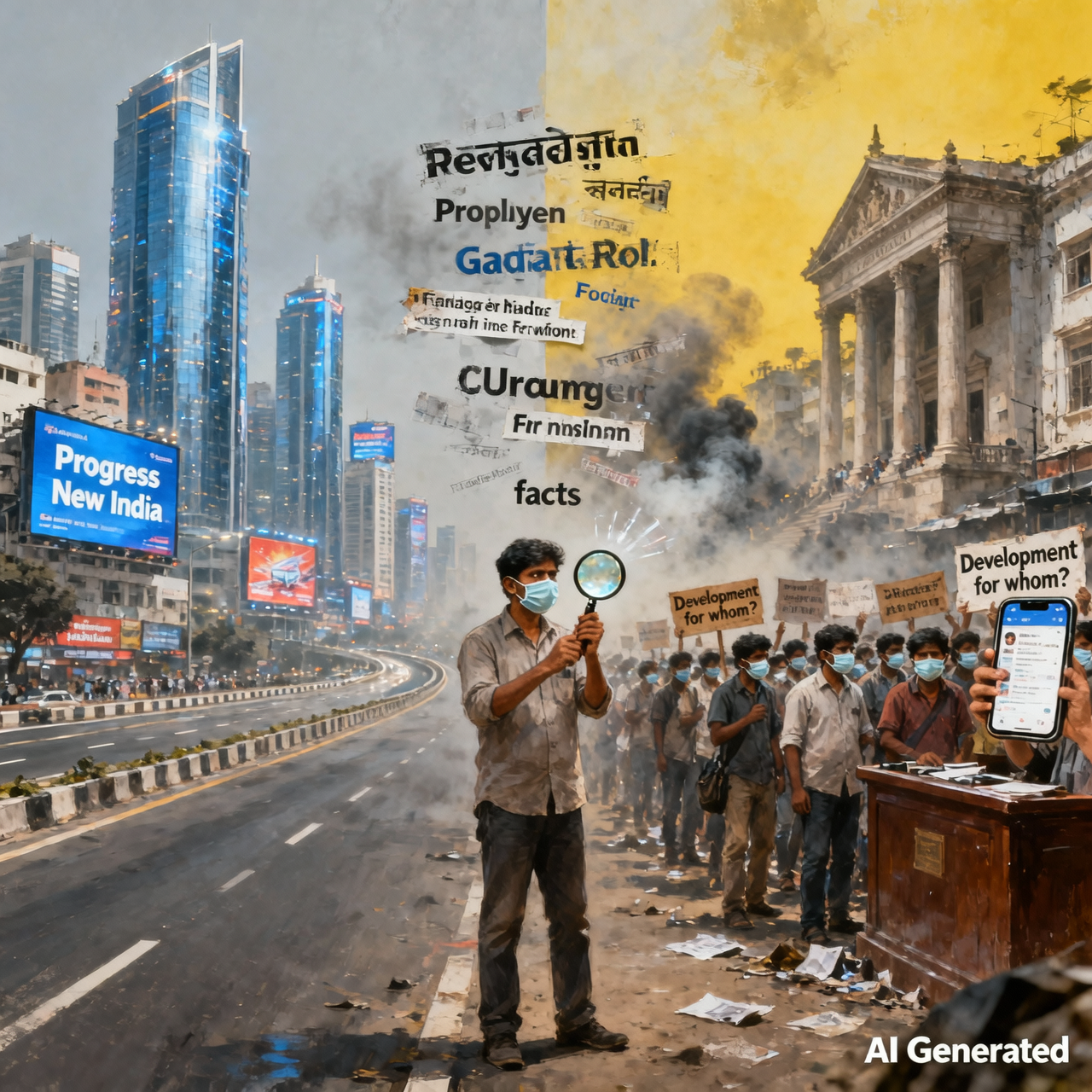
For years, Indians have been told that the nation is progressing at an unprecedented pace. New highways are built, airports are inaugurated, skylines are transformed, and record-breaking economic achievements dominate political speeches. Development has become the most celebrated word in public life.
Yet, beyond the advertisements, slogans, and televised celebrations, there is another India quietly asking a simple question:
Development for whom?
The ordinary citizen does not measure progress through government campaigns or corporate presentations. Progress is measured by the quality of air they breathe, the affordability of healthcare, the accessibility of justice, the reliability of public institutions, and the confidence that their voice still matters.
Unfortunately, for many Indians, that confidence appears to be fading.
The modern citizen lives in a strange contradiction. On one hand, India is projected as an emerging global power. On the other, millions struggle daily with unemployment, rising costs, pollution, delayed justice, administrative opacity, and growing distrust in institutions.
Perhaps the greatest irony of our times is that criticism itself has become controversial.
Question a government policy, and you may be labelled anti-development.
Question environmental clearances, and you may be accused of obstructing progress.
Question public spending, and you may be portrayed as opposing national interests.
Question powerful business interests, and suddenly the conversation becomes uncomfortable.
A healthy democracy should encourage difficult questions. Instead, citizens increasingly feel that asking questions requires courage.
The Public Interest Litigation, once considered the common person's weapon against arbitrary power, appears more difficult and expensive than ever before. Courts certainly have a legitimate responsibility to discourage frivolous litigation, but many ordinary citizens now wonder whether access to justice is slowly becoming a privilege rather than a right.
For a middle-class family, the fear is simple: what happens if raising a public issue results in legal costs that exceed annual savings?
The fear itself becomes a deterrent.
Then there is the issue that literally surrounds us every day—air.
Millions of Indians wake up in cities where pollution levels regularly exceed safe limits. Parents worry about their children's lungs. Elderly citizens struggle with respiratory illnesses. Doctors repeatedly warn about long-term health consequences.
Yet life continues as though this is normal.
Perhaps this is the most successful normalization campaign in modern India: convincing citizens that breathing hazardous air is simply the price of development.
When a society begins accepting polluted air, polluted politics, and polluted public discourse as unavoidable realities, it gradually loses the ability to demand better.
Equally concerning is the growing perception of a close relationship between political power and economic power. Whether such perceptions are entirely justified or not, the public increasingly believes that influential corporations enjoy greater access to policymakers than ordinary citizens ever will.
The farmer seeking compensation, the small entrepreneur struggling for credit, and the young graduate searching for employment often feel invisible in comparison to those capable of influencing policy through wealth, influence, or proximity to power.
Perception matters in democracy.
When citizens begin believing that rules are applied differently to different people, trust weakens.
And trust, once lost, is extraordinarily difficult to restore.
The media, traditionally described as the fourth pillar of democracy, faces its own credibility challenge.
Many citizens believe that large sections of the press have become financially dependent on government advertising, corporate interests, or political affiliations. Whether entirely accurate or not, the perception is widespread enough to create skepticism about the independence of public discourse.
As a result, citizens increasingly turn to social media, independent platforms, and alternative sources of information.
This has created another paradox.
While information has never been more accessible, reliable information has never been harder to identify.
The citizen is left navigating a battlefield of propaganda, misinformation, political narratives, and competing truths.
Perhaps the most vulnerable person in modern India is not the poor, the middle class, or even the opposition supporter.
It is the citizen who simply wants facts.
Not slogans.
Not propaganda.
Not blind loyalty.
Not permanent outrage.
Just facts.
The truth is that no government is perfect. No political party possesses a monopoly over virtue. No institution is beyond criticism. Equally, no institution should be condemned without evidence.
Democracy survives in the space between blind faith and blind cynicism.
That space is shrinking.
The greatest threat to India is not corruption alone, pollution alone, inequality alone, or institutional decline alone.
The greatest threat is public resignation.
The moment citizens begin believing that nothing can change, democracy begins losing its purpose.
When people conclude that powerful interests always win, that accountability is optional, that environmental damage is inevitable, that questioning authority is futile, and that institutions no longer listen, democracy becomes a ritual rather than a living system.
Yet there remains reason for hope.
Citizens still speak.
Courts still hear difficult cases.
Journalists still ask uncomfortable questions.
Activists still challenge authority.
Whistle-blowers still take risks.
Voters still possess the most powerful instrument in any democracy—the ballot.
India's future will not be determined by advertisements claiming success or critics predicting collapse.
It will be determined by whether citizens continue demanding transparency, accountability, environmental protection, institutional independence, and equal treatment before the law.
Development is not merely the construction of buildings, roads, and monuments.
Development is when a citizen can breathe clean air, access justice without fear, question authority without intimidation, and trust that public institutions serve the people rather than power.
Until that happens, many Indians will continue to ask a question that no slogan can answer:
Are we truly developing, or are we simply becoming accustomed to accepting less than we deserve?
1 thoughts on “Development, Democracy and the Citizen Who Feels Forgotten”
Leave a Reply
Your email address will not be published. Required fields are marked *







Raju
Good