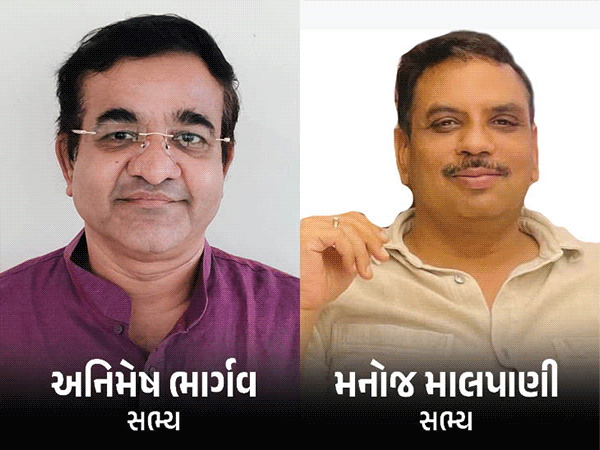
For the first time in the country, non-Muslim (Hindu) members have been appointed to the Waqf Board of a state. The Madhya Pradesh government has reconstituted the Waqf Board with Manoj Malpani of Indore and Animesh Bhargava of Raghogarh in Guna. Sanwar Patel has been re-appointed as the chairman of the board. Office bearers and members of the All India Muslim Festival Committee took to the streets at Budhwara Chowk in Bhopal on Monday to protest against the inclusion of two non-Muslim members in the board. The protesters demanded that the government withdraw the decision, saying it had hurt the sentiments of the Muslim community. Why are Muslim organisations opposing this decision? Shamsul Hasan, patron of the All India Muslim Festival Committee, said that the Waqf is a religious and social institution of the Muslim community, where people waqf their property for the pleasure of Allah. He said it was not appropriate to appoint non-Muslim members in the management of the Waqf Board. The Madhya Pradesh Waqf Board was formed two days ago, in which for the first time two non-Muslim (Hindu) members have been inducted. The committee has been opposing the appointment. Referring to the religious institutions of Ayodhya, Somnath and Mathura, Shamsul Hasan asked why the need was felt to include non-Muslim members in the Waqf Board when the Muslim community had never demanded representation in the management of those institutions. Shamsul Hasan alleged that the Waqf Board was formed in a hurry soon after the implementation of the new law. He said that if new members were to be appointed, then appropriate and experienced people of the Muslim community, such as retired IAS, IPS, doctors, engineers and other experts, should have been given the responsibility. Congress MLA Arif Masood will go to the Supreme Court on the issue of inclusion of Hindu members in the Waqf Board. Addressing a press conference, he said that the matter is still under consideration in the Supreme Court. What was the need for Sanwar Patel to be in such a hurry? The Madhya Pradesh government has made another mistake. There is a provision to keep people from the other two communities, the government has kept three. The commissioner is also from another caste. During the protest, the activists carried posters of Chief Minister Mohan Yadav. He termed the appointment of two non-Muslim members in the Waqf Board as government intervention. The protesters raised slogans like "Dictatorship will not work in the Waqf Board", "Arbitrary will not work" and demanded reconsideration of the constitution of the new Waqf Board. Issues related to other temples, including Ayodhya, were also mentioned and slogans were raised against the government's decision. He said Waqf properties are the property of religious faith and society and hence their management should involve people who have faith in them. He claimed that the decision has caused resentment among the Muslim community. The protesters demanded the government to withdraw the order, warning that the agitation would be widespread across the state if the decision was not reconsidered. It is a matter of joy and pride that Madhya Pradesh has become the first state in the country to implement the Waqf Act-2026. Congratulating Chief Minister Mohan Yadav and Waqf Board Chairman, he said the law will have far-reaching and positive consequences. Sarang said it was wrong to link the Waqf Board with the Masjid Management Committee. The scope of Waqf Board is not limited to mosques only, but its responsibilities are widespread. Shri Hindu Utsav Samiti and Sanskriti Bachao Manch have welcomed the inclusion of two Hindu members in the Waqf Board for the first time. Committee chairman Chandrashekhar Tiwari said the decision will bring transparency in the functioning of the Waqf Board. The Madhya Pradesh government has reconstituted the Waqf Board with Manoj Malpani of Indore and Animesh Bhargava of Raghogarh in Guna. Sanwar Patel has been re-appointed as the chairman of the board. The government claims that it has become the first state in the country to constitute a board under the provisions of the Waqf (Amendment) Act, 2025. The new board has 10 members. Earlier, under the Waqf Act, 1995, the members of the State Waqf Boards were only from the Muslim community. The Supreme Court had asked several questions to the Centre while hearing petitions challenging the constitutional validity of the Waqf (Amendment) Act, 2025. "If non-Muslim members can be included in the Waqf Board, will Muslims also be allowed to participate in the management of Hindu religious trusts in future?" the court asked. A bench headed by Chief Justice Sanjiv Khanna and comprising Justices Sanjay Kumar and K.V. Viswanathan, who was also present, sought clarification from the central government on various provisions of the amended law. The bench also questioned the provision of 'Waqf by User'. Under this arrangement, if a property has been used for religious or charitable purposes for a long time, it can be considered as Waqf property even in the absence of formal documents.

RSS News
Divyabhaskar
0 thoughts on “2 Hindu members of Waqf Board, Muslims oppose: 'We have never sought a place in Ayodhya-Mathura committees' Sarang said, "Don't look through the lens of religion”
Leave a Reply
Your email address will not be published. Required fields are marked *


RECENT NEWS
- Krishnavataram Part 1 Closing Collection: How much was the closing collection of 'Krishnavataram Part 1'? Know – Is this film a hit or a flop?
- Alpha Box Office Collection Day 4: Alia Bhatt's 'Alpha' failed the Monday test, the collection on the fourth day was shocking, yet broke the record of two films.
- When will Vaibhav Suryavanshi play for Team India after the England series? BCCI announces date
- A great disgrace! Zimbabwe beat Bangladesh by 141 runs in ODIs
- A network of 42,000 elderly people in 9 states; 70% of elderly people became self-sufficient by helping each other; Self-help groups started from Tamil Nadu after tsunami