Date: February 11
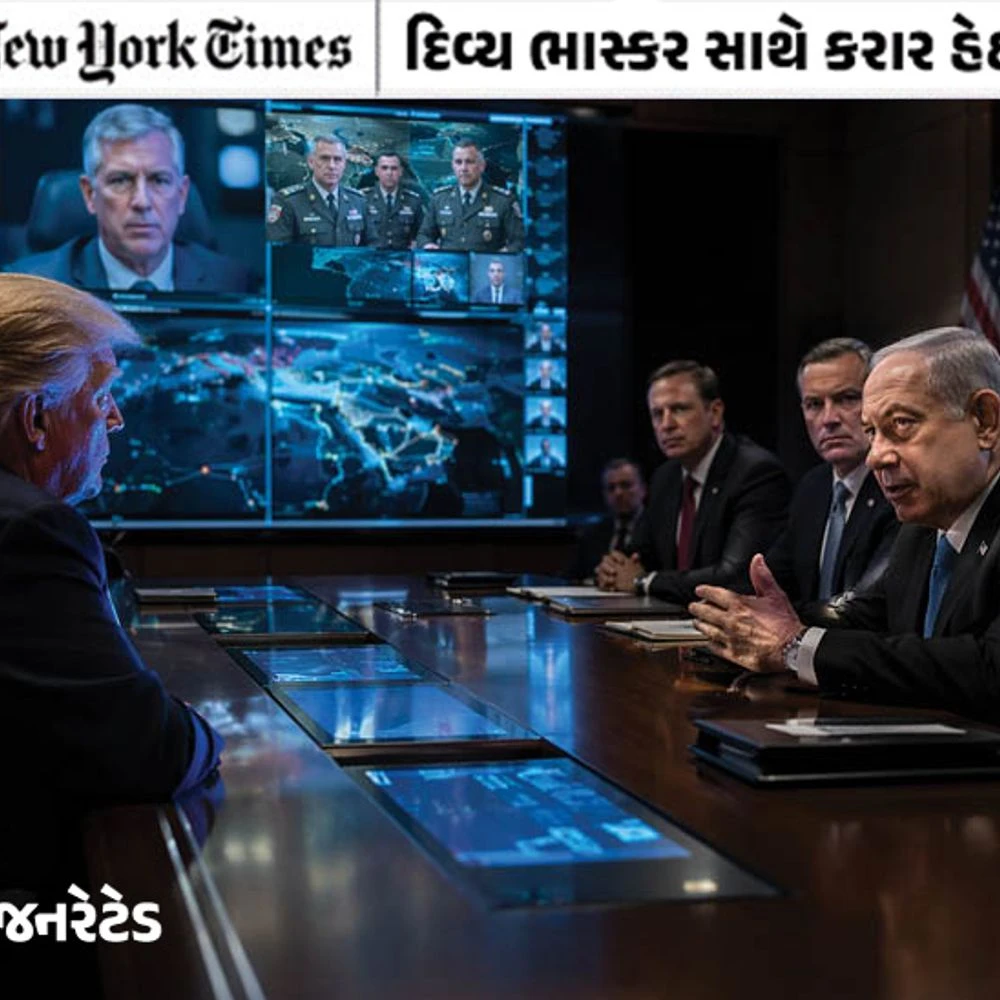
Israeli Prime Minister Benjamin Netanyahu arrived at the White House in the morning. They had been pressuring the US for several months to launch a major attack on Iran. This time, however, the meeting was top-secret. They were taken straight inside without any formal welcome so that the media would not know anything. First the conversation took place in the Cabinet Room and then he was taken to the Situation Room of the White House, where the actual meeting took place. This is the place where the United States makes big decisions related to war and national security, but usually foreign leaders are not brought here. Usually, when there is a big meeting, Trump sits in the chair at the front of the table. From there he sees everyone and leads the meeting. But in this meeting, Trump sat on the side of the table, his face was facing the big screen on the wall. Trump and Netanyahu were face to face. David Barnea, the head of the Israeli intelligence agency Mossad, and Israeli military officials were on the screen. This created an atmosphere as if Netanyahu was standing with his full command in time of war. Very few people were present at the meeting so that no information was leaked. Secretary of State Marco Rubio, Defense Secretary Pete Hagseth, CIA Chief John Ratcliffe, Chairman of the Joint Chiefs of Staff Gen. Dan Cain, Trump's son-in-law Jared Kushner and Special Envoy Steve Witkoff were in attendance. White House Chief of Staff Suzie Wiles was also there. Vice President J.D. Vance was not at the meeting because he was in Azerbaijan and the meeting was abruptly fixed. Netanyahu gave a one-hour presentation and tried to convince Trump that this was the right time to attack Iran. He said that the Iranian government has become weak and if the US and Israel attack together, Iran's military power can be quickly destroyed. Netanyahu claimed that Iran's missile system could be destroyed in a few weeks and that the government would be so weak that it would not be able to close the Strait of Hormuz. Netanyahu also said that protests could resume inside Iran and that the protests could lead to the overthrow of the government if Israel secretly helped. He also suggested that Kurdish extremists from Iraq could enter Iran and open another front that would quickly topple the government. During this time, a video was also shown in which he was shown to potential leaders who could take over after the government fell. It also included the name of Reza Pahlavi, the son of Iran's last Shah and currently living in the United States. Netanyahu repeatedly reiterated that it was necessary to strike now, because if delayed, Iran would become stronger. He said that the danger of doing nothing is greater than the danger of attacking. Netanyahu was very impressed with Trump's presentation. He said he felt the planning was appropriate. This made Netanyahu realize that the U.S. can come along. After this, it was the job of the US intelligence agencies to understand this planning. The next day, only US officials met in the Situation Room. In this, the scheme was divided into 4 parts. The first was to eliminate Iran's Supreme Leader Khamenei and the top leadership. The second was to destroy Iran's military power. The third was to instigate revolt within the country and the fourth was to change the government and bring in a new system. Intelligence agencies said the first two objectives can be achieved but the other two are far from reality. CIA Chief John Ratcliffe called it a joke, and Marco Rubio called it useless. When Trump came to the meeting, he was given the same report. Vice President J.D. Vance had also returned and expressed deep concern over the plan. Gen. Dan Cain also said that Israel often exaggerates plans because it needs U.S. help. After this, Trump made it clear that even if it is not possible to change the government, it does not matter. He said it would be a matter of Israel or Iran, but his decision would not depend on it. His focus was mainly on eliminating Iran's top leaders and dismantling its military power. Trump made the mistake of underestimating Iran and several meetings were held in the coming days. In these meetings, General Kane warned that if a major war broke out against Iran, America's weapons could be quickly depleted. In particular, missile interceptors are already low as the United States continues to help Ukraine and Israel. He also said that it would be very difficult to secure Hormuz and that if Iran closed it, there would be a major impact on global oil supply. But Trump was confident that the war would end very soon. He felt that Iran would not be able to respond further, as had been seen earlier after the attacks in June. Vance was most opposed to starting a war, General Kane never said that war was wrong, but he repeatedly warned of its dangers. He would ask at every plan what would happen next, but Trump often focused on things that aligned with his ideas. There were differences within the cabinet as well. Defense Minister Hegseth was one of the biggest supporters of the war. Marco Rubio was a little cautious and wanted to continue the policy of pressure first, but he didn't try to stop Trump. Suzy Wiles was also concerned that the start of a new war would have political and economic impacts, especially as oil prices could rise, but she also did not openly oppose. Vice President J.D. Vance was the most vocal opponent. "This war will be very costly, could weaken America's strength and anger Trump's supporters," he said. He believed that even if there was to be an action, it should be limited, not changed throughout the war. Vance also feared that it would be difficult to predict what Iran would do in return. If Hormuz is closed, gasoline prices in the United States will rise rapidly and will have major political implications. In the meantime, another important intelligence has come to light that Iran's Supreme Leader and other senior officials are going to meet together in an open place, where they can be attacked. It was considered a rare opportunity. Trump once again gave Iran a chance to negotiate. Meanwhile, Kushner and Witkoff held talks with Iran in Oman and Switzerland. He even proposed that Iran be given free fuel for its entire nuclear program, but Iran rejected it, calling it against its dignity. Kushner and Witkoff told Trump that a deal was possible, but that it would take months, and that Iran was running out of time. The last meeting was held in the last days of February. By this time everyone's views were clear. There was no new argument, only a decision to be taken. The meeting lasted for about an hour and a half. Throughout the process, it was clear that Trump had already made up his mind. They were just waiting for the right time. From here, the final decision of the United States to join the war against Iran was almost decided. At that last meeting, Defence Minister Pete Hegseth and General Dan Cain explained the full plan of the attack. He explained how the attack would take place. How will it be launched and how will it move forward? After this, President Trump said that he wanted to hear the opinion of everyone sitting at the table. Vice President J.D. Vance has made it clear that he thinks the whole plan is wrong. But at the same time, he also said that if the President takes this decision, he will support him. That is, he was personally opposed but was ready to stand by the President's decision in the end. Chief of Staff Suzy Wiles said that if Trump thinks this is necessary for the national security of the United States, he should move on. CIA Chief Ratcliffe did not say whether the attack should be carried out, but he provided new intelligence. He said Iran's top leadership is set to gather at the Ayatollah's compound in Tehran, which could be a major opportunity to carry out an attack. He also said that if regime change only means eliminating the supreme leader, it can be possible. White House legal adviser David Warrington's opinion was taken after this. He said that the plan that has been made is legally correct and the US can do it. He told Trump that if Israel was going to carry out this attack, the United States should also cooperate. White House communications director Steven Cheung spoke about the political and public implications of the decision. He said Trump came to the polls saying he would not fight new wars. People did not vote for war abroad. He also questioned how he would respond to what had been said in the last eight months that Iran's nuclear facilities had been completely destroyed if attacked now. Although he did not say yes or no directly, he did say that whatever decision Trump makes, it will be considered right. Press Secretary Carolyn Leavitt said it was entirely the president's decision and the media team would handle it. Defence Secretary Pete Hegseth - Support Defence Minister Hegseth clearly spoke in favour of the war. "If Iran has to be dealt with at some point, it is better to do it now," he said. He also told how much time and with what force this campaign could be run. Gen. Dan Kane, chairman of the Joint Chiefs of Staff, spoke about the dangers and said the war would rapidly deplete the U.S. arms stockpile. He did not give any personal opinion of his own. He said that if the President gives orders, the army will carry it out. He also explained how the attack would proceed and how weak the US could weaken Iran's military power. Foreign Minister Marco Rubio gave the most clear and balanced opinion. He said that if the aim is to change the government or instigate a revolt from within, it should not be done. But if the goal is to destroy Iran's missile program, then it is possible and can be done. Everyone left Trump to his decision Almost everyone present at the meeting had finally left it to Trump's decision. Everyone knew that Trump had taken big risks in the past and had succeeded many times. So this time too, no one came in his way. Finally, Trump said, "I think we should do this. It is important that Iran does not have nuclear weapons and cannot attack Israel or other countries in the region with missiles." The next day, Trump was on Air Force One. He gave the final order just 22 minutes before the scheduled time. His message was, "Operation Epic Fury is approved. It will not be stopped. Good luck.' It was here that the formal decision to launch a military operation against Iran was made.

RSS News
Divyabhaskar
0 thoughts on “What Netanyahu said Trump agreed to war: Decision was made in a secret meeting between the two, Vice President Vance was against the attack”
Leave a Reply
Your email address will not be published. Required fields are marked *


RECENT NEWS
- Iran closes Strait of Hormuz again: Decision after Israeli strike on Lebanon kills 254 people, Trump says Hezbollah is not involved in the ceasefire
- What Netanyahu said Trump agreed to war: Decision was made in a secret meeting between the two, Vice President Vance was against the attack
- Celebration on the streets of Tehran after the ceasefire! 'America has many times before,' Iranian woman said.
- US Iran War Ceasefire: After the announcement of a ceasefire with Iran, Donald Trump's new message, said - America in the Strait of Hormuz...
- Iran-US Ceasefire: Donald Trump announces to stop war, Strait of Hormuz will open... 10 major updates in US-Iran ceasefire so far