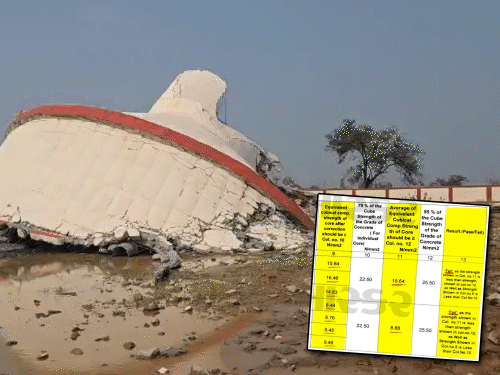
On January 19, a water tank built at a cost of Rs 21 crore in Tadkeshwar village of Mandvi taluka of Surat district collapsed and collapsed. Two reputed institutes investigating the accident, Sardar Vallabhbhai National Institute of Technology (SVNIT) and Gujarat Engineering Research Institute (GERI), have released their laboratory testing reports. The statistics of this report are not only shocking but also expose corruption in government work. The report of both the agencies has revealed that Bhaskar was touched. In the laboratory reports of both the agencies, all the 13 samples of the tank have failed to meet the prescribed parameters. It has been found that only 30 per cent cement was used in the construction of the foundation of the tank. 100% Sample Failure of Government Work
All the 13 samples taken in the Tadkeshwar water tank disaster have failed to test. Reputed institutes like SVNIT and GERI have clarified that the material used in construction does not satisfy the prescribed M30 grade standards anywhere. When 100% of the samples fail in government work, it directly points to not only a technical glitch but also systematic corruption and serious tampering with people's lives. Material used in construction is 50% weak
According to data from the Gujarat Engineering Research Institute (GERI), seven samples were tested. That is, the material used in the construction has proved to be 45% to 50% weak due to insufficient cement. Sharp decline of up to 70% in structural samples
The condition of S-4 to S-7 samples taken from the base of the tank has been found to be pathetic. The strength of S-4 sample is only 8.44 (28.1%), S-5 sample is 8.76 (29.2%), S-6 sample is 9.45 (31.5%) and S-7 sample is 9.48 (31.6%). These samples have seen a sharp decline of 70% against the target. Such inferior quality concrete was not able to withstand the weight of thousands of litres of water which became the main cause of the accident. Serious errors in 6 samples in SVNIT report
Serious defects have also been found in 6 samples tested by SVNIT. C1 samples have 18.90 (63%), C2 samples 18.10 (60.3%) and C3 samples 13.49 (44.9%). Expert Dr. According to Dr. Atul Desai, an important structure like a water tank can be dangerous when the strength is less than 60%. These figures prove that the contractor has not left any kind of compromise with the quality of the material for profiteering. Cow dung and weak percentage in cement mixture
The results of the remaining three samples of SVNIT S1, S2 and S3 have been reported at 17.13 (57.1%), 10.88 (36.2%) and 8.13 (27.1%) respectively. Of these, the S3 sample is the weakest sample of the entire project with quality of only 27% above the target. Such a low result showed that the amount of sand and gravel in the concrete was high, while the amount of cement required for binding was negligible, due to which the concrete broke down like powder. The final report will be submitted after the results of the soil test
Experts and professors from SVNIT who have prepared the report are Dr. Atul Desai said, "At present, only the report of structural engineering (iron and concrete) has been prepared. Soil analysis is being done to find out whether only weak concrete is responsible for the collapse of the tank or the soil condition. Steel pass also concrete fails
A strange fact has come to light in the investigation that the steel used in the tank has passed the standard. But according to the principle of civil engineering, composite action is important. If the iron is strong but the concrete is weak, then the iron does not get a grip. As a result, when the tank was filled with water, even iron could not bear the load due to weak concrete and the entire structure collapsed. Indications of strict action against those responsible
The reports of these two agencies have now been handed over to the police and higher government departments. A 100% sample failure is not an accident, but a well-planned criminal negligence. According to sources, legal action will now be taken against the contractor, supervising engineer and material supplier. In the next phase, the report of soil analysis will also come, which will clarify whether there were any defects in the ground soil or not. However, the current report has spread the stench of corruption throughout the diocese. Also Read: Corruption tank worth Rs 21 crore explodes, a new solid tank that sat in the water as soon as it filled, and a 75-year-old tank barely broke.
The incident, which took place at two different places in Gujarat, has caught everyone's attention. One incident took place near Sarangpur circle in Ahmedabad and the other incident took place at Gayapagala (Tadkeshwar) village in Kamrej taluka of Surat. There was a water tank near Sarangpur Circle in Ahmedabad which was as high as a 10-storey building. The tank was 75 years old. It began to be broken, but the work was so strong that it could not be broken. A JCB machine weighing 8 tonnes had to be climbed on top of the crane to break it. On the other hand, a huge water tank was built at a huge cost of Rs 21 crore in Tadkeshwar village, which is Gayapaga Dham in Kamrej taluka of Surat. The tank was built, but the water was being filled for the trial, and it sat down like a lounge. Now think... How solid a task would have been done 75 years ago and how weak would this new work be! (Read the full story)

RSS News
Divyabhaskar
0 thoughts on “Only 30% cement in the base of the broken tank, all 13 samples failed: Biggest evidence of corruption in Surat, report of two agencies found by Bhaskar reveals”
Leave a Reply
Your email address will not be published. Required fields are marked *



RECENT NEWS
- Congress's 'Jan Aakrosh Yatra' in South Gujarat: Amit Chavda calls AAP 'B team' of BJP, expresses concern over irregularities in Form No-7
- Water Sanitation Committee meeting held in Bharuch: Collector Gaurang Makwana reviews water supply schemes
- Gandhinagar: An important decision of the revenue department, a copy of the document will be available sitting at home for just Rs 100
- Raid: 5 men caught gambling near Chikasa village Bhadarpool, 4 escaped
- Maximum temperature in Porbandar rises by 2 degrees to 33 degrees Celsius