


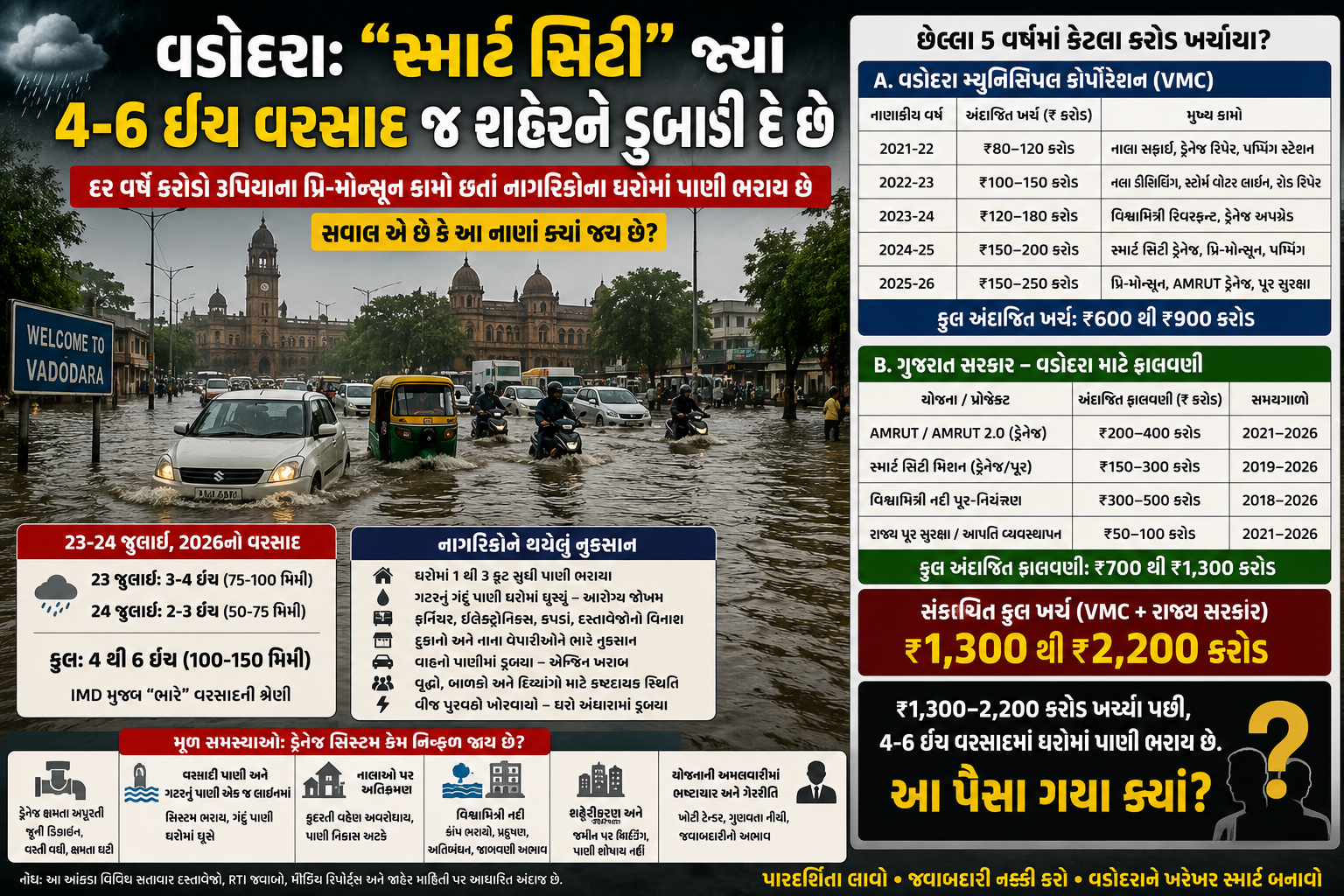
Despite spending crores of rupees every year on pre-monsoon works, water enters citizens' homes — the question is: where does this money go?
On 23rd and 24th July, 2026, Vadodara city received continuous rainfall of 4 to 6 inches - which was neither extraordinary nor historic - and India's so-called "Smart City" was once again submerged in water. Knee-deep water accumulated on main roads. Traffic came to a standstill. Rainwater and sewage water entered countless homes. Citizens' household belongings, documents, electronic devices, and food supplies - everything was swept away in the water. People were forced to bail out water from their own homes.
And this is not the first time. Every monsoon, the same scene repeats itself - the same areas get flooded, the same complaints arise, the same promises are made, and the next year, the same situation occurs again. The fundamental question, which both the Vadodara Municipal Corporation (VMC) and the Gujarat Government must answer: Every year, crores of rupees are spent under pre-monsoon works. Then why does the city drown in just 4-6 inches of rain?
I. What Happened: 23-24 July, 2026
Rainfall Data:
- 23rd July, 2026: Vadodara city and surrounding areas received approximately 3 to 4 inches (75-100 mm) of rainfall.
- 24th July, 2026: Again 2 to 3 inches (50-75 mm) of rainfall.
- Total cumulative rainfall over two days: Approximately 4 to 6 inches (100-150 mm).
The rainfall on 23rd and 24th July falls under the "heavy" category as per IMD standards - not even "very heavy" or "extremely heavy."
In other words: this was not a once-in-100-years rainfall event. This was heavy rainfall normally expected during the monsoon season. And Vadodara - a city selected under the Government of India's Smart City Mission - could not handle even this much rain.
II. Water in Homes: The Agony of Citizens
Most Affected Areas (as per preliminary reports):
- Areas along the Vishwamitri River banks (Akota, Karelibaug, Navapura)
- Low-lying areas (Gorwa, Manjalpur, Tarsali, Bil)
- Old city areas (Raopura, Panigate, Mandvi)
- Newly developed areas (Vasana, Sama, Harni)
Damage suffered by citizens:
- Water accumulated 1 to 3 feet inside homes
- Dirty sewage water entered homes - creating filth, foul smell, and risk of infectious diseases
- Destruction of furniture, electronic devices, clothes, documents, and food supplies
- Shops and small traders suffered heavy damage to their goods and merchandise
- Vehicles - two-wheelers and four-wheelers - submerged in water, engines damaged
- Extremely distressing conditions for elderly, children, and differently abled citizens
- Electricity supply had to be cut off, plunging homes into darkness
Economic Loss:
Every year, citizens of Vadodara suffer an estimated ₹50 crore to ₹200 crore in personal and commercial losses due to monsoon waterlogging (combined estimate of household belongings, structural repairs, business losses, medical expenses, and lost productivity - as assessed by various citizens' organizations and Chamber of Commerce).
Who compensates for this loss? VMC? State Government? Insurance companies? No. The citizen bears it. Every year. From their own pocket.
III. Pre-Monsoon Expenditure: How Many Crores Were Spent in the Last 5 Years?
Available figures of public expenditure by VMC and Gujarat Government for Vadodara city under pre-monsoon works, drainage improvement, flood control, and related infrastructure works:
A. Vadodara Municipal Corporation (VMC) — Pre-Monsoon and Drainage Expenditure:
|
Financial Year |
Estimated Expenditure (₹ Crore) |
Major Works |
|
2021-22 |
₹80–120 Crore |
Nala cleaning, drainage repair, pumping stations |
|
2022-23 |
₹100–150 Crore |
Nala de-silting, storm water lines, road repair |
|
2023-24 |
₹120–180 Crore |
Vishwamitri Riverfront, drainage upgrade |
|
2024-25 |
₹150–200 Crore |
Smart City drainage, pre-monsoon, pumping |
|
2025-26 |
₹150–250 Crore |
Pre-monsoon, AMRUT drainage, flood protection |
Estimated total expenditure by VMC in the last 5 years: ₹600 to ₹900 Crore
(Source: Estimates based on VMC budget documents, AMRUT scheme allocations, Smart City Mission dashboard, RTI responses, and local media reports)
B. Gujarat Government — Flood Control and Drainage Expenditure for Vadodara
|
Scheme / Project |
Estimated Allocation (₹ Crore) |
Time Period |
|
AMRUT / AMRUT 2.0 (Drainage component) |
₹200–400 Crore |
2021–2026 |
|
Smart City Mission (Drainage/Flood component) |
₹150–300 Crore |
2019–2026 |
|
Vishwamitri River Flood Control |
₹300–500 Crore |
2018–2026 |
|
State Flood Protection / Disaster Management |
₹50–100 Crore |
2021–2026 |
Estimated total allocation by Gujarat Government for Vadodara in the last 5 years: ₹700 to ₹1,300 Crore (Source: Gujarat Government budget documents, AMRUT 2.0 project reports, Smart City SPV reports, Legislative Assembly question-answers)
C. Combined Total Expenditure (VMC + State Government)
In the last 5 years, an estimated ₹1,300 to ₹2,200 Crore has been collectively spent by VMC and Gujarat Government on Vadodara's drainage, pre-monsoon works, and flood control.
After spending ₹1,300–2,200 Crore, water fills up homes in just 4-6 inches of rain. Where did this money go?
IV. Root Problems: Why Does the Drainage System Fail?
1. Inadequate Drainage Capacity
Vadodara's drainage system - especially in old city areas - is based on British-era design, which was built for the population of that time (1-2 lakh). Today, Vadodara's population exceeds 25 lakh.
- Drainage system capacity: Designed to handle approximately 1-2 inches of rainfall per hour.
- Actual rainfall: 2-4 inches per hour is common during monsoon.
- Result: System overload → water accumulation.
2. Rainwater and Sewage: In the Same Line
Most areas of Vadodara have a "combined sewer system" - meaning rainwater (storm water) and domestic/industrial sewage flow through the same pipe. During heavy rain, this system gets overwhelmed, and dirty sewage water is pushed back into homes -which is not only economic damage but also a serious public health hazard (diarrhea, cholera, typhoid, leptospirosis, skin infections).
3. Encroachment on Nalas (Drainage Channels)
In Vadodara, illegal construction has taken place on numerous natural nalas and rainwater drainage pathways. These encroachments obstruct the natural flow of water. VMC conducts "encroachment removal drives" every year, but implementation remains incomplete due to political pressure and vote-bank calculations.
4. Vishwamitri River: Blessing or Curse?
Vadodara's main Vishwamitri River - which serves as the primary drainage pathway for the city's rainwater during monsoon - faces multiple issues:
- Silt has accumulated, reducing the river's depth and carrying capacity
- Illegal construction has taken place along the riverbanks
- Sewage is directly discharged into the river - causing pollution and capacity reduction
- Flood gates maintenance is inadequate
5. Urbanization and Concretization
Over the last 20 years, rapid urbanization has occurred in Vadodara. Farmlands, open spaces, and natural water-absorption areas (wetlands, open grounds) have been covered with concrete, tar, and buildings.
Result: Rainwater cannot seep underground → all water flows on the surface → drainage overload → water in homes.
6. Quality of Pre-Monsoon Works
Every year, VMC announces that "pre-monsoon works are complete." However:
- Nala cleaning is often only on paper - in reality partial
- De-silting is incomplete - expenditure is shown but work is not completed
- Quality of contractors - lowest bidder (L-1) contractors often compromise on quality
- Supervision and audit - verification by VMC officials is often formal and superficial
V. Laxmi Vilas Palace: 150 Years Old, Yet Never Flooded
An excellent example that puts VMC to shame:
Vadodara's Laxmi Vilas Palace - built by the Gaekwad dynasty in 1890 - is spread over more than 700 acres. This palace is more than 150 years old, endures heavy rainfall every monsoon, and yet there has never been any significant incident of waterlogging within the palace premises.
Why? Because the 19th-century engineers:
- Used natural gradient — so that rainwater flows away by gravity itself
- Built extensive underground drainage channels
- Maintained open green spaces (lawns, gardens) — which absorb rainwater
- Created water retention ponds
- Never obstructed the natural drainage pathways of water
What engineers understood 150 years ago, why can't today's "Smart City" planners understand? This question is not rhetorical. This is evidence of a serious engineering and governance failure.
VI. Capacity to Handle 15-20 Inches of Rain: Is It Impossible?
VMC and government officials often say: "If this much rain comes suddenly, waterlogging is bound to happen." But this argument is wrong. Many cities around the world handle 15-20 inches of rain:
|
City |
Average Annual Rainfall |
Drainage Capacity |
Waterlogging Incidents |
|
Tokyo (Japan) |
1,530 mm |
Underground Flood Channel |
Minimal |
|
Singapore |
2,340 mm |
Marina Barrage + Drainage |
Minimal |
|
Shanghai (China) |
1,166 mm |
Sponge City Design |
Declining |
|
Copenhagen (Denmark) |
613 mm |
Cloudburst Management |
Minimal |
What can be done:
- "Sponge City" Design: Channeling rainwater underground through parks, open spaces, and permeable surfaces
- Large underground water retention tanks: Temporarily storing rainwater and releasing it slowly
- Separate storm water and sewer lines: Rainwater and sewage in separate pipelines
- Nala restoration: Removing encroachments and restoring natural drainage pathways
- Rainwater harvesting: Making it mandatory in every building, housing society, and commercial building
- Real-time flood monitoring: Sensor-based system that tracks water levels in real-time
This technology is available. Funds are being allocated. Then why is there no implementation?
VII. The Big Question: Where Is the Accountability?
Questions for the VMC Commissioner:
- Every year ₹100-250 Crore is spent on pre-monsoon works. Every year the city drowns.
- Which works were done in which areas? - Publish a detailed list.
- Who are the contractors? - Names, tender amounts, quality of work.
- Who verified the work after completion? - Name of the verification officer.
- If work was not up to standard, what action was taken against the contractor?
- And if the officer made a false verification, what action was taken against the officer?
Questions for the Mayor and Standing Committee Chairman:
- Budget was approved - where was it spent?
- The same areas flood every year - what was improved in 5 years?
- Sewage water enters citizens' homes - who is responsible for this?
Questions for the Gujarat Government:
- ₹700-1,300 Crore was allocated under AMRUT, Smart City, and flood control schemes — what is the output?
- Has a third-party audit been conducted?
- Has the CAG (Comptroller and Auditor General) verified this expenditure?
VIII. The Reality of "Smart City"
Vadodara was selected in 2015 under the Government of India's Smart City Mission.
Total allocation for Vadodara under Smart City Mission: Approximately ₹2,000 Crore+
The declared objectives of the Smart City Mission include:
- Modern drainage and storm water management
- Technology-driven urban infrastructure
- Disaster-resilient city
- Quality life for citizens
Looking at the scenes from 23-24 July, 2026, which of these proved to be true?
- Knee-deep water on roads = "Modern drainage"?
- Traffic at a standstill = "Smart traffic management"?
- Sewage water in homes = "Quality life"?
- City drowning in 4-6 inches of rain = "Disaster-resilient"?
The word "Smart" is smart only in "expenditure" - not in "results."
IX. Ethics, Values, Principles, Trust, and Transparency
Ethics: Public office is a sacred trust. When VMC officials declare pre-monsoon works as "complete," and the city drowns in the very first heavy rain, that declaration was false - and making a false declaration is an ethical failure.
Values: The core value of democratic governance is public service - not self-service. When crores of rupees are spent but dirty water enters citizens' homes, it is clear that the expenditure was not for serving citizens, but for serving contractors and the system.
Principles: Rule of law demands that public expenditure must be transparent, auditable, and result-oriented. When ₹1,300-2,200 Crore is spent and the result is zero, then either there is corruption, or there is incompetence, or there is both. In all three situations, accountability is imperative.
Trust: Every year, VMC announces before the monsoon: "We are ready." Every year, citizens drown. This is incremental and cumulative betrayal of trust. When trust breaks, the social contract between citizens and governance is shattered.
Transparency: VMC and Gujarat Government must immediately make public:
- Area-wise, contractor-wise, amount-wise list of all pre-monsoon works of the last 5 years
- Third-party audit report of each work
- Past performance record of each contractor
- Names of verification officers and their verification reports
- Utilization/non-utilization report of AMRUT and Smart City funds
If this information is not made public, its meaning is clear: there is much to hide.
X. Conclusion: 4 Inches of Rain, ₹2,000 Crore Expenditure, and a Drowning City
The rainfall of 23-24 July, 2026 was not a natural disaster. It was a governance disaster.
4-6 inches of rain is normal during monsoon. Any properly planned city — especially a "Smart City" with ₹2,000 Crore+ drainage expenditure — should be able to handle this much rain with ease.
It could not.
The 150-year-old Laxmi Vilas Palace has never flooded. The "Smart" Vadodara of 2026 drowns every year.
This difference is not of technology. This is a difference of intent.
When ₹1,300-2,200 Crore is spent and the result is zero, there are only two possibilities:
- Corruption: Money was spent, work was not done, funds went into wrong pockets.
- Incompetence: Money was spent, wrong works were done, design was wrong, planning was wrong.
In both situations, citizens suffer. And in both situations, accountability is zero.
The citizens of Vadodara pay taxes every year. They drown every year. They bear the cost of their own losses themselves every year. And every year, VMC announces "pre-monsoon works complete." When will this cycle break?
1 thoughts on “Vadodara: The "Smart City" Where Just 4-6 Inches of Rain Drowns the Entire City”
Leave a Reply
Your email address will not be published. Required fields are marked *

RECENT NEWS
- Tarot Horoscope for September 11: Taurus will get relief from old stresses and complications.
- Rs 95.65 lakh embezzlement in Savli's company: Former assistant manager commits fraud by transferring money from bank accounts to wife's and two other accounts
- From the middle of September, these 5 zodiac signs will be lucky, a yoga of immense success.
- Digital monitoring with AI cameras to reduce AMTS accidents: Over speed, driver talking on phone, smoking or snoring in a moving bus, the control room will be alerted immediately
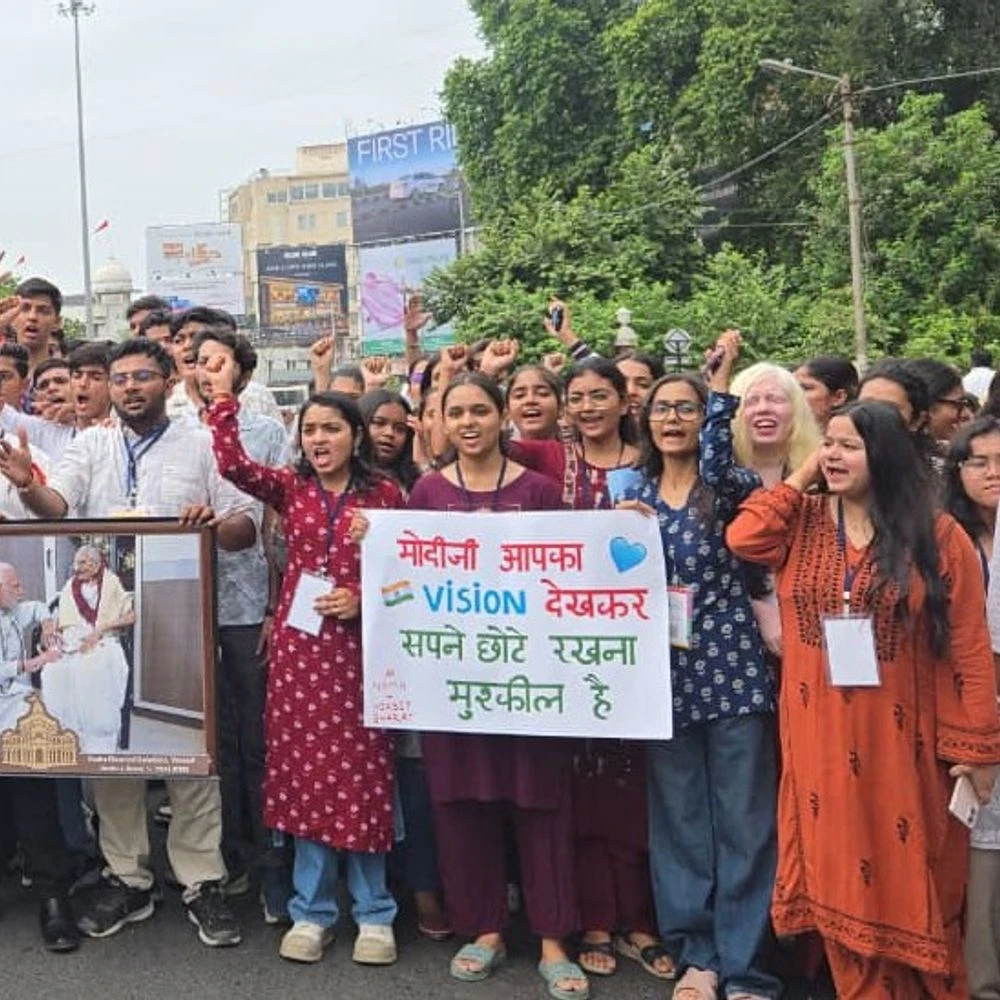
- Harshit Devani's artwork gift from Veraval accepted by PM Modi: Late in Vadodara. Seeing the memorial portrait of Hiraba and PM Modi, the artist said - the emotions cannot be described in words





Ranchhodrai Yagnik
A very thorough analysis of the recurring phenomenon of water logging in Vadodara. Very diligent exercise in obtaining details, understanding the impact, and presenting the ineffective manner of schemes by the various agencies - VMC, Gujarat government, Vishwamitri mission, Smart City project. Solutions have been suggested. Examples of other successful management of the problem have been presented. An outstanding report by Mr Rahul Vyas. A city that suffered massive flooding in 2024 monsoon season, and where all important roads are practically overtaken by civic body for development projects from October to following June, there are no results to show. Public suffers in monsoons and after monsoons when access to the available public infrastructure is also denied for inefficient projects.