It doesn't take a cloudburst to bring Vadodara to a standstill anymore. This monsoon, residents once again woke to submerged lanes, stalled two‑wheelers and water lapping at shop shutters after only a modest spell of rain. Continuous heavy rain left water accumulated on the city's main roads, disrupting daily life. For a city that markets itself as a "Sanskari Nagari" and a Smart City aspirant, the question writes itself on every waterlogged street corner: where does all the money go?
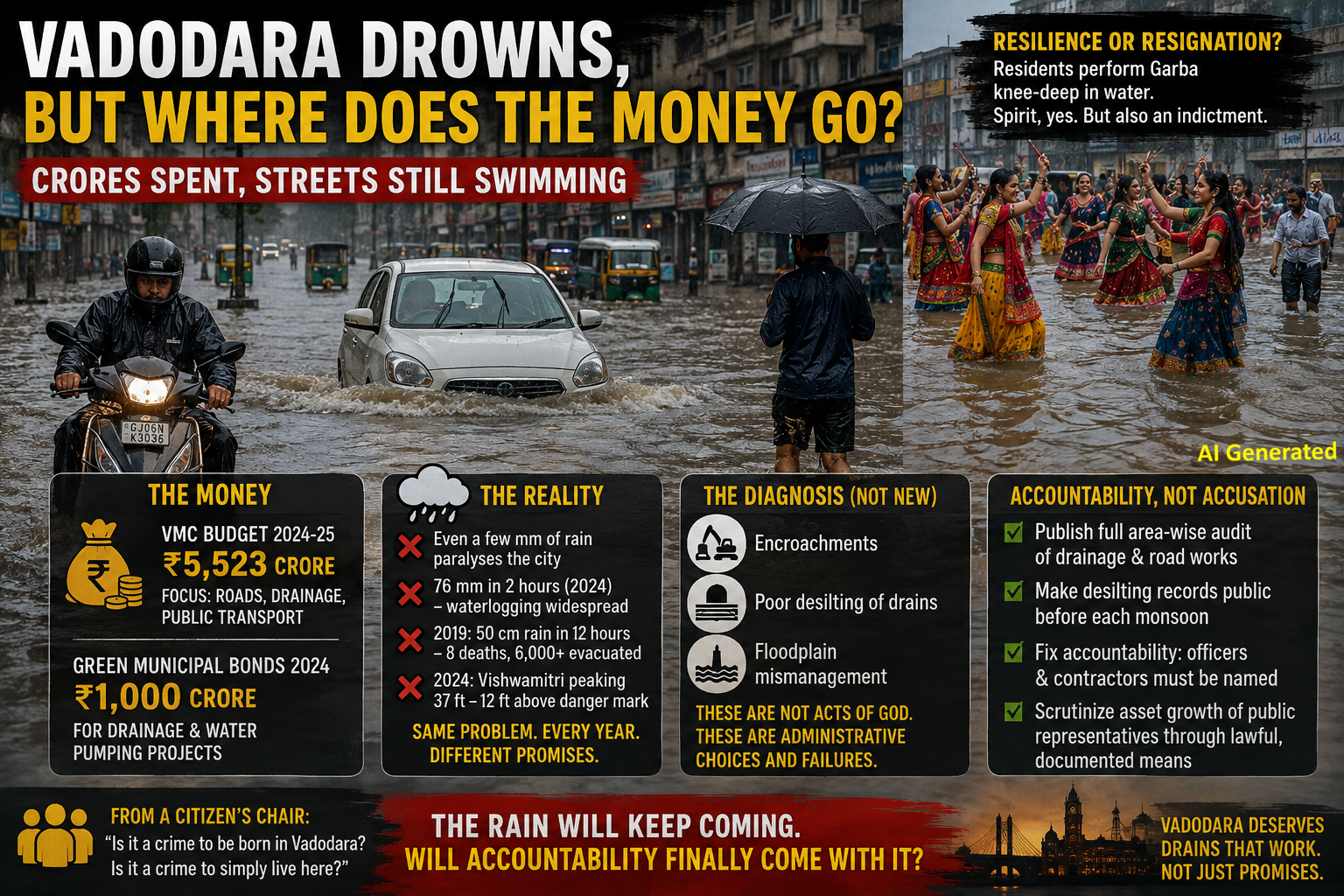
The paradox: modest rain, maximum chaos: The numbers tell an uncomfortable story. Vadodara's flooding is no longer only about extraordinary weather. Even sharp but short spells overwhelm the city. In one 2024 episode, the city received 76 mm of rain in just two hours, causing waterlogging in many areas and disrupting normal life. Residents this season report that far lighter showers a matter of a few millimetres in some pockets were enough to leave arterial roads impassable. When it does pour, the consequences are dramatic and now grimly familiar. In the 2019 disaster, nearly 50 cm of rain fell within 12 hours, the Vishwamitri River rose to a metre below the danger line and the Ajwa dam overflowed, flooding the city. That flood caused 8 deaths and the evacuation of more than 6,000 people. Five years later the pattern repeated: in 2024 the Vishwamitri surged again, peaking at 37 feet — 12 feet above the danger mark.
The city has become so accustomed to living in water that its resilience has turned surreal this year, a viral video showed residents performing Garba knee‑deep in water on a flooded road. It was celebrated as spirit. It should also be read as an indictment.
The money: crores committed, streets still swimming: This is where the anger sharpens. Vadodara is not a poor municipality starved of funds. The VMC's budget for the fiscal year 2024‑25 stood at an estimated around ₹5,523 crore, for 2025-26 around ₹6,200 crore, and for 2026-27 around ₹7,609 crore focusing heavily on roads, storm water drainage, and public transport infrastructure. On top of that, in 2024 the Corporation raised ₹1 billion through five‑year green municipal bonds at a 7.90% coupon, with the funds earmarked for three water pumping and drainage projects aimed at improving sewage and water disposal.
Thousands of crores for roads and drainage and yet the drains still choke, the roads still flood, and the same low‑lying neighbourhoods drown on schedule every June to September. The disconnect between spending and outcome is the central civic scandal of our time, and it deserves a straight answer, not another press release.
The diagnosis is already on record: Officials and the public do not lack a diagnosis; the causes have been named repeatedly. The VMC has faced routine criticism during monsoons for severe waterlogging in low‑lying areas, its handling of the Vishwamitri floodplains has come under the scanner from environmentalists and citizens, and unchecked encroachments and inadequate storm‑water drain desilting have been blamed for the recurring floods in 2019 and 2024.
Encroachment. Poor desilting. Floodplain mismanagement. These are not acts of God, they are administrative choices and administrative failures. Each one is a decision that a department made, or failed to make, year after year, despite the budget lines that exist precisely to prevent them.
Welfare of citizens, or growth of the powerful?
Here is the question every Vadodara household is entitled to ask its elected representatives: when the budget runs to thousands of crores and the drains still fail, whose interest is being served the citizen's, or the contractor's, the councillor's and the party's?
Accountability, not accusation, is the demand. A ruling dispensation that genuinely places citizen welfare first would:
- Publish a full, area‑wise audit of every rupee spent on storm‑water drainage and road resurfacing over the past five years, with third‑party verification of whether the work was actually done to specification.
- Make the desilting and drain‑cleaning records public before each monsoon, so claims of “pre‑monsoon readiness” can be checked against reality on the ground.
- Fix personal accountability name the officers and contractors responsible for drains that fail and recover costs for substandard work rather than quietly re‑tendering it.
- Order a transparent scrutiny of asset growth among current and former mayors, corporators and senior officials through the appropriate statutory bodies, using publicly available election affidavits and RTI‑backed records not rumour.
That last point matters and must be handled with care. Citizens have every right to ask why an office meant for public service coincides with visible private prosperity but the answer must come from documented affidavits, tax records and audits examined by lawful authorities, not from a newspaper's speculation. Demanding that scrutiny is journalism. Assuming its conclusion is not.
From a citizen's chair: “Is it a crime to be born here?”
Strip away the budget figures and what remains is exhaustion. Talk to a shopkeeper in a low‑lying ward bailing water out of his stock for the fifth straight year, or a mother who cannot send her child to school because the lane is a canal, and you hear the same weary line: “Is it a crime to be born in Vadodara? Is it a crime to simply live here?”
They pay their property tax on time property tax is one of the Corporation's largest internal revenue sources. They watch inauguration ribbons cut and hoardings go up. And then they watch the water rise, again, over roads that were “just repaired.” Their patience is not infinite, and it should not have to be.
How long must a citizen fight to get what the budget already promises? Has an unspoken “acceptable level” of inefficiency and leakage quietly become the standard a ceiling nobody in power seems in a hurry to lower? These are the questions the people of Vadodara are asking, and they are fair ones.
The bottom line: Vadodara does not need more sympathy videos or more emergency rescues. It needs its own money to do the job it was budgeted for. Thousands of crores, green bonds, Smart City tags none of it means anything to a family standing in ankle‑deep water on a road that flooded after a few millimetres of rain. The rain will keep coming. The only real question is whether the accountability will finally come with it.
0 thoughts on “Ankle deep again: A little rain, a big bill, and a city that keeps asking why?”
Leave a Reply
Your email address will not be published. Required fields are marked *

RECENT NEWS
- Tarot Horoscope for September 11: Taurus will get relief from old stresses and complications.
- Rs 95.65 lakh embezzlement in Savli's company: Former assistant manager commits fraud by transferring money from bank accounts to wife's and two other accounts
- From the middle of September, these 5 zodiac signs will be lucky, a yoga of immense success.
- Digital monitoring with AI cameras to reduce AMTS accidents: Over speed, driver talking on phone, smoking or snoring in a moving bus, the control room will be alerted immediately
- Harshit Devani's artwork gift from Veraval accepted by PM Modi: Late in Vadodara. Seeing the memorial portrait of Hiraba and PM Modi, the artist said - the emotions cannot be described in words