When the Temple of Justice Becomes a Labyrinth: The Troubling Saga of Review Petition (C) No. 003035/2025
Date: 07 February 2026
PROLOGUE: THE WEIGHT OF A QUESTION UNANSWERED
"All the rights secured to the citizens under the Constitution are worth nothing, and a mere bubble, except guaranteed to them by an independent and virtuous Judiciary."
These words, etched in the annals of constitutional jurisprudence, resonate with haunting prescience as we examine a case that has traversed the corridors of justice for over twenty months—only to find doors closed, communications unanswered, and fundamental questions about electoral integrity left unaddressed. The journey of Dr. Rahul Vasudevbhai Vyas, a citizen of Vadodara who dared to challenge what he perceived as systemic electoral irregularities, reads less like a legal proceeding and more like a Kafkaesque nightmare where the seeker of justice finds himself trapped in an endless maze of procedural opacity.
This is not merely the story of one man's legal battle. This is a mirror held up to the face of our democracy—and what reflects back demands our urgent attention.
THE GENESIS OF A DEMOCRATIC GRIEVANCE
The Election That Sparked a Constitutional Question: On 7th May 2024, the citizens of Vadodara-20 Lok Sabha constituency exercised their sacred democratic right. When the results were declared on 4th June 2024, Dr. Hemang Yogeshbhai Joshi of the Bharatiya Janata Party emerged victorious. For most, it was the end of an electoral exercise. For Dr. Rahul Vasudevbhai Vyas, an independent candidate, it was the beginning of an odyssey that would test the very foundations of India's democratic institutions.
Dr. Vyas, armed with data, observations, and constitutional conviction, filed Election Petition No. 3/2024 before the Hon'ble High Court of Gujarat. His allegations were not frivolous—they struck at the heart of electoral integrity:
The Disturbing Pattern of Consistency: An analysis of Lok Sabha election results from Vadodara-20 spanning 2014, the 2014 by-poll, 2019, and 2024 revealed what can only be described as a statistical anomaly that defies probability. Despite fluctuations in voter turnout—71% in 2014, 47% in the by-poll, 68% in 2019, and 62% in 2024—the ruling party candidates consistently received approximately 72% of the vote share. The percentage of votes received by the top three entities (BJP, INC, and NOTA) remained eerily constant at 98.04%, 98.89%, 97.79%, and 97.57% respectively.
As Chanakya wisely observed: "The root of wealth is the state." When patterns defy the natural variations inherent in democratic choice, when numbers align with mathematical precision across varying circumstances, the citizenry has not merely a right but a sacred duty to question.
The EVM Battery Anomaly: On counting day, 4th June 2024, every Electronic Voting Machine in the Vadodara Lok Sabha-20 constituency showed battery percentages of 98% or higher—after 27 days of storage in locked rooms. When challenged, the technical staff offered an explanation that would make any electrical engineer raise an eyebrow: "due to high temperature in Vadodara city, there was no deterioration of EVM battery."
The Ranking That Never Changed: Perhaps most troubling was the observation that from the first round of counting to the last, the rankings of all 14 candidates and NOTA remained identical. In the natural chaos of democracy, where every vote shifts possibilities, such perfect consistency is not a testament to order—it is a question mark against authenticity.
THE HIGH COURT CHAPTER—WHERE PROCEDURE TRUMPED SUBSTANCE
The Application Under Order 7 Rule 11: A Premature Burial? The election petition was met not with adjudication on merits but with an application under Order 7 Rule 11 of the Civil Procedure Code, 1908. On 12th December 2024, the Hon'ble Gujarat High Court rejected the election petition at the threshold. But the circumstances surrounding this rejection raise profound questions about procedural fairness:
The Vanishing Date: The case was scheduled for final order on 2nd December 2024. Yet, on that day, the case did not appear on the cause list. It was mysteriously transferred to 13th December 2024—without any order, without any communication to the petitioner. The final judgment was delivered on 12th December 2024, a day when the petitioner was absent because he was unaware of the changed date.
"Procedure established by law must be just, fair, and reasonable, not fanciful, oppressive, or arbitrary." When dates change without notice, when petitioners are kept in procedural darkness, when justice is administered in absentia without prior intimation—what message does this send to citizens who approach courts as their last resort?
The Disparity in Time: During hearings, the senior advocate representing the respondent was accorded approximately one hour on 16th October 2024 and thirty minutes on 17th October 2024. The petitioner, appearing in person, was allocated approximately fifteen to seventeen minutes, squeezed into the dying minutes of court hours at around 4:40 PM on 24th October 2024.
"A person becomes great not by sitting on some high seat, but through higher qualities. Can a crow become an eagle by simply sitting on the top of a palatial building?" The seniority of counsel cannot—and must not—determine the quantum of justice a citizen receives. Before the law, the self-represented litigant and the senior advocate must stand equal.
The Delayed Judgment: The oral order was delivered on 12th December 2024. The detailed judgment was not uploaded on the Gujarat High Court website until 23rd December 2024—eleven days during which the petitioner could not even begin to formulate his next legal step. Justice delayed in the digital age, when upload is a matter of minutes, raises uncomfortable questions about intent.
THE SUPREME COURT—HOPE AND HEARTBREAK
Special Leave Petition: Article 136 and the Promise of Constitutional Review: With unwavering faith in the constitutional design, Dr. Vyas approached the Supreme Court of India through Special Leave Petition (Civil) No. 6218/2025. The petition raised substantial questions of law:
- Whether election petitions can be summarily dismissed under Order 7 Rule 11 CPC when they disclose valid causes of action under the Representation of the People Act, 1951?
- Whether the Gujarat High Court's interpretation violated settled precedents including “Azhar Hussain v. Rajiv Gandhi” (AIR 1986 SC 1253), “Ram Sukh v. Dinesh Aggarwal” (2009), and “G.M. Siddeshwar v. Prasanna Kumar” (2013)?
- Whether the consistent vote patterns across four elections warranted investigation rather than dismissal?
On 4th April 2025, the Special Leave Petition was dismissed with a one-line order: "We are not inclined to interfere with the impugned judgment passed by the High Court. Hence, the Special Leave Petition is dismissed."
The hearing lasted approximately one minute. No opportunity for oral arguments was provided. No reasons were recorded. A matter touching the integrity of electoral democracy—a matter that could affect public confidence in the entire voting system—was disposed of before the petitioner could even complete a sentence.
"The judiciary must remain vigilant against the tyranny of the executive." But who guards the guardians when vigilance itself is compressed into sixty seconds?
THE REVIEW PETITION SAGA—NINE MONTHS IN PROCEDURAL PURGATORY
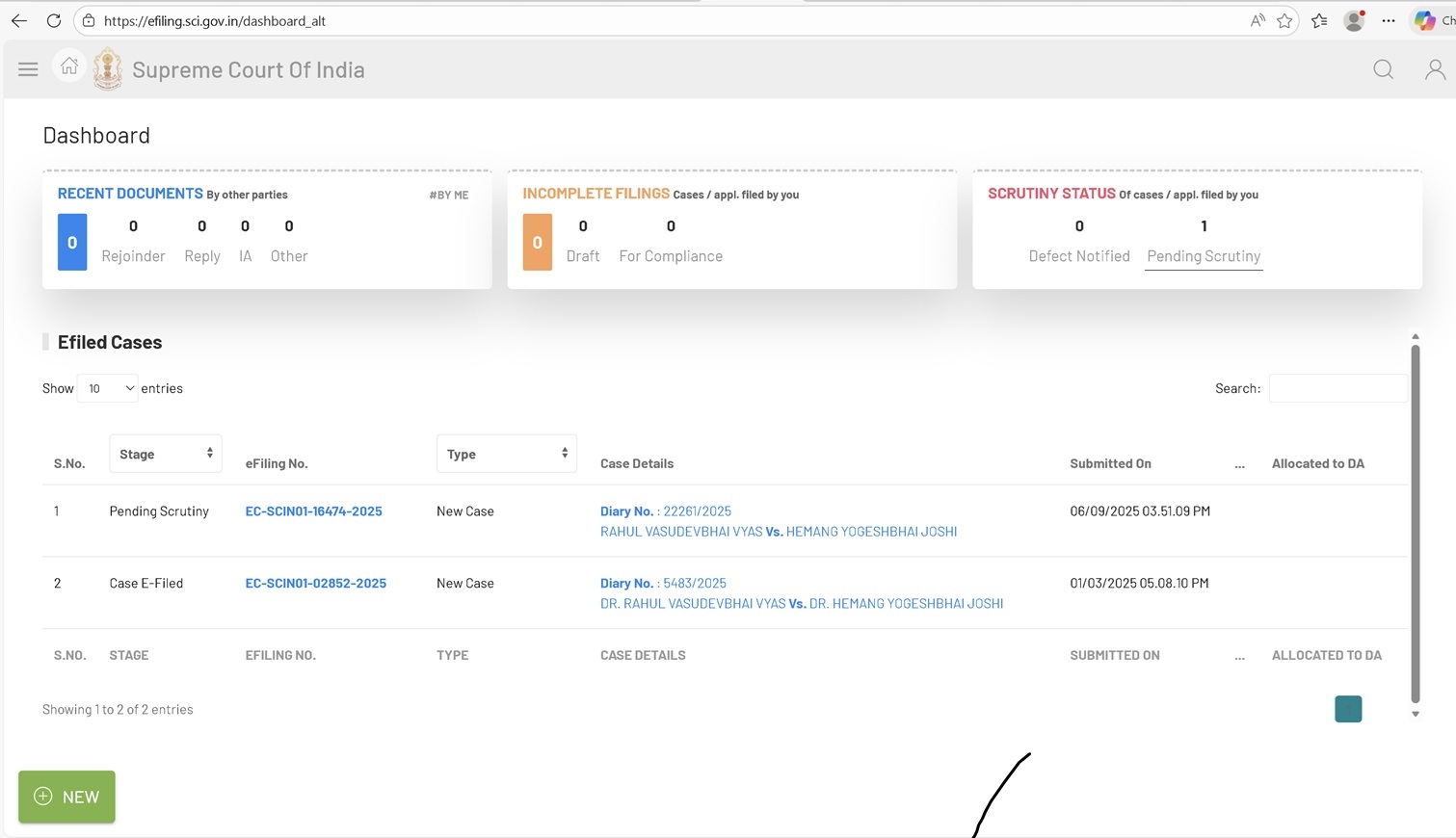
Filed on 25th April 2025: The Beginning of a Bureaucratic Odyssey: On 25th April 2025, Dr. Vyas filed a Review Petition under Article 137 of the Constitution of India. What followed is a chronicle of procedural opacity that should concern every citizen who believes in the promise of accessible justice.
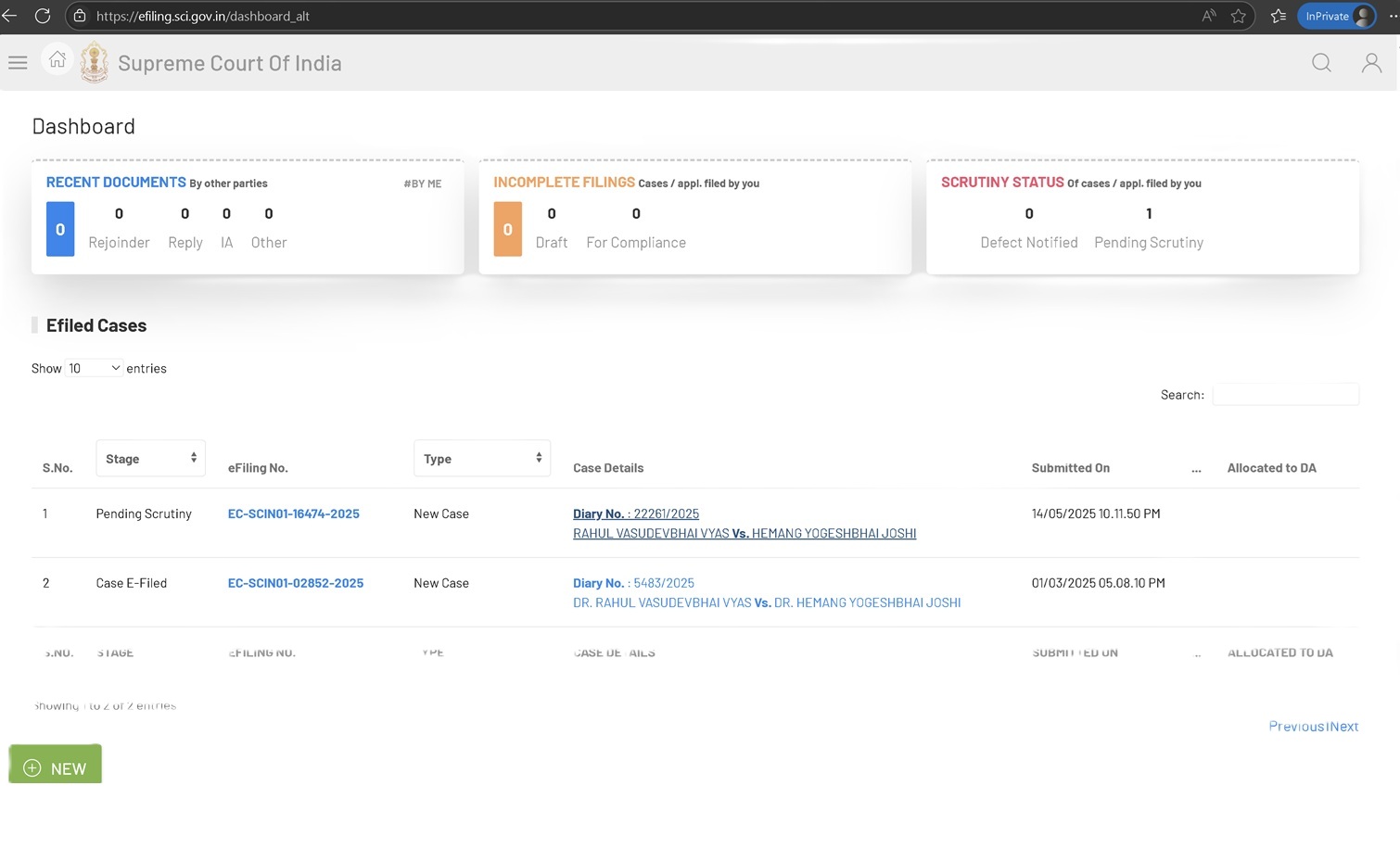
The First Communication Gap: From the date of filing until 21st July 2025—a period of nearly three months—there was no communication from the Registry. The e-Filing portal displayed "Pending Scrutiny." The petitioner waited, believing that the machinery of justice was processing his plea.
The Email of 21st July 2025: After receiving no updates, Dr. Vyas sent an email to the Supreme Court Registry seeking status. The response came on 22nd July 2025: the petition was defective and required four modifications. But here is the troubling part—the petitioner had already uploaded corrections on 14th May 2025, as evidenced by portal screenshots. The Registry, apparently, had not received them.
"Democracy survives when citizens have the right to make informed choices." When official portals show one status while Registry records reflect another, when corrections filed in good faith are not received, when months pass without acknowledgment—the citizen is not making informed choices. The citizen is groping in procedural darkness.
The Symphony of Silence: Following the defect communication, Dr. Vyas embarked on a marathon of compliance and follow-up:
- 25th July 2025: Corrected version submitted
- 21st August 2025: Follow-up and further corrections
- 29th August 2025: Additional submissions per telephonic guidance
- 17th September 2025: Further corrected version
- 19th September 2025: Application for condonation of 67-day delay submitted (as telephonically demanded)
More than six emails were sent between 14th October 2025 and 7th January 2026. Not one received a response. Not one was acknowledged. The silence was deafening.
The Portal Paradox: As of 7th January 2026, the petitioner faced a Kafkaesque contradiction:
- The SCI e-Filing Portal showed: "Pending Scrutiny"
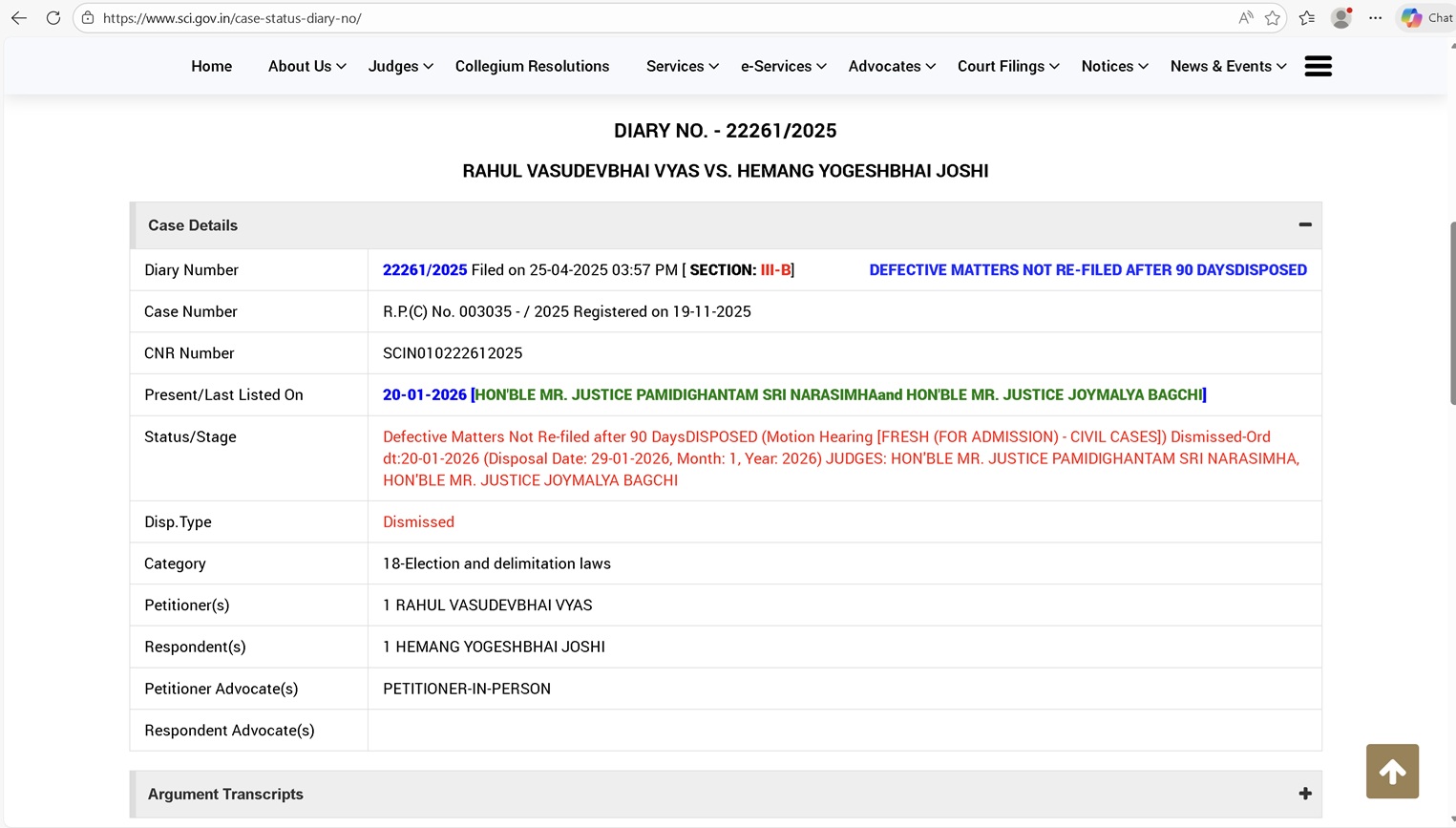
- The SCI Main Website showed: "Defective matters not refiled after 90 days"
Two official government portals, two contradictory statuses, one bewildered citizen caught between them.
THE FINAL ACT—THE CHAMBER HEARING AND ITS AFTERMATH
The Letter to the Chief Justice of India: 11th January 2026
Having exhausted every possible channel of communication, Dr. Vyas took the extraordinary step of writing directly to the Hon'ble Chief Justice of India. The application, sent both by email and speed post, was not a complaint but a prayer for clarity. It requested:
1. Confirmation of whether corrected documents were on record
2. Reconciliation of contradictory portal statuses
3. A consolidated final defect memo if issues remained
4. Indication of next procedural steps
5. Basic acknowledgment of his correspondence
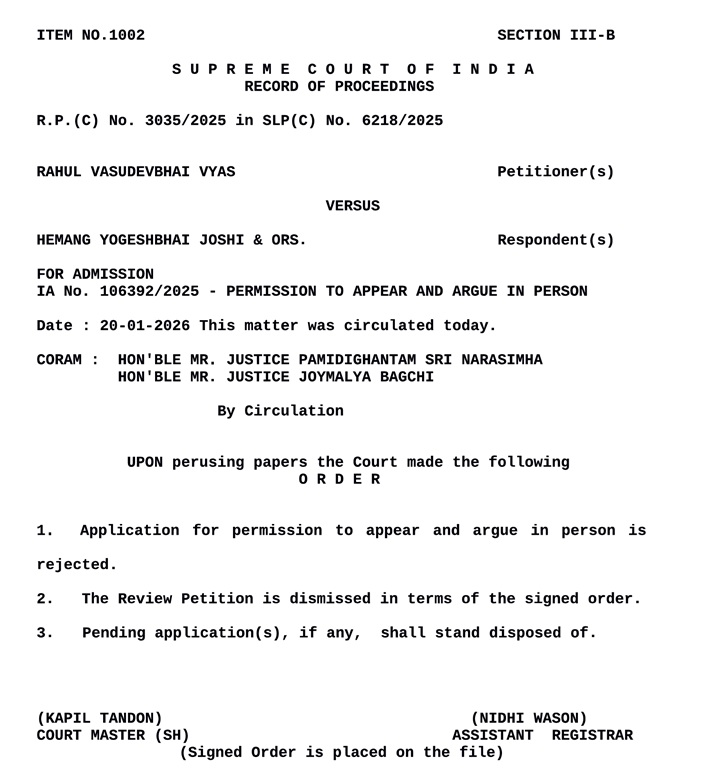
The Listing: The review petition was finally listed for chamber hearing on 20th January 2026, with Case Number R.P.(C) No. 003035/2025, having been registered on 19th November 2025.
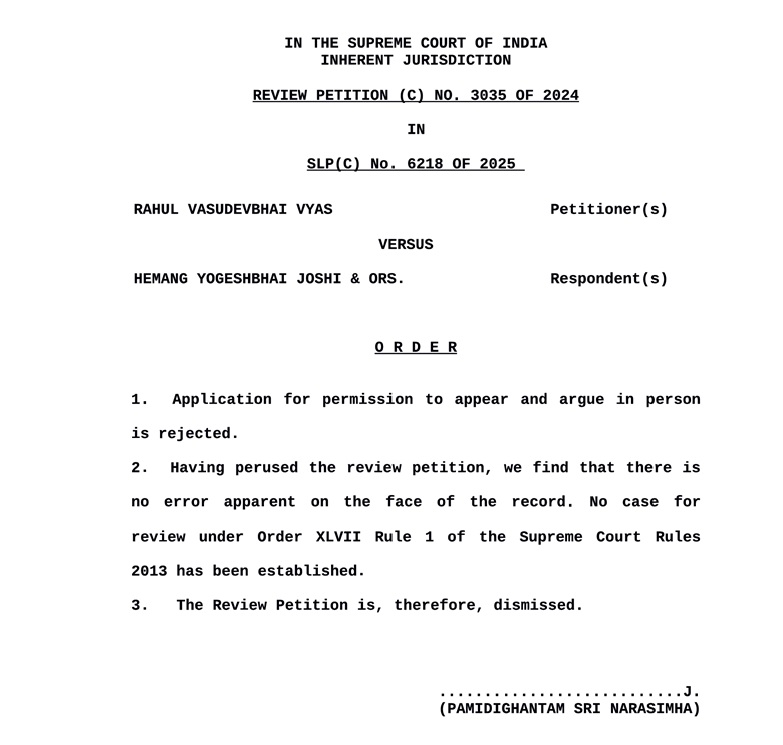
The Order of 29th January 2026: The final order, available online on 29th January 2026—nine days after the hearing—contained three points:
1. Application for permission to appear and argue in person: REJECTED
2. Having perused the review petition, no error apparent on the face of the record was found. No case for review under Order XLVII Rule 1 of the Supreme Court Rules 2013 was established.
3. The review petition is therefore DISMISSED.
Not a single ground raised in the review petition was discussed. No reasons were provided. No grounds from the petition were addressed. No reference was made to the substantial questions of law raised. The petition evaporated in the judicial machinery without leaving a trace of engagement with its substance.
THE QUESTIONS THAT HAUNT DEMOCRACY
Why Nine Days Between Hearing and Order?
The chamber hearing was on 20th January 2026. The order was available online on 29th January 2026. What transpired in those nine days?
In an age of instantaneous digital communication, where court orders can be uploaded within hours, a nine-day gap invites speculation that courts should ideally never attract. Was there deliberation? Was there consultation? Were there considerations beyond the legal merits?
"The bedrock of our democracy is the rule of law and that means we have to have an independent judiciary, judges who can make decisions independent of the political winds that are blowing."
When timing raises questions, transparency becomes the only antidote to suspicion. Silence, in such circumstances, fertilizes distrust.
The Mandate on Election Petitions: Did it Apply?
It is settled law that election petitions are not to be dismissed at the threshold under Order 7 Rule 11 CPC unless they are patently frivolous or vexatious. The Supreme Court's own precedents—"Raj Narain v. Indira Nehru Gandhi” (1975), “Azhar Hussain v. Rajiv Gandhi” (1986), “G.M. Siddeshwar v. Prasanna Kumar” (2013)—establish this principle unequivocally.
The election petition filed by Dr. Vyas contained specific allegations, data, and patterns. It may have been unpolished in legal draftsman ship—he was a party-in-person. But did it deserve examination on merits? The courts said no. The citizen remains unconvinced.
The Black Box Called EVM:
At the heart of this petition lies a question that India has refused to answer with the transparency democracy demands: What code runs our Electronic Voting Machines?
The petitioner raised concerns about EVM software—software that no candidate, no citizen, no independent authority is permitted to examine. The Election Commission of India guards this code with the secrecy typically reserved for military installations. Yet this code determines who governs us. This code translates the will of 900 million voters into electoral outcomes.
"A ruler without discipline is like a mad elephant; it can destroy everything." When the instrument of democracy is opaque, when its functioning is an article of faith rather than verification, the foundation of representative government rests on trust alone. And trust, without the anchor of verification, is a fragile foundation for something as important as democracy.
The petitioner asked for the EVM software to be examined in the presence of candidates. The prayer was dismissed as "beyond the scope of an election petition." If not in an election petition, then where? If not by citizens who contest elections, then by whom? If not now, then when?
THE INSTITUTIONAL CRITIQUE—REGISTRY AS GATEKEEPER
When Administrative Machinery Becomes an Obstacle Course
The journey of Review Petition (C) Diary No. 22261/2025 through the Supreme Court Registry is a case study in administrative opacity. Consider the timeline:
| Date | Event | Days Elapsed |
|------|-------|--------------|
| 25.04.2025 | Review Petition e-filed | Day 0 |
| 06.05.2025 | Defect letter issued | Day 11 |
| 14.05.2025 | Corrections uploaded (portal shows "Pending Scrutiny") | Day 19 |
| 21.07.2025 | First email seeking status (no prior communication) | Day 87 |
| 22.07.2025 | Reply received stating petition defective | Day 88 |
| 25.07.2025 to 17.09.2025 | Multiple corrections submitted | Days 91-145 |
| 19.09.2025 | Condonation application submitted | Day 147 |
| 14.10.2025 to 07.01.2026 | Six+ follow-up emails—NO RESPONSE | Days 172-257 |
| 11.01.2026 | Letter to Chief Justice of India | Day 261 |
| 20.01.2026 | Chamber hearing | Day 270 |
| 29.01.2026 | Order available online | Day 279 |
Nine months. Two hundred seventy-nine days from filing to final order. Six emails unanswered. Portal statuses contradicting each other. A petitioner left to navigate a system, appearing as a citizen with nothing but constitutional faith. "Judicial independence is not a cloistered virtue; it is the bedrock of democracy." But judicial independence also means independence from bureaucratic barriers that filter out citizens before they can even reach the judicial mind.
THE LARGER MALAISE—PATTERNS ACROSS THE SYSTEM
Gujarat High Court: A Prelude to Supreme Court Silence
The procedural irregularities at the Gujarat High Court were not isolated incidents—they formed a pattern that repeated at the Supreme Court level:
At Gujarat High Court:
- Dates changed without notice (2nd December to 13th December 2024)
- Judgment delivered when petitioner was absent
- Detailed order delayed for eleven days
- Disparity in time allocation between senior advocates and party-in-person
At Supreme Court:
- SLP dismissed in approximately one minute without oral hearing
- Review petition languished for nine months
- Emails ignored
- Portal statuses contradicted each other
- Final order nine days after chamber hearing
"Democracy survives only when citizens have a right to challenge injustice." But when the mechanisms of challenge are themselves barriers, when the doors of justice swing open readily for some and remain stubbornly shut for others, democracy does not die in one dramatic moment—it erodes, silently, incrementally, through a thousand procedural frustrations.
THE CONSTITUTIONAL IMPLICATIONS
Fundamental Rights: Articles 14 and 21 Under Strain
Article 14 guarantees equality before law. When a senior advocate receives hours of hearing time while a party-in-person receives minutes, when emails from ordinary citizens are ignored while institutional communications receive prompt attention, the promise of equality becomes a cruel irony.
Article 21 protects life and liberty, which the Supreme Court has expansively interpreted to include the right to a fair procedure, the right to be heard, the right to access justice. When a citizen files a review petition and spends nine months in procedural limbo, when communications are met with silence, when corrections filed are not received, this right is not just denied—it is mocked.
Article 136 empowers the Supreme Court to grant special leave to appeal from any court or tribunal. This is an extraordinary jurisdiction, meant to be exercised to correct substantial injustice. When an SLP raising questions about electoral patterns across four elections is dismissed in one minute without hearing, the purpose of this constitutional provision is defeated.
Article 137 allows the Supreme Court to review its own judgments. This is the final constitutional safety valve, the last chance to correct errors apparent on the face of the record. When a review petition is dismissed without addressing any of the specific grounds raised, without engaging with any of the precedents cited, without providing any reasons whatsoever, this safety valve becomes merely ornamental.
THE EVM QUESTION—DEMOCRACY'S ACHILLES HEEL
The Code That Controls Our Votes
We must pause here to address the elephant in the room—the Electronic Voting Machine and its inviolable secrecy.
Dr. Vyas raised specific concerns:
1. Battery anomalies (98%+ after 27 days)
2. Consistent vote patterns defying statistical probability
3. Rankings that never changed during counting
His prayer was simple: allow candidates or their representatives to examine the EVM software during installation. The Election Commission refused. The courts found the prayer "beyond scope."
Consider what this means: We vote on machines whose functioning we must accept on faith. We trust that the code translates our intentions accurately. We believe that no manipulation is possible. `And we have no way—absolutely no way—to verify any of this.
Countries around the world have debated EVM security. Germany's Federal Constitutional Court ruled that electronic voting without paper trails violates democratic principles because citizens cannot verify the process. The Netherlands abandoned EVMs entirely after security concerns. Ireland spent millions on EVMs only to warehouse them unused after public resistance.
In India, we press a button, hear a beep, see a slip (if VVPAT is available), and trust. That trust is the foundation of our electoral democracy. "The ruler's foremost duty is to protect his kingdom, wealth, and subjects." In a democracy, the rulers are chosen by the people. When the mechanism of choice is opaque, when questions about it are dismissed as beyond scope, the very legitimacy of governance becomes questionable.
THE RULING PARTY NEXUS—ALLEGATIONS AND OBSERVATIONS
A Pattern That Demands Scrutiny
The petitioner has made serious allegations that deserve to be stated plainly, with the caveat that these are allegations and not proven facts:
1. Alignment of Election Commission with Ruling Party: The petitioner alleges that responses from the Election Commission of India to his complaints were either absent or inadequate. Information about ruling party candidates allegedly reached the party before proper channels would allow.
2. Judicial Transfers and Case Transfers: The petitioner observes a pattern where judges who do not align with perceived ruling party interests are transferred, or cases are reassigned to different benches. This observation, whether accurate or not, reflects a perception that undermines public confidence.
3. Advocate Seniority and Judicial Access: The petitioner experienced disparity in treatment between senior advocates (representing the ruling party's winning candidate) and himself (an independent candidate appearing in person).
4. Procedural Conveniences: Dates that change without notice, orders that are delayed, communications that go unanswered—these may be bureaucratic inefficiencies, or they may be something more. The lack of transparency makes it impossible to distinguish negligence from design. We do not assert the truth of these allegations. But we assert their seriousness. In a democracy, even the appearance of impropriety must be addressed. When citizens begin to believe—rightly or wrongly—that the system is rigged against them, democracy suffers a wound that no constitutional provision can heal.
THE COST OF CORRUPTION—A NATION'S BURDEN
Short-Term Gains, Long-Term Catastrophe: "The corruption and alignment due to personal gain will support you in short term but the cost is always paid by all citizens." Those who manipulate systems for immediate advantage fail to calculate the compound interest of institutional decay. When courts lose credibility, disputes move to streets. When elections lose legitimacy, power loses consent. When citizens lose faith, compliance becomes coercion.
The petitioner in this case invested twenty months of his life, countless hours of effort, significant emotional and financial resources, pursuing justice through proper channels. He followed every rule, filed every document, waited every day. What did he receive in return?
- A one-minute dismissal of his SLP
- Nine months of silence on his review petition
- Final rejection without reasons
- Six emails without acknowledgment
- Portal statuses that contradicted each other
If this is what awaits a citizen who plays by the rules, why would any citizen continue to play by the rules? The tragedy is not one man's loss—the tragedy is the lesson that loss teaches to every citizen watching.
THE WAY FORWARD—REFORMS THAT CANNOT WAIT
Recommendations for Democratic Restoration
Based on the patterns observed in this case and others like it, the following reforms appear urgent:
1. EVM Transparency:
- Allow independent technical audits of EVM software
- Provide candidates access to observe software installation
- Publish source code for public scrutiny
- Conduct parallel paper ballot verification in randomly selected constituencies
2. Registry Reforms:
- Mandate response timelines for all communications
- Ensure portal statuses are synchronized across platforms
- Create dedicated helpdesks for party-in-person litigants
- Publish processing timelines for each category of petition
3. Hearing Standards:
- Establish minimum hearing times for substantial matters
- Ensure parity between represented and self-represented parties
- Record reasons for all disposals, however brief
- Provide opportunities for oral arguments before dismissal
4. Election Petition Procedures:
- Mandate merit examination before threshold dismissal
- Time-bound resolution of election disputes
- Special benches with electoral expertise
- Video recording of all election petition hearings
5. Judicial Accountability:
- Transparent mechanisms for transfer of judges
- Public disclosure of case reallocation patterns
- Regular audits of procedural compliance
- Citizen feedback systems for court administration
THE PETITIONER'S JOURNEY—A HUMAN STORY
Dr. Rahul Vasudevbhai Vyas: Citizen as Conscience
Behind the case numbers and legal provisions is a human being. Dr. Vyas is not a politician. He is a consultant from Vadodara who observed anomalies in his constituency's election and chose to act.
He filed his nomination online, only to encounter website errors. He spent three hours with the technical team without resolution. He was forced to submit offline, already disadvantaged before the election began. He contested as an independent—without party machinery, without funding, without the army of lawyers and agents that political candidates command.
He lost the election. That is democracy—most candidates lose. But he observed patterns that troubled him. Numbers that didn't add up. Procedures that weren't followed. Machines that behaved unusually. And he chose not to remain silent.
"Democracy survives only when citizens have a right to challenge injustice." For twenty months, he has challenged. He has filed petitions, written emails, made phone calls, submitted corrections, waited in procedural queues, and maintained his faith in institutions that have given him little reason for that faith. His applications have been rejected. His arguments have been unheard. His emails have been unanswered. His questions remain unaddressed. But his journey is not meaningless. It is a testament—a testament to what citizens face when they dare to question, a record of institutional response (or its absence), a document for history to judge.
THE VERDICT OF CONSCIENCE: When Law Falls Silent, Citizens Must Speak
This editorial does not claim that Dr. Vyas is right in all his allegations. Courts have examined his petitions and found them wanting. That is their prerogative, their constitutional function, their judicial determination.
But we do claim that the manner of examination raises questions. We do claim that procedural treatment reveals disparities. We do claim that democratic institutions must be held to higher standards precisely because democracy depends on them.
The questions raised in Election Petition No. 3/2024 deserved answers:
- Why do vote percentages remain constant across four elections despite varying turnouts?
- Why do EVM batteries show no deterioration after weeks of storage?
- Why do candidate rankings remain unchanged throughout counting?
- What code runs the machines that count our votes?
Instead of answers, the petitioner received dismissals—at the High Court threshold, in the Supreme Court in one minute, in review without reasons.
Perhaps the answers would have vindicated the electoral system. Perhaps investigation would have proven the patterns to be coincidental, the batteries to be superior, the rankings to be authentic. We will never know. The questions were not examined—they were rejected.
And in that rejection lies a loss not just for one petitioner, but for democratic discourse itself.
EPILOGUE: THE CALL TO CONSCIOUSNESS: "Judicial independence is not a cloistered virtue; it is the bedrock of democracy."
We conclude this editorial with neither optimism nor despair, but with awareness. Awareness that our institutions are imperfect. Awareness that procedures can become barriers. Awareness that silence from those who should speak is itself a message.
The story of R.P.(C) No. 003035/2025 is not over. It is part of a larger story—the story of Indian democracy in the third decade of the twenty-first century, struggling with questions of transparency, accountability, and trust. The petitioner has done his part. He has questioned, documented, persisted, and recorded. History will have access to his emails, his applications, his portal screenshots, his timeline of silence.
Now the question passes to us—the citizens, the observers, the inheritors of this democracy:
Will we continue to trust systems we cannot verify?
Will we accept procedures that exclude rather than include?
Will we remain silent when silence becomes complicity?
The answers we give—through our attention, our advocacy, our action—will determine whether democracy survives not as a label but as a living reality. "The root of wealth is the state." The root of democracy is its people. When the people stop questioning, democracy stops breathing. Let us not stop breathing.
Dr. Vyas fought with whatever resources an ordinary citizen possesses. He fought without a lawyer, without political backing, without government-funded senior advocates. He fought because he believed that in India, one citizen’s voice still matters. Democracy survives only when citizens have the right to challenge injustice. When that right is extinguished without a whisper, we are left with only the hollow ritual of pressing a button on a machine whose heart nobody is allowed to see. History will judge this silence harshly. Because “a crow, even if it sits on the highest throne in the land, will never become an eagle”. He did everything the system asked of him. The system responded with silence, delay, and dismissal. This is not justice delayed. This is justice denied — systematically, institutionally, and with chilling efficiency.
These are not abstract fears. They are documented experiences of a citizen who fought with nothing but constitutional faith and received, in return, institutional indifference. “All the rights secured to the citizens under the Constitution are worth nothing, and a mere bubble, except guaranteed to them by an independent and virtuous Judiciary.” When a Special Leave Petition raising substantial questions of electoral integrity is dismissed in approximately one minute without oral hearing, when a review petition is dismissed without addressing a single ground, when emails remain unanswered for months — the citizen is entitled to ask: Is the judiciary still independent, or has it become institutionally aligned?
Disclaimer: This editorial is based on court filings, official portal screenshots, and correspondence made available by the petitioner. Judicial orders referred to are matters of public record. The views expressed are analytical and do not impute motive without evidence. Readers are encouraged to access primary documents for complete context.
This editorial is based on publicly available court documents, petitions, and applications provided by the petitioner in the referenced case. The allegations contained herein represent the petitioner's claims as stated in his legal filings and have not been independently verified by this publication. Courts of competent jurisdiction have adjudicated upon these petitions and rendered their decisions. This editorial represents commentary and opinion on matters of public interest concerning judicial procedure, electoral transparency, and access to justice. It does not constitute legal advice or definitive findings of fact. All parties mentioned are presumed to have acted in accordance with their understanding of law and duty unless proven otherwise in appropriate proceedings. The quotations used are from various sources of jurisprudence and political philosophy and are employed for rhetorical and analytical purposes. Readers are encouraged to examine primary sources and form their own conclusions. For comments, corrections, or further information, contact the editorial desk (+91 94092 67098).

0 thoughts on “DEMOCRACY UNDER SIEGE: A Citizen's Nine-Month Battle Against Registry Walls and Judicial Silence Raises Fundamental Questions About Electoral Justice in India”
Leave a Reply
Your email address will not be published. Required fields are marked *


RECENT NEWS
- Ankita Parmar's Insta Girl Naina Parmar Gets Zilla Panchayat Ticket, Husband Says This Fight Is For People's Rights
- Poets of the city were present at the release of 'Adhyakshar': 'Adhyakshar' was created with prose-poems, folk songs and works of the students.
- 'Where will we go now, our shelter has been snatched away': 'If inflation is rising, what will we do for our women', say Ward-1 residents 'We will vote for those who will do good work'
- 30 hoardings removed from Akota-Taj Hotel road
- Navkar Mantra Diwas celebrated: 16,000 Jains chanted 17.28 lakh Jains at 3 places