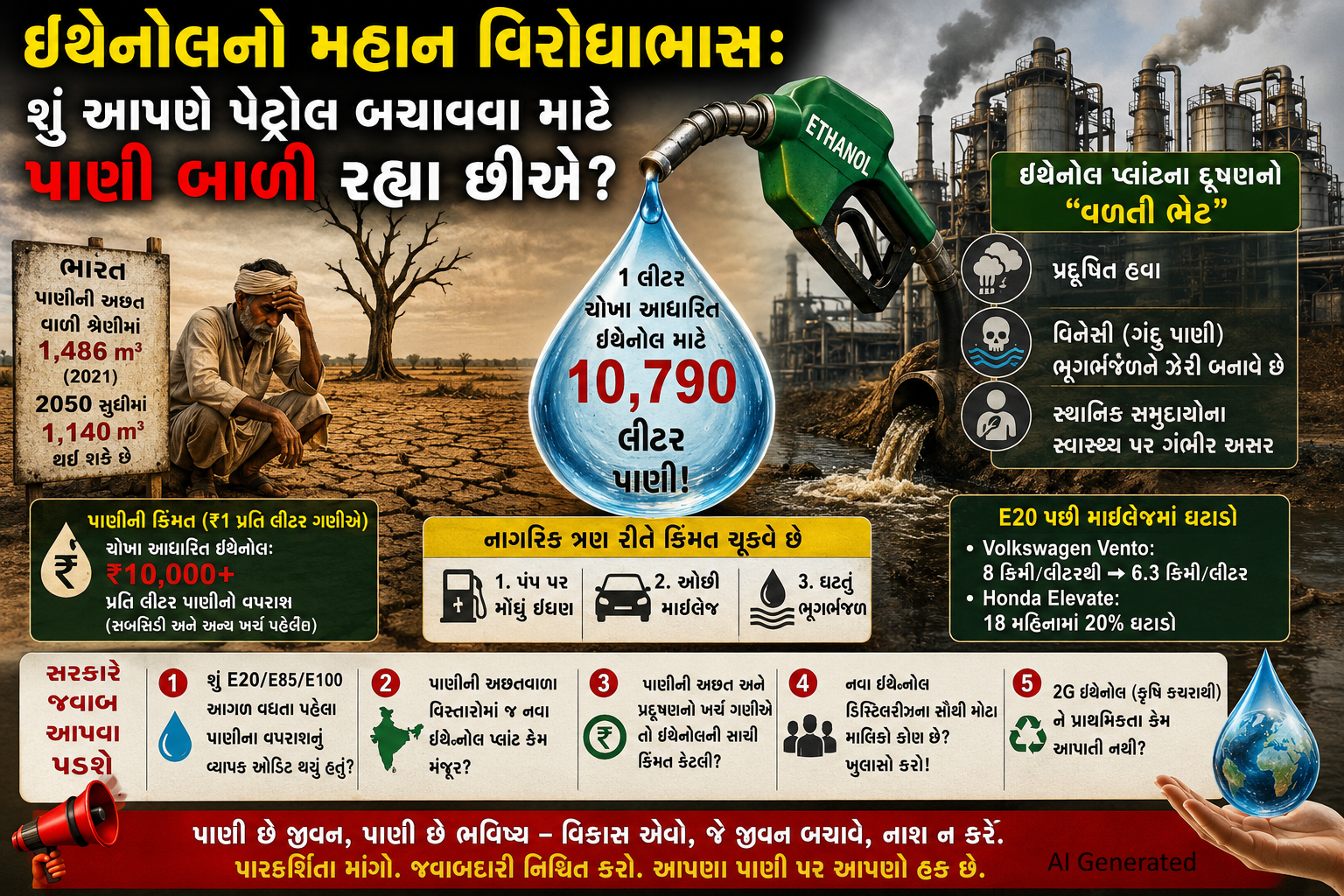
The Great Ethanol Paradox: Are We Burning Water to Save Petrol?
India's ambitious ethanol blending programme has been celebrated as a shining success story of energy independence. India achieved 20 per cent ethanol blending in petrol in March 2025, five years ahead of target, and the Government is now aggressively pushing for E85 and E100 flex-fuel adoption. But beneath the glossy press releases lies an uncomfortable question that every Indian citizen deserves an answer to: at what real cost?
While official communication celebrates carbon savings, a growing body of scientific evidence, expert opinion and independent journalism suggests the country may be trading one crisis (oil imports) for another, far more dangerous one — a water catastrophe.
The Numbers That Should Worry Every Indian
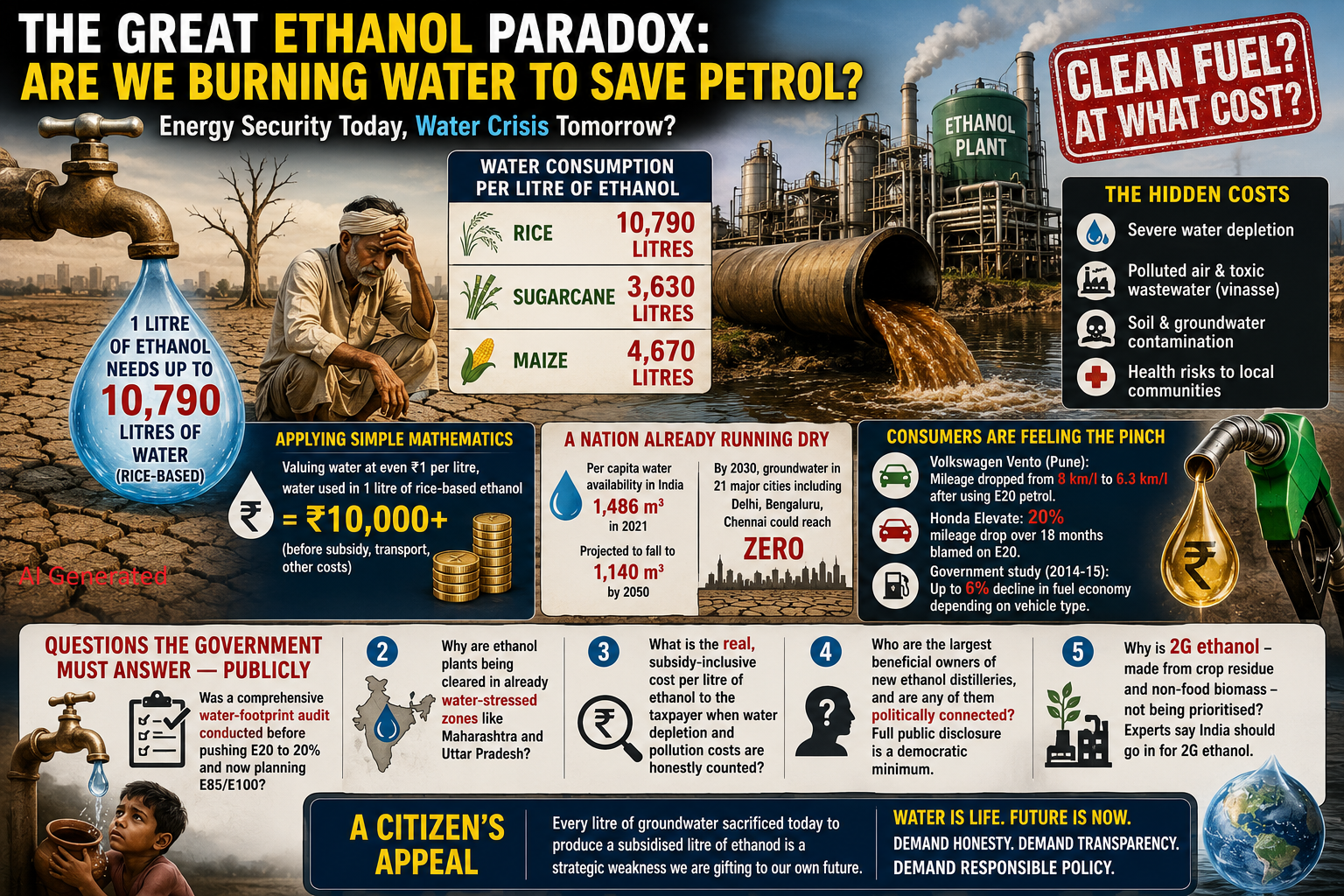
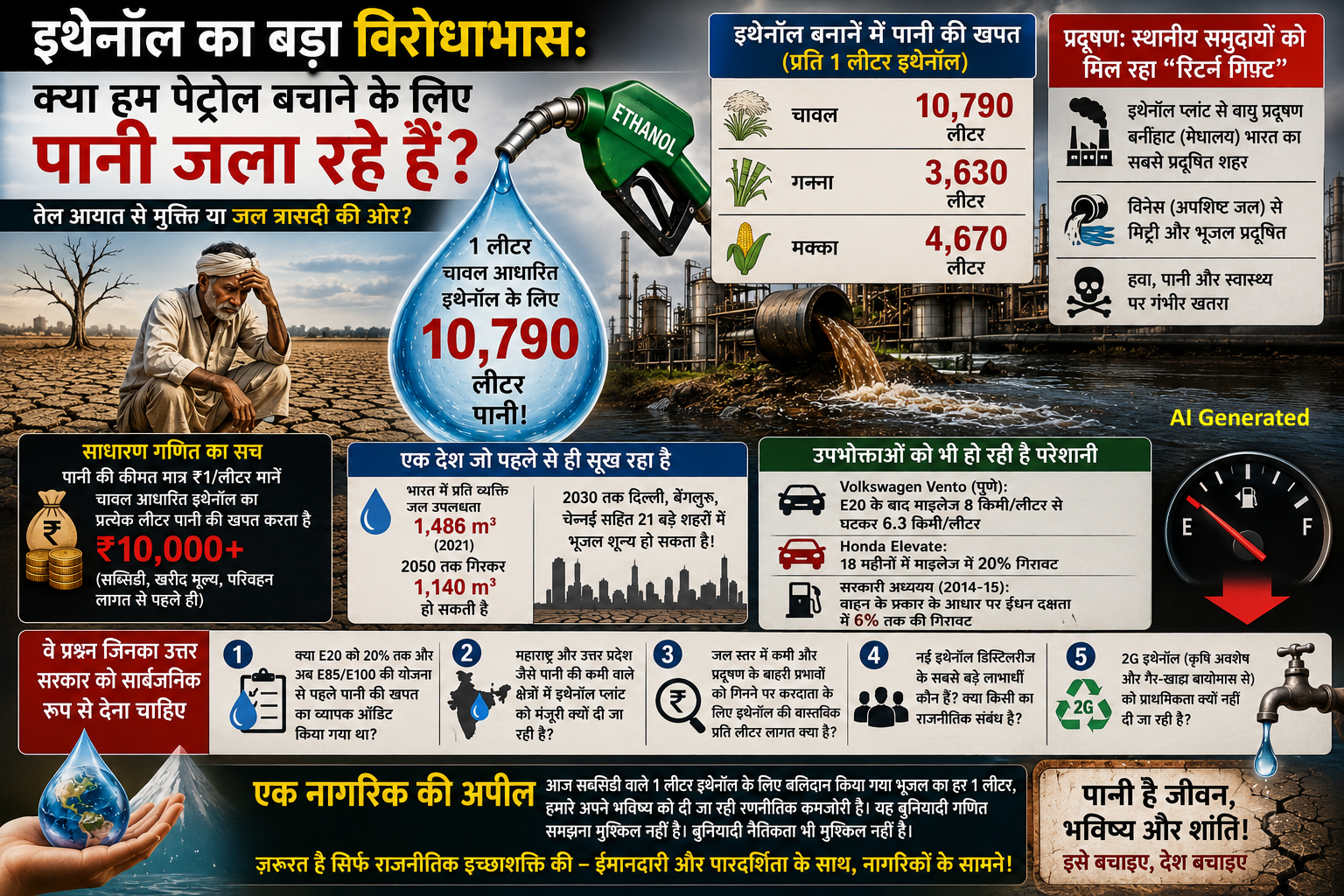
The most damning statistic comes not from activists, but from government-linked data itself. According to data shared by Food Secretary Sanjeev Chopra, rice-based ethanol stands at roughly 10,790 litres per litre, compared to about 3,630 litres for sugarcane and 4,670 litres for maize. Let that sink in. For every single litre of "green" ethanol, thousands of litres of water - a resource experts warn will trigger the next global conflict - are being consumed.
Applying Simple Mathematics
If we apply the most basic economic logic - valuing even ₹1 per litre of water - then each litre of rice-based ethanol effectively consumes water worth ₹10,000+ in resource terms, before any subsidy, procurement price, or transport cost is added. Meanwhile, public spending on ethanol production extends well beyond what oil marketing companies pay for procurement, and production costs differ substantially by feedstock. Compare this to international pure petrol prices hovering near global benchmarks. The question the Government of India must answer is straightforward: does this math genuinely serve the citizen, or does it serve someone else?
Pollution: The "Return Gift" to Host Communities
The water crisis is only half the story. Communities living near ethanol plants are paying an even higher price - with their air, water and health. A documentary has revealed Byrnihat, Meghalaya as India's most polluted city, with ethanol plants contributing to severe air and water contamination despite government claims of clean fuel benefits. The pollution is not incidental - it is structural. Ethanol mills produce large volumes of vinasse (wastewater). If untreated, this causes severe soil and groundwater pollution.
As environmental expert has pointed out, ethanol mills generate large volumes of wastewater (vinasse), which can pollute surface and groundwater if not treated properly. In effect, the very regions that host these plants are receiving toxic effluents as their "return gift" for supporting the national biofuel dream.
A Nation Already Running Dry
This ethanol expansion is happening at the worst possible moment. India's per capita water availability has already fallen to 1,486 cubic metres in 2021, placing it in the water-stressed category, with projections indicating it could drop to around 1,140 cubic metres by 2050. NITI Aayog's Composite Water Management Index has warned that by 2030, groundwater in 21 major cities, including Delhi, Bengaluru, and Chennai, could reach zero. And yet, much of India's growth in first-generation ethanol production has taken place in states already facing groundwater pressure, including Maharashtra. Production targets and feedstock planning have expanded rapidly without fully integrating regional water availability and long-term water-use considerations.
Consumers Are Feeling the Pinch Too
The pain is not limited to farmers and villagers. Ordinary vehicle owners are already complaining. A Pune-based Volkswagen Vento owner reported that his mileage dropped from a consistent 8 km/l to 6.3 km/l after refilling with E20 petrol. Another user reported a 20% mileage drop in a Honda Elevate over 18 months, blaming E20 as the villain. Even the Government's own commissioned study is telling. A 2014-15 project by the Union Ministry of Heavy Industries, conducted jointly by ARAI, IIP and Indian Oil Corporation, revealed up to 6% decline in fuel economy, depending on the vehicle type. So the citizen pays thrice: once at the pump for costlier fuel, again in lost mileage, and a third time through the depleted water table under their feet.
Questions the Government Must Answer — Publicly
The people of India deserve transparent, on-record answers to these questions:
- Was a comprehensive water-footprint audit conducted before pushing E20 to 20% and now planning E85/E100?
- Why are ethanol plants being cleared in already water-stressed zones like Maharashtra and Uttar Pradesh?
- What is the real, subsidy-inclusive cost per litre of ethanol to the taxpayer, when water depletion and pollution externalities are honestly counted?
- Who are the largest beneficial owners of the new ethanol distilleries, and are any of them politically connected? Full public disclosure is a democratic minimum.
- Why is 2G ethanol — made from crop residue and non-food biomass — not being prioritised? Experts say India should go in for 2G ethanol, produced from non-food biomass, agricultural residues, and waste materials to offset bringing more areas under sugarcane, rice and maize cultivation.
A Citizen's Appeal
Governance is a trust. Ministers, bureaucrats, and their families are supposed to view the 140-crore citizens of this country as their extended family - not as consumers of decisions taken behind closed doors. If the next global conflict is truly going to be fought over water - as scientists, diplomats and defence strategists have warned for years - then every litre of groundwater sacrificed today to produce a subsidised litre of ethanol is a strategic weakness we are gifting to our own future. The basic mathematics is not difficult. The basic morality is not difficult either. What is missing is political will to apply both - honestly, transparently, and in front of the citizen.

0 thoughts on “E20 Petrol: The Hidden Water Cost Behind India's "Green Fuel" Push — Is the Math Really Adding Up?”
Leave a Reply
Your email address will not be published. Required fields are marked *


RECENT NEWS
- Tarot Horoscope for September 11: Taurus will get relief from old stresses and complications.
- Rs 95.65 lakh embezzlement in Savli's company: Former assistant manager commits fraud by transferring money from bank accounts to wife's and two other accounts
- From the middle of September, these 5 zodiac signs will be lucky, a yoga of immense success.
- Digital monitoring with AI cameras to reduce AMTS accidents: Over speed, driver talking on phone, smoking or snoring in a moving bus, the control room will be alerted immediately
- Harshit Devani's artwork gift from Veraval accepted by PM Modi: Late in Vadodara. Seeing the memorial portrait of Hiraba and PM Modi, the artist said - the emotions cannot be described in words