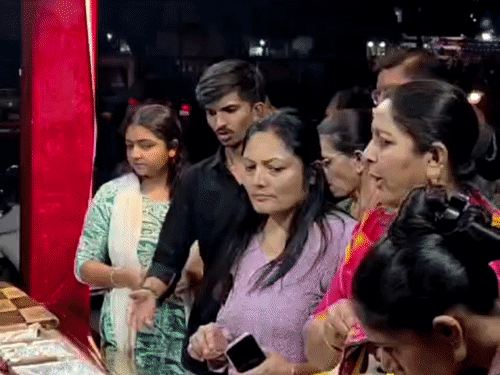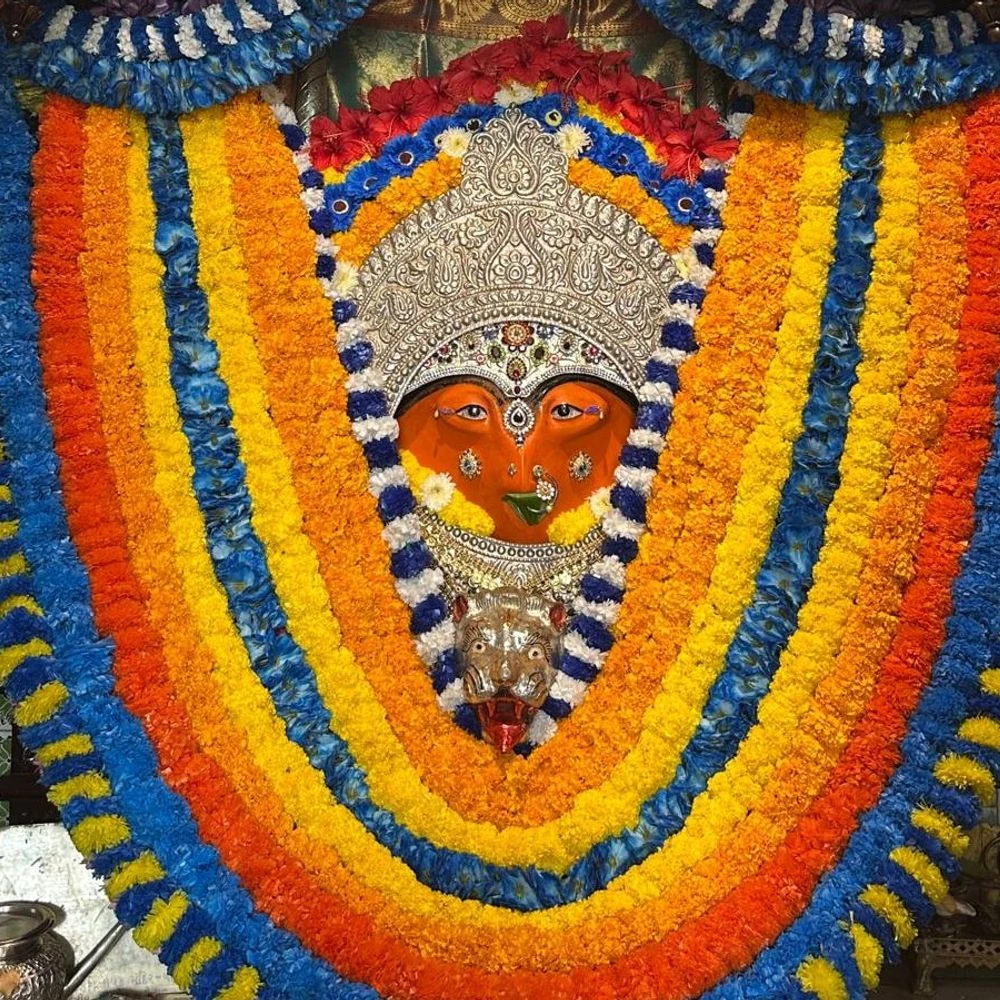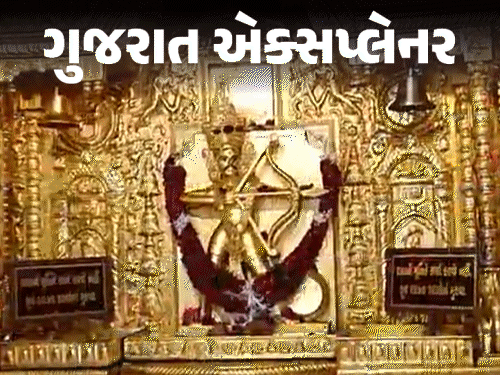
Ghantakarna Veer Dev is worshipped only once a year in the Jain shrine Mahhudi. That day is - Kali Chaudas. On this day, lakhs and crores of rupees are bid for every ritual to sit in the havan, to worship the foil, to offer the crown, to perform aarti. This time the tithi of Kali Chaudasi is from Saturday afternoon on the 7th to Sunday afternoon on the 8th. That is, the havan is on the morning of the 8th. After all, why is the bid of crores being spoken for the Havan on Kali Chaudase? Why is the worship of Ghantakarna only on Kali Chaturdas? Why is Sukhadi Prasad not taken out of Mahuda? We will know the answers to these questions in the Gujarat Examiner. Question 1: Who is Ghantakarna Mahavira? Answer: The protector of Jain rule, Kshetrapala or the deities with spiritual power are known as 'Veer'. There are 52 such heroes. The thirtieth hero among them is Ghantakarna Veer Dev. Ghantakarna Veera was a Kshatriya king named Mahabal in his previous birth. His kingdom was on a mountain named Shri, in Srinagar, Uttar Pradesh. There were 23 Jain Jinalayas on this mountain. King Mahabal used to protect the Jain pilgrims who came to visit them from the violent animals and robbers of the forest. He used to carry bows and arrows with him and protect them. Ghantakarna Veer Dev is mentioned in many Jain ancient texts such as 'Vividhi Tirthakalpa' written by Jinprabhsuri, 'Jal Yatradi Vidhi' by Ratnasekharsuri and 'Ghantakarna-Kalpa' written by Shanti Chandrapadhyay. King Mahabal was also considered the protector of Jain rule as he protected the Jain pilgrims. That is why the people of the Jain community worship Ghantakarna Dev more. Many people of Hinduism also go to have darshan of Ghantakarna Veer Dev. The temple of Ghantakarna Veer is in Mahudi village. Mahudi is 10 km from Vijapur, 48 km from Gandhinagar and 65 km from Ahmedabad. Mahudi village is on the banks of the Sabarmati River. The ancient name of Mahudi was Madhupuri. It was later known as Mahudi. Apart from Jains, Ghantakarna is also important among Hindus: According to Pandit Akhilesh Audichya, who has studied Ghantakarna Veer, Ghantakarna is also mentioned in Hinduism and Buddhism. But there are important deities in Jainism. It is the responsibility of Ghantakarna to protect the people who go on a pilgrimage or pilgrimage. If a woman prays to Ghantakarna from the heart when she is in distress, then help will be provided. According to Hindu beliefs, Ghantakarna Veer is considered to be the form of Kshetrapala. There are temples in the hills of Uttarakhand and the Himalayas. Khetrapal of Badrikashram (Badrinath Dham) region is Ghantakarna. Ghantakarna is carved in the architecture of Konark Sun Temple. There is also a temple in Odisha. Bhairav, Kshetrapal. In Garhwal, Parchadhari is considered to be the deity. Before the gates of Badrinath Dham are opened, the gates of the Ghantakarna temple are opened and the gates of Badrinath Dham are closed. According to the Linga Purana, when Lord Kartikeya was born to kill Tarakasura, Brahma created four powers to help Kartikeya. One of them was Ghantakarna. The other three were Nandisen, Lohitaksha and Kumud Malin. These four were originated by Brahmaji. This is the Hindu belief but in Jainism, Ghantakarna is the most revered hero deity. Question 2: Why do Jains worship Ghantakarna? Answer: The story is related to Jainacharya BuddhisagarSurishwer Ji Maharaj. We will talk about who BuddhisagarSurishwar ji was, but first let's know the story of how he pleased Ghantakarna Veer Dev. For years, there was a pilgrimage center for Jains in Madhupuri (Mahudi). Here the 1250-year-old original hero Padmaprabh Swami resides in the Jinalaya. There was a population of Jains in the vicinity. Some of them used to come to this Jinalaya for service. Jain saints used to come to offer prayers. One of them was BuddhisagarSurishwer Ji Maharaj. He felt that the Jains had Tirthankaras. They have their own gods, but Jainism needs an awakened deity to protect the religion of Jainism and mankind. Jains do not ask for anything from their gods, they do not put any restrictions on them. But there should be a hero whom the Jain society and any person can keep in check. If he remembers God in crisis, he will be present. It was necessary to manifest such a deity. BuddhisagarSurishwer Ji Maharaj started penance in Mahudi itself. Soon, under the influence of this penance, Veer Dev Ghantakarna appeared in front of him. He had arrows and bows in his hands. A golden crown was shining on his head. A divine aura was spreading. He wore bell-shaped earrings in his ears. The ear is said to be a diagonal and a bell-like shape, from which the name Ghantakarna is derived. When Ghantakarna Veer was pleased, he asked Maharaj Sahib to ask for a boon. Then Maharaj Sahib asked for a boon that Jainism would be protected and if any human being asked for his help, he would help him in problems and good works. BuddhisagarSurishwer Ji Maharaj, who was sitting in meditation, drew a picture of Ghantakarna Veer on a wall. He thought of making a statue of Ghantakarna Veer out of marble stone. He entrusted the sculpture of the idol to Moolchandra Mistry, but Moolchand Mistry could not find the marble stone he needed to make the idol. The muhurat was passing in this direction. So Buddhisagar Maharaj ordered the idol to be carved out of the Kharapat stone. Within 12 days, the idol was carved and ready. Maharaj saw the idol at the sculptor's place. Then he decided to lift it and place it in a small temple next to the Padmaprabhaswamy Jinalaya. At the time of Muhurat, BuddhisagarSurishwer Ji Maharaj ordered two or three people to bring the idol. Because the idol of salt stone should not be very heavy. So two or three people lifted it. But it was not lifted by the men. Five, seven, twelve and finally fifteen people tried to lift it, but the idol of Ghantakarna Veer Dev could not be lifted. Buddhisagar Surishwarji came to know about this. He himself went and sprinkled Vashshepa (pure, fragrant powder) by chanting mantras. Maharaj said: Call five girls of the village. He will carry the idol. Five girls of Mahudi village came. The idol which fifteen men could not lift was lifted by five girls and placed it at the place where Ghantakarna Veer Dev is sitting today. Then Buddhisagar Maharaj performed the pranapratishtha. That day was Vikram Samvat 1980, Magsar Sud Trij. It has been a century since the establishment of Ghantakarna Veer. Now let's know about Buddhisagar Surishwar Ji Maharaj. BuddhisagarSurishwar Ji was a Jainacharya, but he was born in the Patel family. His father was the son of Shivrambhai and Mata Amba. The family had immense faith in Bahuchara Mataji, so they took care of their son as well. His birthplace was Vijapur. He was brilliant in his studies and along with his schooling, he also read books on Jainism. He studied Jainism deeply and decided to embrace Jainism and take initiation. He took initiation from Guru Ravisagar ji in the year 1957 and the year was 1901. In Palanpur, Banaskantha, at the age of 27, he took initiation and became Muni Buddhisagar Surishwar. He had read 36,000 books at a very young age. He had authored about 131 books. Out of these, 108 were published. He gave importance to 'sadhna'. He was constantly engrossed in 'sadhana'. In the year 1924, he performed the Pran Pratishtha Vidhi of Ghantakarna Veer Dev. The next year in 1925, BuddhisagarSurishwar ji passed away. His Samadhi Mandir is in Vijapur. The idol of Ghantakarna is made of salt stone, it does not get worn out, it is preserved for a long time, that is why it is allowed to be worshipped only on one day in a year. That day is Kali Chaturdas. Question 3: Why is Ghantakarna worshipped only on Kali Chaturdas? Answer: Answer: Answering this question, Bhupendrabhai Vora, Trustee of Shri Mahudi (Madhupuri) Jain Shwetambar Idol Pujak Trust, says, "The best day to worship the one who is a hero is Kali Chaturdas. Hanuman ji is a hero. Kaal Bhairav is a hero. That is why it is very important to worship him on Kali Chaturdas. Similarly, Ghantakarna is also a hero. Therefore, the most important day for his worship is Kali Chaturdas. Pandit Akhilesh Audichya, who has studied about Ghantakarna Veer, says, "Maran, Mohan, Uchchatan, Vashikaran, Vidveshan... Worship of Ghantakarna is the best way to protect against negative energies, to get rid of diseases, to get Lakshmi, for success in business, for the completion of the journey smoothly. According to the Rakshavidhan in Jainism, the main responsibility of protection lies with Lord Ghantakarna. The day of Kali Chaturdas, is the best day for Tantra Vidya and that is why special worship of Ghantakarna on this day is important. According to Jainism, there is no vehicle of Ghantakarna Dev. If someone invokes this deity in his mind, he immediately appears. There is a stotra and a moola mantra to please them. The original mantra should be done by asking the scholar but the stotra can be done by anyone. Many people believe that the picture of Ghantakarna Mahavir should be placed in such a way that the arrow points towards the door of the house. But this is wrong. Because Ghantakarna is a god. He is not the gatekeeper of our house. Honor the deity by placing the picture of the deity in the temple of the house. You can keep the idol or image of Ghantakarna Mahavir on the left side of the main deity in the temple of the house. Ghantakarna is such a god that you do not keep his idol or image and even if you only remember him in your mind and chant it, he is always ready to help you. Many people believe that Goddess Kali, Kaal Bhairav, the Aghor form of Mahadev, Ghantakarna, all these should be worshipped at night. But according to the scriptures, if you worship any deity daily, then the morning is the right time. Confirming this, Bhupendrabhai Vora says, "The night worship of Kali Chaturdas, the havan at night, is important. But in Jainism, the violence of micro-beings increases at night, so we perform homa on the afternoon of Kali Chaudash. Maha Puja is performed on one day in a year of Ghantakarna Veer. Languages are spoken to take advantage of this puja, havan, etc. Question 4: Why is there a bid of lakhs and crores for worship? Answer: The importance of bidding is already in Jainism. There is a concept in it that God has given us as much money as per our ability. It is the spirit of giving back by bidding. This is because the money given through bidding is also used for the well-being of the people who come to the temple, for the festivals of the temple. Lakhs and crores of rupees are bid for the Havan of Ghantakarna Veer on Kali Chaturdase. In this regard, Sanjaybhai Vora, a committee member of Shri Mahudi (Madhupuri) Jain Shwetambar Murtipujak Trust, says, "Ghantakarna Dada is not spoken only for the home. Different dialects are spoken. In all these dialects, the one who speaks the most is benefited. All these dialects are spoken in the courtyard of the temple on the night of Dhanteras. Talking about the worship of Kali Chaudas, Sanjaybhai said that the cleaning ceremony of the foil on the idol of Dada is done at 3 pm on the night of Dhanteras. The cleaning ceremony means that the old leaf is removed and a new gold foil is added. Dada is anointed, special pujas are performed. Varakh Puja is performed before the Hom of Kali Chaudas begins. In the morning, along with the Varakh Puja, Kesar Puja is also performed. Kesar Puja means putting a saffron dot on the toes of the feet of Veer Dada and on the head. No dialect is spoken for saffron puja. Every devotee can take advantage of saffron puja. There is a long queue for saffron puja. Kesar Puja starts at 7 am, which lasts till 12 noon. Then the havan starts at 12-39 noon in the Vijay Muhurat. 108 Ahuti are offered in the havan. As the offering is made, the temple rings 108 times. Lakhs of devotees reach Mahudi during the Havan of Kali Chaturdas. The premises are crowded. It is the belief of the devotees that they carry the red thread of Nadachadi in the Havan. This thread is long from head to toe. They sit with the thread of the Nadachadi in their laps. As soon as the offering is made in the havan and the bell rings, the devotees tie one knot at a time in the thread of the Nadachadi. When there are 108 knots, they take the sacred thread home. Those who have problems in studies keep it in a book, if someone has financial problems, keep it in a safe, and if someone is sick, they wear it around their necks. With this kind of faith, the devotees arrive on the morning of Kali Chaturdas. Sanjaybhai Vora says, "Our ancestors gave land for Dada's temple. My grandfather used to hoist the flag all his life. We have been hoisting the flag for 100 years. The temple has been renovated. When there was a bid to hoist the flag, our family took advantage of it. We came to know about Ghantakarna Mahavir, its manifestation and worship. Now let's know about his prasadi Sukhadi. Question 5: Why is Sukhadi not taken out of Mahudi? Answer: Ghantakarna is the prasad of Veer Dev Sukhadi. If you go to the Ghantakarna temple in Mahudi, then there is a different Sukhadi counter. You have to take a coupon from a counter. You can buy Sukhdi Prasad for different rupees like 25 rupees, 50 rupees, 100 rupees, 500 rupees. Take Sukhadi with hot ghee and give it to Ghantakarna Dada. The priest there takes out one or two pieces and gives the dish of Sukhadi back to the devotees. A quarter of the Sukhadi in the dish has to be eaten standing in the temple. It is not taken outside. There is no superstition or belief behind the devotees not being able to take Sukhdi to their homes. Buddhisagar Surishwar ji is the foresight behind this. Sanjaybhai Vora, a committee member of the trust, says that when Gurudev installed the consecrating, he felt that no person in the village should go hungry. Whoever comes to the temple should have a full stomach of prasad. Therefore, the Sukhdi is not taken outside. The second view is that if the Sukhdi prasad is allowed to be taken outside, then it should be used to eat with the chavanas. If not, then the dignity of the prasad will not be maintained. That is why Buddhisagar Surishwar ji had said that Sukhdi should be kept in the village only. Even today, if there is more Sukhdi in the temple, then Mahudi is given to every house and everyone eats. We also send it to the schools of Mahudi in the afternoon so that the children can get nutritious food. Sukhdi is the prasad which has 'happiness' in its name. The one who gives happiness is Sukhadi. Ghantakarna is also fond of Sukhadi to Veer Dev and that is why it is offered to him as prasad. Otherwise, there are many rumors that if you take Sukhdi outside the temple or outside the Mahudi, then Ghantakarna Veer will get angry. Bad things will start happening to us. Don't be misled by such things. These are just baseless statements. In short, Maharaj Sahib's intention was to ensure that the prasad of Sukhdi reached the hungry.

RSS News
Divyabhaskar
0 thoughts on “Why is the bid of crores being spoken for the havan of Ghantakarna: The bow and arrow deity is worshipped only once a year; Why is the Sukhdi Prasad of Mahudi not taken outside?”
Leave a Reply
Your email address will not be published. Required fields are marked *


RECENT NEWS
- Ahmedabad News: Massive fire breaks out at Limek Company near Bavla, Ahmedabad, one person killed, plant burnt down
- Why is the bid of crores being spoken for the havan of Ghantakarna: The bow and arrow deity is worshipped only once a year; Why is the Sukhdi Prasad of Mahudi not taken outside?
- Mehsana will be festive on Diwali: Annakoot, Govardhan Puja and Chopda Puja will be held in 6 temples.
- The Sabarmati-Muzaffarpur special train will arrive at Mehsana station at 7:57 pm on November 7 and 14
- Heavy deployment of purchases in Jamnagar's famous mask market: 15 to 20 tons of masks produced; Parcels of Jamnagari masks dispatched to UK, USA and Gulf countries