In his novel 'Ten Kilometres from the City', Nilesh Raghuvanshi describes a life far away from Bhopal that is thriving, full of difficulties and challenges, but also very deep and philosophical. The journey between this town and the city – oblivious to any other life outside its borders – is determined by the storyteller's bicycle. Like a narrator and a record, this bicycle is one of the last traces of the place, which has now transformed from an unrecognizable, neo-liberal and ordinary extension of the city that is difficult to identify. In the novel, childhood memories of bicycles begin to emerge, because 'in childhood, small feet are big wings'. A female narrator reminds us of the days when there were bicycles with black sticks, not the pink-looking ladies' bicycles that are now available. Where was the imagination that girls would ride bicycles? But our narrator would also ride such a gentleman's bicycle like this: 'I started cycling freely. Sometimes bending, sometimes stretching, sometimes whistling, sometimes waving, sometimes slanting the handle and myself, sometimes dropping one hand, sometimes getting up from the seat and releasing both hands. I started waving with the bicycle. The bicycle is not just an adventure, it is also a politics – a symbol of a time and lifestyle, when it was not just a symbol of poverty or compulsion. While reading this novel, I went back to the days gone by – the past, which is both a time and a space. I was reminded of the old memories – the long and slow summer holidays spent in Ajmer, where my mother is headed. I used to go there every summer and spend hours reading novels by Colonel Ranjit and Rajhans, which I used to rent from a small shop near Prabhat Talkies. The road from Sindhi Mohalla to Prabhat Talkies was uphill and filled with the stench of open drains. But I used to be happy, because I also got a bicycle from the same shop from where I used to buy books. The bicycle fare for the whole day was less than a rupee. The fun of cycling and reading novels made those summers special. The feeling of time is different in different places. It is not the time that ticks in our clocks, but the one that remains calm and steady in the background – like a window that can be seen both inside and outside. This form of time is not seen in big cities. Very few writers capture the peace of the moment, but when they do, we find writers like Vinod Kumar Shukla, Sara Rai or Nilesh Raghuvanshi. But do films like 'Bareilly Ki Barfi' or 'Tanu Weds Manu' — now called small-town films — show this tranquility cinematically? Before answering this question, one might ask, what exactly is a 'small town'? My experience with Ajmer was probably like a small town, and I am sure that today's Ajmer will challenge my definition. In fact, what is neither a village nor a city is often called a small town — a category defined by 'no' (i.e. what is not). In the last couple of decades, we have seen a flood of small-town films and serials. They probably started with 'Bunty and Babli'. You see that Bunty not only wants to leave the place, but also wants to run away at the slow pace of time. How beautifully does Leisutganj combine this time and space, from where the restless youth of New India want to run away. Babli is from Pankinagar. When we come to Bareilly or Dhanbad or Mirzapur, it is a matter of survival. A small town is not a station nor a village of 'Mother India'. A small town is a place in which new aspirations and aspirations of the middle class are emerging and he struggles with them. Films have depicted this struggle in the form of comedy, not as tension. We have left behind the village of the whites and the black market of Bombay-Calcutta. Those who want depth have to go a few miles away from the city, and that too on a bicycle! The small town is the place in which the new aspirations and aspirations of the middle class are emerging and they struggle with them. Films have depicted this struggle as a comedy, not as a tension. We have left behind the village of the whites and the black market of Bombay-Calcutta.
(These are the author's own views)

RSS News
Bhaskar
0 thoughts on “Rita Kothari's column: The voices of small towns are beginning to be heard in our stories”
Leave a Reply
Your email address will not be published. Required fields are marked *


RECENT NEWS
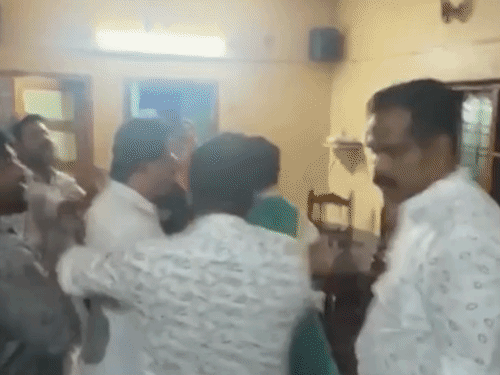
- Woman Congress MLA clashes with Congress MLA in Kerala: Activists clash, push her; Ramya Haridas hospitalized, FIR against 7 people
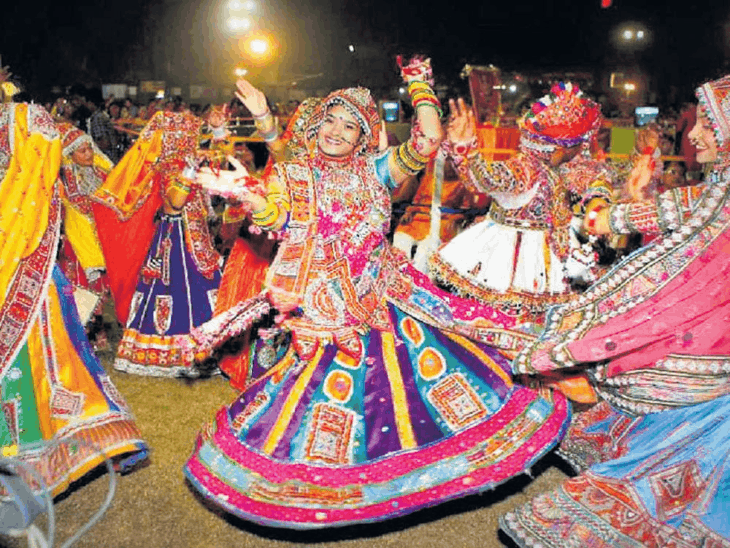
- Ban on Muslims in Garba during Navratri in Maharashtra: VHP announces rules; Aadhar card will be checked, tilak on forehead will be mandatory; Only then will Garba be entered.
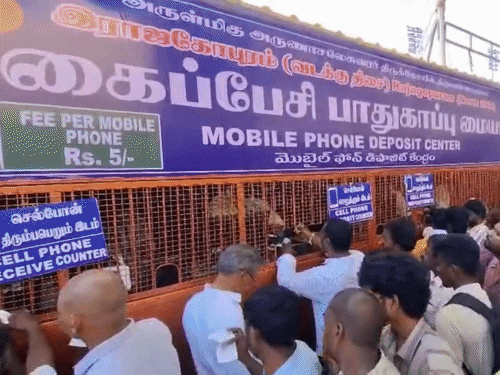
- Phone ban in Tamil Nadu pushes youth away from temples: Devotees drop by 20%; Mobile phones banned in 52 temples from September 1
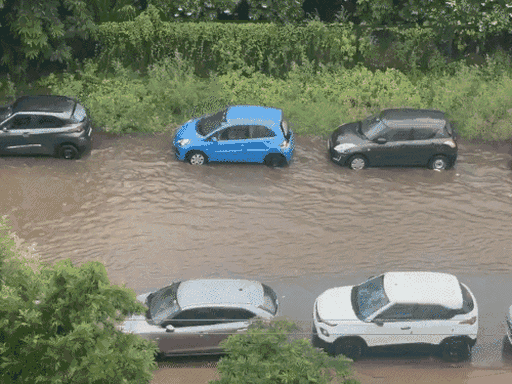
- Rains in Rajasthan, MP-UP, rivers overflowing, schools closed: Bihar floods, 6.65 lakh people affected; Char Dham Yatra halted in Kedarnath
- Huma Qureshi gets Rs 65,000 in 'Gangs of Wasseypur', endured body shaming, trolling; She had to struggle even after the hit